
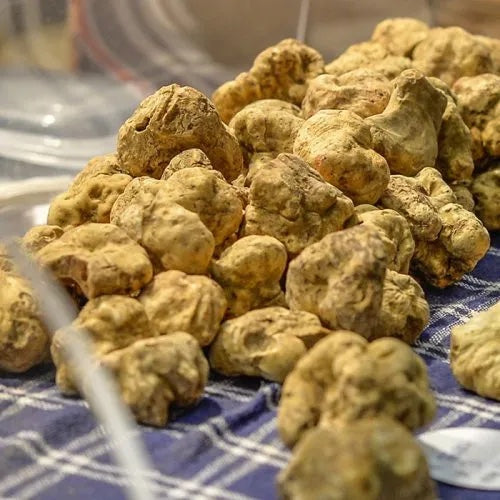
Truffles occupy a strange place in the food world. They are not vegetables, not fungi in the supermarket sense, not herbs, not seasonings. They are subterranean fruiting bodies of certain fungi that grow only in symbiotic relationships with specific tree roots, in specific soils, in specific climates — most of them on the Italian peninsula. The truffle is one of the few high-value foods that no one has successfully industrialized.
Of the dozens of edible truffle species in the world, only a handful matter for the kitchen. And of those, the most prized — the Italian white truffle, Tuber magnatum pico — sells at auction for thousands of dollars per kilogram, year after year, with no commercial farming alternative on the horizon.
This is a brief history of how an underground fungus from the Italian countryside became the most expensive ingredient in the world, why Italian regions own the global truffle conversation, and what's worth knowing before you cook with one.
Origin: A Subterranean Fungus, Not a Mushroom
Truffles belong to the genus Tuber, a group of subterranean ascomycete fungi that form mycorrhizal relationships with the roots of specific trees — primarily oaks, hazels, poplars, and lindens. The fungus exchanges minerals from the soil for sugars from the tree; in the process, it produces a fruiting body underground.
Truffles are not mushrooms grown below ground — they are an entirely different reproductive strategy. Above-ground mushrooms release spores into the air. Truffles, sealed in soil, release intense aromatic compounds to attract animals — wild boars, mice, and historically humans — to dig them up and disperse the spores in the process.
That smell is what makes them culinarily interesting. The aromatic compound profile of a fresh white truffle includes more than 200 distinct volatile molecules, dominated by sulfur-containing compounds the human nose registers as garlic, hay, and earth. No synthetic version captures the full profile, which is why most "truffle oil" sold commercially is flavored with 2,4-dithiapentane — a single synthetic molecule, not actual truffle.
Ancient Use: From Pliny to the Roman Banquet
The Romans wrote about truffles. Pliny the Elder, in his Naturalis Historia (first century CE), described them as a culinary delicacy with mysterious origins — born of thunder and rain, he speculated. Roman aristocracy ate them at banquets, often paired with eggs, honey, and wine. They were considered aphrodisiacs.
The Greeks knew them too, though less prominently. Theophrastus mentions them, and Galen later wrote about their medicinal properties. The species these ancient writers actually referred to is debated — likely a mix of Tuber and the lesser desert truffles (Terfezia) of the Mediterranean rim — but the concept was there: a hidden, prized, aromatic underground fungus, treasured but never reliably found.
After Rome's collapse, written references thinned. Truffles persisted in folk knowledge — particularly in northern and central Italy, where forest cultures maintained the traditional skills of truffle hunting — but disappeared from elite cuisine for nearly a millennium.
Renaissance Rediscovery and the Rise of Alba
Truffles returned to elite tables in the Renaissance. The Savoy court in Piedmont, the Medici in Florence, the Estense in Modena — Italian aristocratic kitchens of the fifteenth and sixteenth centuries treated truffles as a prized ingredient, often as gifts exchanged between courts. Catherine de' Medici is sometimes credited with bringing the Italian truffle tradition to France when she married Henry II in 1533.
By the seventeenth and eighteenth centuries, truffle markets had formalized in Piedmont and Umbria, with seasonal fairs that still run today. The composer Gioachino Rossini, one of the truffle's great nineteenth-century admirers, called it "the Mozart of mushrooms."
The modern global stature of the Alba truffle, however, owes most to a single twentieth-century figure: Giacomo Morra, a hotelier and restaurateur from Alba who organized the city's annual truffle fair starting in 1929 and built the international reputation that defines the market today. The Times of London crowned him "King of Truffles" in 1933. The fair he founded — the Fiera Internazionale del Tartufo Bianco d'Alba — runs annually from October through November and remains the global reference point for white truffle pricing.
The Italian Regions: Why Geography Matters
Italian truffles are graded by species, not by region — but the regions still matter, because climate and soil shape both yield and quality.
Piedmont is the world capital of the white truffle (Tuber magnatum pico), particularly the area around Alba, the Langhe, and Monferrato. The white truffle's cultivation is impossible: it grows only wild, in calcareous clay soils under oak, hazel, poplar, and linden trees, and only in seasons of specific rainfall. October to December is the active season.
Umbria, Marche, and Tuscany are the heartland of the Italian black truffle (Tuber melanosporum) — the same species the French call the Périgord truffle. Norcia in Umbria is the historic center; Acqualagna in the Marche is the other major hub. Black truffles can be cultivated to some degree (truffle orchards with inoculated tree seedlings exist), but the wild yield from Italian forests still dominates the high-quality market.
Molise and Abruzzo are emerging white truffle regions, with growing harvests in recent decades. Emilia-Romagna produces summer and Burgundy truffles in the Apennine foothills.
The Five Species That Matter
Of the more than 60 Tuber species in the world, five matter culinarily for Italian cuisine:
- Tuber magnatum pico — Italian white truffle. The most expensive. Pale yellow exterior, marbled white-and-tan interior, intensely aromatic. Eaten raw, shaved at the table. Season: October to December.
- Tuber melanosporum — black winter truffle. Black exterior, deep violet-black interior with white veining. Aromatic but more subdued than white. Cooked or shaved. Season: November to March.
- Tuber aestivum — summer truffle (also called scorzone). Black warty exterior, lighter interior, milder flavor. Affordable entry point. Season: May to August.
- Tuber uncinatum — Burgundy truffle (autumn truffle). Similar to aestivum but more aromatic, harvested later. Season: September to December.
- Tuber borchii — bianchetto truffle. White-fleshed but smaller and less aromatic than magnatum. Sometimes confused with white truffle in lower-end markets. Season: January to April.
How Truffles Are Found — and Studied
Truffle hunting is a regulated craft in Italy. Hunters — trifolau in Piedmontese dialect — work with trained dogs, traditionally the Lagotto Romagnolo, the only breed bred specifically for truffle hunting. Pigs were used historically but caused too much damage to the truffles and the soil; they were effectively phased out in Italy by the 1970s.
Truffle hunters are licensed by Italian regional authorities. Each region sets its own season dates and quotas, and licenses are passed down through families more often than purchased. Many of the best truffle-hunting territories are kept secret across generations.
The economics are unforgiving: a strong year produces tons across Italy; a dry year produces almost nothing. Climate change has shortened and shifted the seasons over the past two decades, putting wild truffle populations under measurable pressure. Italian research institutions, particularly the University of Perugia's Department of Agricultural, Food and Environmental Sciences (DSA3), have spent decades studying truffle ecology, mycorrhization of host trees, and the microbial communities that allow Tuber species to fruit. Their work has produced reliable cultivation methods for Tuber melanosporum through inoculated seedlings, but Tuber magnatum still resists every attempt.
Italian Culinary Use: Restraint, Not Decoration
Italian cooking treats truffles with restraint. The traditional rule: heat damages the aromatic compounds, so most preparations involve shaving raw truffle at the table, over a hot dish, just before eating.
Classic Italian preparations include:
- Tajarin al tartufo bianco — Piedmontese egg pasta finished with butter, parmigiano, and shaved white truffle
- Uova al tartufo — soft-cooked eggs with shaved truffle and a few drops of extra virgin olive oil
- Risotto al tartufo — Carnaroli or Arborio risotto finished with truffle and parmigiano
- Pizza al tartufo — traditionally pizza bianca (no tomato) with mozzarella di bufala, a finishing drizzle of extra virgin olive oil, and shaved truffle just before serving. Tomato-based versions with mozzarella di bufala, fresh basil, and finishing truffle are increasingly common in modern Italian pizzerias, though purists keep the white-pizza version as the canonical preparation.
- Tartare di carne con tartufo — beef tartare with shaved truffle and a few drops of EVOO
- Bruschetta al tartufo — toasted bread with butter or olive oil and shaved truffle
The pattern is consistent: truffle goes on top of a simple, warm, fat-rich base. Real truffle on pizza is a ritual, not a topping — a few grams shaved at the table over extra virgin olive oil and warm dough, never baked into the cheese. Heat above ~70°C destroys most of the aromatic compounds.
Truffle Oil and the Authenticity Problem
Most "truffle oil" sold in supermarkets contains no actual truffle. The dominant aromatic compound — 2,4-dithiapentane — is a synthetic molecule that mimics one of the many notes in real truffle aroma, suspended in neutral oil. It tastes intense in small amounts and identical in large amounts; real truffle aroma is layered and changes with temperature and time.
Real truffle oil exists, but it's expensive, perishable, and requires actual shaved truffle in the bottle — usually visible. If a bottle of "truffle oil" costs less than a bottle of fresh extra virgin olive oil, it almost certainly contains no real truffle.
Authenticity issues extend beyond the oil aisle. In 2017, Italy's financial police (the Guardia di Finanza) uncovered a €66 million truffle fraud involving species substitution and false geographic claims — lower-value species sold as Tuber magnatum, North African truffles passed off as Italian. The case is one of the reasons Italian truffle hunters and dealers operate within a strict regional licensing and grading system, and one of the reasons most serious Italian kitchens skip commercial truffle oil entirely and use shaved fresh truffle directly, or truffle butter and truffle paste made with real shaved truffle.
Modern Italian Valorization
The truffle is one of the clearest examples of how Italian culinary culture preserves and elevates a natural product. The same fungus exists in France, Spain, Croatia, and parts of Eastern Europe. Italian valorization — the regulated harvesting, the regional fairs, the codified culinary uses, the protected territories — is what made Italian truffle a global category.
That valorization framework is reinforced by organizations like Slow Food, founded in 1986 in Bra — about 25 kilometers from Alba, in the heart of Piedmont's truffle country. Slow Food's mission of protecting traditional, regional, small-scale food production runs directly through the Italian truffle ecosystem: the licensed trifolau, the regional fairs, the seasonal restraint, the refusal to industrialize a wild product. The truffle is, in many ways, the archetypal Slow Food ingredient — impossible to mass-produce, deeply tied to specific places, and meaningless without the cultural knowledge that surrounds it.
For American kitchens, working with real Italian truffle means understanding the seasons, choosing the right species for the dish, and treating the truffle as an ingredient that finishes a meal rather than carries it. The simplest preparation is often the best: a few grams of shaved white truffle over fresh tagliatelle with butter and parmigiano, or shaved black truffle over scrambled eggs cooked in extra virgin olive oil.
Frequently Asked Questions
What is a truffle?
A truffle is the underground fruiting body of certain fungi in the genus Tuber, growing in symbiotic relationships with specific tree roots. They are not mushrooms in the conventional sense — they fruit below ground and rely on aromatic compounds to attract animals to dig them up and disperse their spores.
Why are truffles so expensive?
Most prized truffles, especially the Italian white truffle (Tuber magnatum pico), cannot be cultivated commercially. They grow only wild in specific Italian regions, in narrow seasons, and require trained dogs and licensed hunters to find. Yields vary dramatically by year, and demand consistently exceeds supply.
Where do the best truffles come from?
Italian white truffles are concentrated in Piedmont (especially around Alba), with significant harvests also in Umbria, Marche, Molise, and Abruzzo. Italian black winter truffles come primarily from Umbria (Norcia), Marche (Acqualagna), and Tuscany. The same black species also grows in southern France (Périgord) and Spain.
When is truffle season in Italy?
White truffle season runs from October through December. Black winter truffle season runs from November through March. Summer truffles (scorzone) appear from May through August, and Burgundy truffles arrive in September. Each Italian region sets its own legal season dates and licensing rules.
What is the most expensive truffle?
The Italian white truffle (Tuber magnatum pico) is the most expensive food product by weight after saffron. Auction records have included a 1.5-kilogram specimen sold for $330,000 in 2007 and an 830-gram Piedmontese white truffle sold for €103,000 in 2021. Most retail-quality white truffles trade for several thousand dollars per kilogram during the season.
Is truffle oil real?
Most commercial truffle oil contains no actual truffle. It is flavored with 2,4-dithiapentane, a synthetic compound that mimics one note of real truffle aroma. Real truffle oil exists but is expensive and usually contains visible shaved truffle in the bottle. If a bottle costs less than fresh extra virgin olive oil, it almost certainly contains no real truffle.
How are truffles used in Italian cooking?
Italian cooking treats truffles with restraint. Most preparations involve shaving raw truffle over a warm, simple, fat-rich base — egg pasta, risotto, eggs, bruschetta, pizza bianca — just before serving. Heat above roughly 70°C destroys most of the aromatic compounds, so cooking truffles into dishes is generally avoided.
What is the difference between white and black truffles?
White truffles (Tuber magnatum pico) are pale yellow with a marbled interior, more aromatic, eaten raw, and seasonal from October to December. Black truffles (Tuber melanosporum) are darker, more subdued, can tolerate gentle warming, and run November to March. White truffles cannot be cultivated; black truffles can be partially cultivated through inoculated trees.