
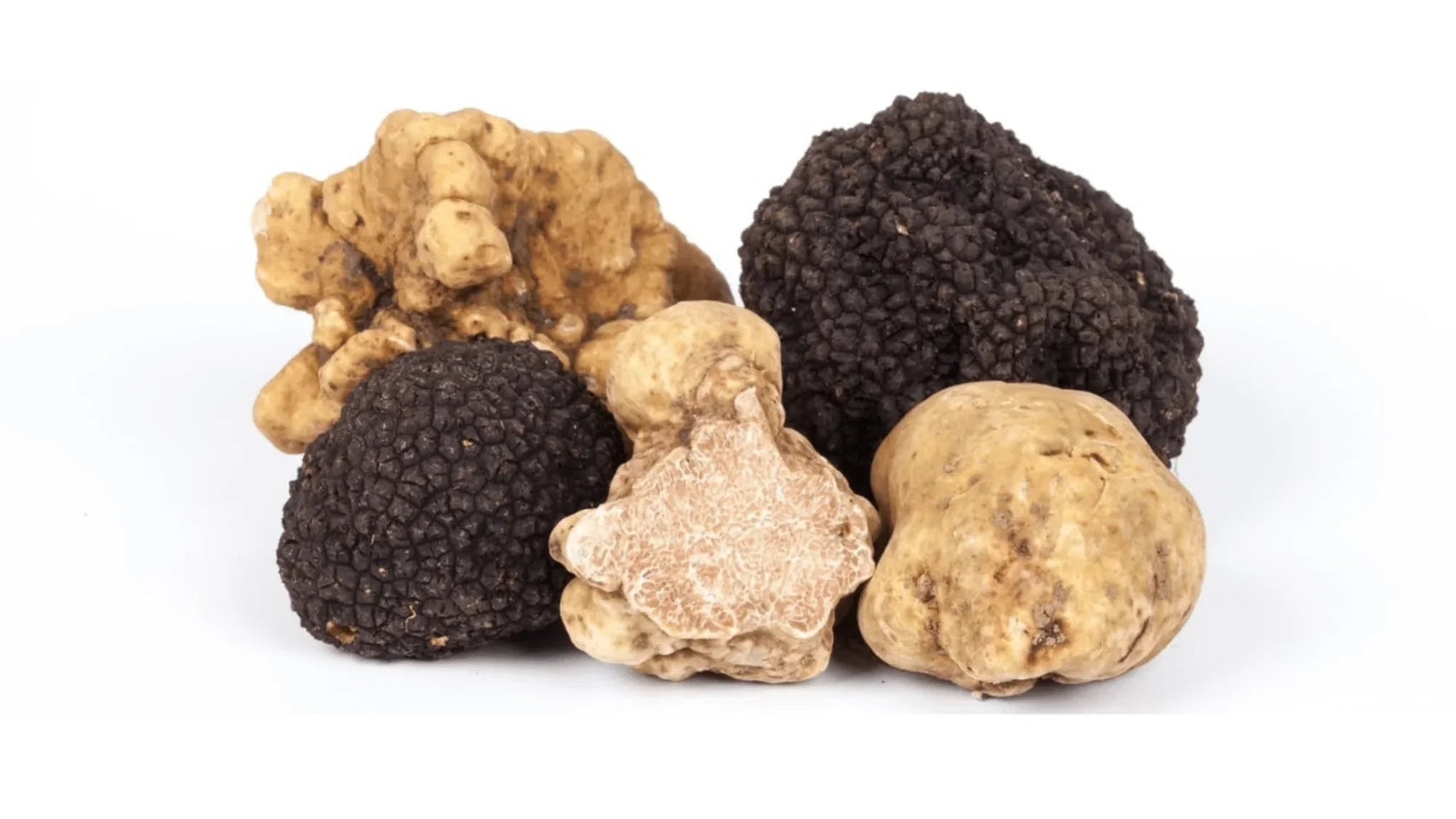
The two truffles you'll see on a menu — or in our shop — are not the same fungus. White Truffle (Tuber magnatum Pico) and Black Truffle (Tuber melanosporum) are different species with different behaviors in the kitchen, different seasons, and very different prices. Knowing which is which is the difference between using one well and wasting it.
This is the short version of what to look for, when to buy each, and how to handle them at home.
What They Actually Are
Truffles are subterranean fungi in the genus Tuber, which form a symbiotic relationship with the roots of certain trees — oak, hazel, and others. Most are inedible. Two are worth talking about.
- Tuber magnatum — the Italian white truffle, the rare one. (More on the species.)
- Tuber melanosporum — the black winter truffle, the workhorse. (More on the species.)
How They Look
White Truffle (Tuber Magnatum)
Pale, smooth exterior. The aroma is what you're paying for — intense, sulfurous, garlicky in a good way, gone if you put it near heat. White truffle is always used raw, shaved over a finished dish at the table, and often carried by a drizzle of white truffle EVOO to extend the aroma across the plate.
Black Truffle (Tuber Melanosporum)
Darker, rough exterior. The aroma is more stable — earthy, woody, and it actually develops with gentle heat. That makes black truffle the one for sauces, butters, and warm preparations. It pairs with fat: cream, butter, and black truffle EVOO all amplify it.
How to Actually Use Them
White Truffle
Never cook it. Shave it raw at the table over warm pasta, fresh egg yolk, risotto, or a simple cheese. The dish should be hot enough to release the aroma, not hot enough to destroy it. For context on how Italy treats white truffle, La Cucina Italiana maps where to eat it in the Langhe.
Black Truffle
Heat is your friend. Fold it into sauces, infuse it into butter, layer it through a stuffing or an emulsion. The flavor diffuses evenly and holds.
The Rule That Matters Most
White truffle finishes a dish. Black truffle gets built into one.
Either way, fat carries the aroma. Butter, cream, and truffle-infused EVOO are not optional accessories — they're the medium.
Where They Grow
White Truffle is largely a Piedmont story, with smaller populations in Emilia-Romagna and Tuscany. Alba's annual Fiera Internazionale del Tartufo Bianco is the global reference point.
Black Truffle ranges more widely — across Italy, France, Spain, and increasingly cultivated orchards in the United States. In Italy, the Marche region is the historic heartland; Acqualagna alone produces roughly two-thirds of Italian truffle output, and its annual international truffle fair covers all four Italian species across the year.
When to Buy
- White truffle: September – December
- Black truffle: November – March
Why White Costs More
White truffle resists cultivation. It only fruits in the wild, only in specific terroirs, only for a few months a year. Supply is tight every season. Black truffle, by contrast, is now grown in managed orchards across multiple countries — which keeps supply steadier and prices lower.
Where to Find Real Truffle
Most Americans first encounter "truffle" through brands like TRUFF or Sabatino — usually as a hot sauce, a jarred conserve, or a flavor compound. Those are processed products, not the raw ingredient.
Fresh white truffle, in particular, is a different category. It's not bottled, not blended, not stable past about a week. In the United States, a small group of importers carries it during its short autumn window — Milan Truffle and Marky's among them.
The Short Version
Same genus, different species, different rules. White is the rare one you shave raw at the table. Black is the structural one you cook with. Both are at the top of what Italy exports — and both are worth understanding before you buy.
Browse our fresh truffles in season, or our truffle EVOO year-round.