
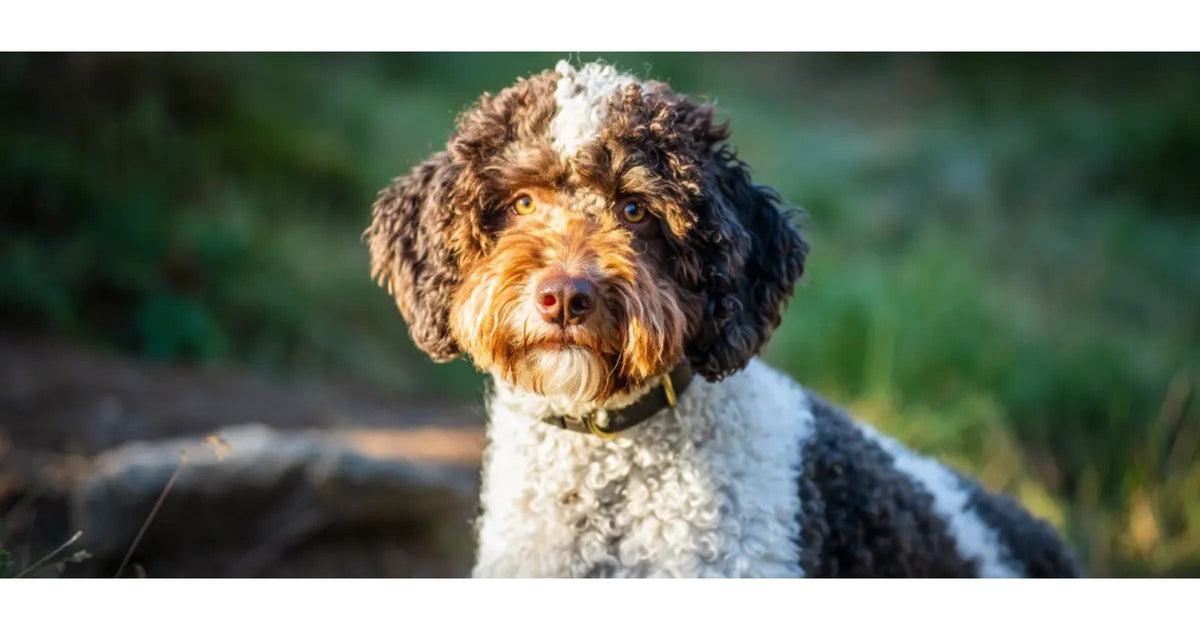
1. The Single-Specialization Claim
In a courtyard at Imola, in 1988, a group of Italian breeders incorporated the Club Italiano Lagotto to save a dog from extinction. By that point in the 20th century, the Lagotto Romagnolo had nearly been lost twice: first to the great wetland drainages of late 19th-century Romagna that ended its original role as a water retriever, then to the chaos of two world wars that scattered its bloodlines. The breed they preserved is, by every authoritative measure, the only dog breed in the world bred specifically and exclusively for one job: finding truffles.
The Club Italiano Lagotto's official breed description states the claim directly: a dog "specialized in the search for truffles on any type of terrain... the only breed in the world specialized in the search for the precious tuber." This is not marketing language. It is the formal position of the Italian national breed authority recognized by the European Kennel Club (ENCI) and by the international canine federation (FCI), which granted international recognition to the breed on March 10, 1995.
In the United States, the same recognition is held by the American Kennel Club, which lists the Lagotto Romagnolo as the only AKC-recognized breed for truffle hunting. The Lagotto Romagnolo Foundation, a US 501(c)(3) non-profit, oversees American health screening standards and maintains the global Lagotto pedigree database.
This is a dog with three institutional pillars: the Italian breed club holding the historical line, the AKC holding the US recognition, and the Lagotto Romagnolo Foundation holding the scientific and health standards. Most dog breeds have one such institution. The Lagotto has three. Across all three, the same claim holds: one breed, one specialization, one job.
2. Etruscan Origins: The Necropolis of Spina
To understand the Lagotto Romagnolo, you start before there was an Italy.
In the 6th and 5th centuries BC, on the northern Adriatic coast where the Po Delta empties into the sea, the Etruscan civilization built the trading port of Spina. The site, near modern Ferrara, was a major hub of commerce with the eastern Mediterranean. Among the archaeological finds at the Necropolis of Spina are tomb paintings and ceramic decorations depicting daily life: hunting scenes, fishing scenes, market scenes — and dogs.
One dog appears systematically across these depictions. Small, robust, with the characteristic hispid and curly coat of a water dog. The morphology is indistinguishable from the modern Lagotto Romagnolo.
The Etruscan trade routes brought continuous exchange with eastern peoples, and through that exchange came the foundation populations of water-working dogs that adapted to the wetlands of Italy's northeastern coast. By the time the Romans expanded into Etruscan territory in the 3rd century BC, these dogs were already an established working population in the marshes from Ravenna through the Comacchio valleys to what is now Friuli and the Istrian coast.
The same morphology — small mesomorphic build, dense curly coat, alert intelligent expression — defines the Lagotto Romagnolo recognized today by the AKC and FCI, 2,500 years later. Few dog breeds in the world can claim that kind of documented archaeological continuity.
3. Linnaeus' Canis Acquaticus
The 18th-century Swedish naturalist Carl Linnaeus, who founded the modern system of biological classification, described a Mediterranean dog type he called Canis acquaticus — water dog — and noted it was "long widespread in the basin of the Mediterranean." His descriptive drawing of the breed is morphologically identical to the Lagotto Romagnolo as the breed exists today.
This identification matters for two reasons. First, it places the breed in scientific literature 250+ years ago, with a published reference image. Second, Linnaeus' framing of the breed as "long widespread" by the 18th century means the morphology was already stable well before his time — pushing the breed's recognized continuous bloodline back to the medieval period at minimum.
Most modern dog breeds were standardized in the 19th-century era of dog shows and stud books. The Lagotto Romagnolo predates this period by centuries.
4. Andrea Mantegna's 1456 Fresco: Visual Historical Evidence
In 1456, the Italian Renaissance painter Andrea Mantegna began the frescos of the Camera degli Sposi — the Bridal Chamber — in the Palazzo Ducale of Mantua, court of the Gonzaga family. The cycle was completed in 1474 and is today recognized as one of the masterpieces of the Italian Renaissance.
In one scene, known as "The Meeting" (L'Incontro), Marquis Ludovico III Gonzaga stands amid his court. At his feet sits a small dog. The dog has a dense curly coat, alert posture, and proportions identical to the modern Lagotto Romagnolo.
This is the earliest widely-cited fine-art depiction of the breed and one of the strongest visual records of its morphological continuity. Mantegna's known commitment to anatomical realism — verified across his portrait work and used by Renaissance scholars as a benchmark for the period — makes the dog's identification as a Lagotto Romagnolo as certain as any pre-photographic dog identification can be.
In 1456, in the most prestigious frescoed room of one of Italy's great Renaissance palaces, the Lagotto Romagnolo was already a recognizable breed of sufficient status to be portrayed alongside its owner, the ruler of Mantua.
5. The Original Function: Càn Lagòt, the Marsh Retriever
The breed name itself is the working description. In the Romagnolo dialect, càn lagòt means "water dog" or, more precisely, "hunting dog in the marsh with curly and hispid fur." The name predates the modern Italian language as a standardized form.
For centuries, the Lagotto worked the valleys of Comacchio and the Ravenna lagoons alongside men called vallaroli — the marshmen who held concessions on the famous tinelle (waterfowl hunting blinds) and accompanied the nobility on duck and coot hunts. The Lagotto was their retriever and their companion. The breed's dense, curly, double-layered coat is functionally waterproof: water cannot reach the skin even after extended swimming, and the coat retains warmth even when the dog has broken through thin ice.
The work itself was extraordinary. During the great organized coot hunts (the rastrelli), hundreds of small boats would surround flocks of thousands of birds. The Lagotti would swim for hours, often through freezing water, retrieving downed birds and bringing them back to the boats. This is the population of working dogs that survived intact and homogeneous for centuries, bred consanguineously by generations of vallaroli who valued working ability above all else.
One trait was preserved with particular care: the Lagotto's hunting instinct toward live game was bred out. A retriever cannot be distracted by what it sees. The Club Italiano Lagotto's modern breed standard describes this directly: "Having had the hunting instinct cancelled, in its work it is not distracted by game and can be considered the only true specialist for the search for truffles."


6. From Water Dog to Truffle Dog: 1840–1890
The 19th century brought the great drainages. Beginning in the mid-1800s, Italian agricultural authorities began systematic reclamation of the Comacchio marshes and the Romagna wetlands for cultivation. The vallaroli tradition faded. The waterfowl populations shrank. The Lagotto's original purpose disappeared.
What did not disappear was the dog's remarkable olfactory capacity. Lagotti raised in the surviving marsh communities were noticed by truffle hunters working the Apennine valleys inland. The same scent-discrimination ability that found wounded coots through underwater cover could find Tuber magnatum pico through 4–12 inches of forest soil. Between 1840 and 1890, the breed underwent a gradual functional transition: from water retriever to truffle specialist.
By the interwar period (1920s–1930s), the Club Italiano Lagotto's historical records document that "the totality of the canine auxiliaries of Romagnolo truffle hunters and of neighboring areas were Lagotti." The breed had completed its transition and become the working standard.
This transition is significant for one reason: the trait set that defined the working water dog — high scent capacity, ground-focused work, methodical search pattern, immunity to game distraction, willingness to work for hours — was identical to the trait set required for truffle hunting. The Lagotto was not retrained. The breed was redirected to a different application of the same skills.
Explore fresh Italian truffles
Milan Truffle imports seasonal fresh truffles direct from Italian hunters — Tuber magnatum (white), Tuber melanosporum (black), and Tuber aestivum (summer). Shipped overnight across the United States and Canada.
7. Near-Extinction and Reconstruction (1970s)
By the mid-20th century, the Lagotto had reached a crisis. Without breed registration or selective breeding standards, indiscriminate crossbreeding by hunters seeking immediate working results had nearly erased the genetic line. The dogs that worked the Apennine truffle territories in the 1960s were Lagotti in name only; many were mixed-breed working dogs without registered pedigree.
In the mid-1970s, a small group of Romagnolo cynophiles intervened. The effort was led by Quintino Toschi (president of the local cynophile group in Imola) and Francesco Ballotta (a senior ENCI judge and breeder who personally remembered the Lagotti of his youth). They were joined by Antonio Morsiani, a cynologist of international standing, and Lodovico Babini, a veteran cynophile.
Their work over the following two decades involved tracking surviving pure-line Lagotti through both the original marsh communities and the Apennine truffle territories, reconstructing the genotype through careful selective breeding, and producing biometric measurements on hundreds of dogs to draft a formal breed standard.
The Club Italiano Lagotto was incorporated in Imola in 1988. ENCI granted formal recognition of the breed in 1992 with approval of Antonio Morsiani's morphological standard. International FCI recognition followed in 1995. The American Kennel Club granted full breed recognition in 2015. From near-extinction in 1970 to AKC-recognized breed in 45 years.
8. The CIL Standard: Size, Coat, Color, Temperament
The breed standard recognized by ENCI in 1992 (Standard 325/bis, Group 8 Section 3 — water dogs) and approved by FCI in 1995 specifies:
- Height at withers: Males 43–48 cm (ideal 46 cm / approximately 18 inches). Females 41–46 cm (ideal 43 cm / approximately 17 inches). Tolerance of 1 cm above or below.
- Weight: Males 13–16 kg (approximately 29–35 lbs). Females 11–14 kg (approximately 24–31 lbs).
- Build: Medium-small mesomorph, square frame, rustic and well-proportioned. Trunk length equal to height at withers.
- Coat: Dense, woolly in texture, tightly curled, with abundant undercoat. Both outer coat and undercoat are water-repellent. The coat does not shed in the manner of most breeds; instead it grows continuously and requires annual clipping.
- Colors recognized: Off-white solid, white with brown or orange patches, brown roan, solid brown (in various shades), solid orange. A brown mask (testa di moro) appears on some individuals. The standard was updated to allow solid brown with or without white, and solid orange with or without white.
- Eyes: Large, rounded, color ranging from ochre to dark hazel to brown depending on coat. Expression alert, intelligent, lively.
- Tail: Set at medium height, scimitar-shaped in repose, raised in attention. Never curled into a ring.
- Paws: Webbed (zampe palmate) — a direct inheritance from the breed's water-working origin. The webbing is functional both in soft soil work and in water.
The Italian standard explicitly disqualifies overly trimmed or "show-coated" Lagotti: "Cottoned coat as in the Poodle or Bichon Frisé, shaved or otherwise hyper-trimmed in any form, is grounds for exclusion from judgment." The breed must look like a working dog. This rule was added by the CIL to prevent the kind of show-bred drift that has separated working and show lines in many sporting breeds.
9. Hypoallergenic Status and Coat Care
The Lagotto Romagnolo is widely regarded as a hypoallergenic dog breed — one of the few breeds recommended for households with mild to moderate dog allergies. Two coat properties produce this status:
- The tight curl of the outer coat traps shed hair and dander within the coat rather than releasing it into the household environment
- The breed does not undergo seasonal shedding; hair growth is continuous, and shed hair is trapped in the curl until removed by brushing or clipping
The American Kennel Club lists the Lagotto Romagnolo among its hypoallergenic dog breed designations. As with all hypoallergenic claims, the designation is comparative, not absolute. People with severe dog allergies should still consult an allergist before introducing any breed to the household.
Coat care requires:
- Weekly brushing with a soft-bristle brush or wide-tooth comb to prevent matting
- Annual clipping (most owners use a professional groomer)
- Regular ear cleaning — the pendulous ears predispose the breed to ear infections in humid environments
- Avoidance of human-style shampoos, which can strip the water-repellent coat oils
10. Hereditary Health in the US: What Responsible Breeders Screen For
The Lagotto Romagnolo Foundation, the US 501(c)(3) non-profit dedicated to breed welfare, maintains screening standards for the hereditary conditions documented in the breed. American buyers should expect any responsible Lagotto breeder to provide screening documentation for all of the following before sale.
Orthopedic conditions
Hip dysplasia: The breed shows a moderate incidence of hip dysplasia, screened in the United States through the Orthopedic Foundation for Animals (OFA). The Lagotto Romagnolo Foundation publishes an OFA-FCI hip comparison reference that allows breeders to translate between the American (OFA) grading scale and the European (FCI) scale used by the Italian and other European breed databases.
Patellar luxation: Knee joint instability, screened by orthopedic evaluation. The Foundation's patellar luxation page documents incidence in the breed.
Genetic disease screening
Lysosomal Storage Disease (LSD): A recessive genetic disorder affecting cellular metabolism. DNA test available; all responsible breeders test parents before breeding. Foundation reference page.
Hyperuricosuria (HUU): A genetic predisposition to urinary stone formation. DNA test available. Foundation reference page.
Benign Familial Juvenile Epilepsy (BFJE): A juvenile-onset seizure disorder typically presenting between 5 and 9 weeks of age, often resolving spontaneously by 13 weeks. DNA test available. Foundation reference page.
Cerebellar Abiotrophy (CA): A degenerative neurological condition affecting motor coordination. Foundation reference page.
Eye conditions
Annual ophthalmologic examination by a board-certified veterinary ophthalmologist (OFA Eye Certification Registry, formerly CERF) is recommended throughout the working dog's productive life. The Foundation's eyes reference documents the screening protocol.
What a responsible US breeder provides
Documentation, before purchase, of:
- OFA hip evaluation for both parents (Good, Excellent, or Fair only; no Dysplastic or Borderline)
- DNA test results for LSD, HUU, BFJE on both parents (clear or carrier status documented)
- Annual eye examination certification on both parents
- Patellar luxation evaluation on both parents
- Pedigree registration with AKC and ideally cross-referenced with the Lagotto Romagnolo Foundation database
Puppies sold without this documentation are not necessarily unhealthy, but the buyer has no way to verify breeding-pair health screening. For a working dog expected to perform 8–12 hours of field work per week over 8–12 years, the screening matters.
11. How to Choose a Working Lagotto
The Lagotto Romagnolo distinguishes more sharply than most breeds between show-line and working-line bloodlines, despite the CIL's standard explicitly resisting this divergence. For US buyers, the question is: what do you actually want?
- Companion dog: Most AKC-registered Lagotti work well as family companions. Look for breeders with full health screening, reasonable price (USD 2,500–4,000 for a registered puppy from screened parents), and exposure to varied environments during the 8–10 week socialization window.
- Working truffle dog: Look specifically for parents with documented field work, ideally with verifiable hours and finds. A working Lagotto from documented working bloodlines costs more (USD 4,000–8,000 untrained, or up to USD 15,000+ for a fully trained adult). The Club Italiano Lagotto's Campionato Sociale di Lavoro (Social Working Championship) is the gold standard for documented field competence.
- Show conformation: Working bloodlines and show bloodlines have begun to diverge in the United States despite the Italian standard's resistance. For both, the CIL standard requires the dog look rustic and working, not over-groomed.
For a comprehensive overview of all working truffle dog breeds — including the Lagotto Romagnolo and seven other breeds historically used for the work — see Milan Truffle's pillar article on the best truffle dog breeds.
12. Frequently Asked Questions
The breed and its history
Is the Lagotto Romagnolo the only breed used for truffle hunting?
The Lagotto Romagnolo is the only breed in the world bred specifically and exclusively for truffle hunting, and the only AKC-recognized truffle dog breed. Other breeds — including the Bracco Italiano, Hungarian Vizsla, English Pointer, German Shorthaired Pointer, Spinone Italiano, Jack Russell Terrier, and Cocker Spaniel — are also used for truffle work, but were not bred specifically for the task.
Where does the name "Lagotto Romagnolo" come from?
Lagotto comes from the Romagnolo dialect word càn lagòt, meaning "water dog" or "marsh hunting dog with curly and hispid fur." Romagnolo identifies the region of origin: Romagna, the eastern half of Emilia-Romagna in northern Italy.
How old is the Lagotto Romagnolo breed?
The morphology appears in archaeological depictions at the Etruscan Necropolis of Spina (6th-5th century BC), and the modern Lagotto is recognized as the direct descendant. The breed was depicted in Andrea Mantegna's 1456 fresco in the Palazzo Ducale of Mantua. As a formally registered breed, the Lagotto Romagnolo received ENCI recognition in 1992 and FCI international recognition in 1995.
When did the AKC recognize the Lagotto Romagnolo?
The American Kennel Club granted full breed recognition to the Lagotto Romagnolo in 2015, placing it in the Sporting Group as the only AKC-recognized breed for truffle hunting.
Was the Lagotto Romagnolo originally a truffle dog?
No. The Lagotto was originally a water dog, used in the marshes of the Comacchio valleys and Ravenna lagoons to retrieve waterfowl. The transition from water retriever to truffle specialist took place between approximately 1840 and 1890, as wetland drainage projects ended the breed's original purpose. The same scent capacity and methodical search behavior worked equally well for truffles.
Did the Lagotto Romagnolo nearly go extinct?
Yes. By the mid-20th century, indiscriminate crossbreeding by hunters seeking immediate working results had nearly erased the breed's genetic line. In the 1970s, a group of Romagnolo cynophiles led by Quintino Toschi, Francesco Ballotta, and Antonio Morsiani reconstructed the breed through careful selective breeding. The Club Italiano Lagotto was incorporated in Imola in 1988. ENCI recognized the reconstructed standard in 1992.
Physical traits and care
How big is a Lagotto Romagnolo?
Males stand 43–48 cm (17–19 inches) at the withers with ideal height 46 cm; females 41–46 cm with ideal height 43 cm. Males weigh 13–16 kg (29–35 lbs); females 11–14 kg (24–31 lbs). The breed is classified as medium-small.
Is the Lagotto Romagnolo hypoallergenic?
The Lagotto Romagnolo is widely classified as hypoallergenic — among the AKC's recommended breeds for households with dog allergies. The tightly curled coat traps shed hair and dander within itself rather than releasing it into the environment, and the breed does not undergo seasonal shedding. The designation is comparative, not absolute; severe allergy sufferers should consult an allergist.
Does the Lagotto Romagnolo shed?
The Lagotto Romagnolo does not shed in the conventional sense. Hair grows continuously and sheds into the coat itself, where it is trapped by the tight curl until removed by brushing or annual clipping.
How often does a Lagotto Romagnolo need grooming?
Weekly brushing is sufficient for daily coat health. Annual clipping is required because the coat does not shed and otherwise mats. Most owners use professional groomers familiar with the breed's specific coat structure.
Do Lagotti have webbed paws?
Yes. The Lagotto Romagnolo has functional webbed paws (zampe palmate) — a direct inheritance from the breed's water-retrieving origin. The webbing assists both in water work and on soft forest terrain during truffle hunting.
What colors does the Lagotto Romagnolo come in?
ENCI/FCI recognized colors are: off-white solid, white with brown or orange patches, brown roan, solid brown in various shades, and solid orange. Some individuals have a brown mask (testa di moro). The standard was updated to allow solid brown with or without white, and solid orange with or without white.
Health and breeding
What hereditary health conditions affect the Lagotto Romagnolo?
The Lagotto Romagnolo Foundation documents five primary screened conditions: hip dysplasia (OFA evaluation), patellar luxation, Lysosomal Storage Disease (LSD, DNA-testable), Hyperuricosuria (HUU, DNA-testable), Benign Familial Juvenile Epilepsy (BFJE, DNA-testable), and Cerebellar Abiotrophy (CA). Responsible US breeders screen for all of these.
What is Benign Familial Juvenile Epilepsy in Lagotti?
BFJE is a recessive genetic disorder causing seizures typically beginning between 5 and 9 weeks of age in affected puppies. The condition usually resolves spontaneously by approximately 13 weeks, though affected dogs require veterinary monitoring. A DNA test is available; responsible breeders test both parents before breeding.
What is Lysosomal Storage Disease in the Lagotto Romagnolo?
LSD is a recessive genetic disorder affecting cellular metabolism. Affected dogs progressively lose neurological function. A DNA test is available, and responsible breeders test breeding pairs to prevent affected litters. The Lagotto Romagnolo Foundation maintains the US screening protocol.
How much does a Lagotto Romagnolo puppy cost in the United States?
A registered puppy from screened parents typically costs USD 2,500–4,000. Puppies from documented working bloodlines cost USD 4,000–8,000. A fully trained working truffle dog can cost USD 10,000–15,000 or more, particularly when imported from Italian working kennels.
How long do Lagotti live?
The Lagotto Romagnolo typically lives 14–16 years, longer than the average for medium-sized dogs. Good genetic screening and weight management contribute to the upper end of this range.
Working traits
Are Lagotti good family dogs?
Yes. The Italian breed standard describes the temperament as "sober, intelligent, affectionate, strongly attached to its owner, easily trainable." The breed is calm in the home, energetic outdoors, and adaptable to apartment living provided sufficient daily exercise and mental stimulation. The Lagotto is also noted as a good alert dog, attentive to its territory without being aggressive toward strangers.
How much exercise does a Lagotto Romagnolo need?
Lagotti require 1–2 hours of vigorous daily activity, ideally combining walking with scent-work or play that engages the breed's working instincts. Lagotti who do not get sufficient mental stimulation can develop destructive behaviors.
How long does it take to train a Lagotto for truffle hunting?
Most working Lagotti require 12–18 months of consistent training to reach field readiness, starting at approximately 3 months of age. Foundation scent-recognition training takes 4–6 months; field application takes another 8–12 months of practical experience.
What is the difference between a Lagotto and a Poodle?
Both breeds have continuously growing, non-shedding curly coats. The differences are significant: the Lagotto is smaller (medium-small vs. Standard Poodle large), bred for working scent-detection rather than retrieving/companionship, has a denser and more water-repellent coat, and shows a markedly different head shape (wider, more rounded). The Lagotto's hunting instinct toward live game is bred out; the Poodle retains a retrieving instinct.
Is the Lagotto Romagnolo the same as a Spanish Water Dog?
No. They are distinct breeds despite both being European water dogs with curly coats. The Spanish Water Dog (Perro de Agua Español) is descended from water dogs that arrived in the Iberian Peninsula via North Africa during the Moorish conquests — long after Lagotto-type dogs were already established in northern Italy from earlier Etruscan-era exchanges with the eastern Mediterranean. The two breeds have separate documented histories and separate breed standards.
Why is the Lagotto Romagnolo becoming popular in luxury small-dog markets?
The Lagotto Romagnolo has emerged as a distinctive choice in the same prestige small-breed market that historically favored companion breeds like the Pomeranian, the Maltese, and the toy Poodle. The appeal layers four factors: hypoallergenic status (relevant for urban households), apartment-compatible size, documented Italian heritage and AKC recognition, and — distinctively — a verified working-breed lineage rather than a purely decorative pedigree. US registrations of the Lagotto Romagnolo with the AKC have grown steadily since formal breed recognition in 2015, with adopters concentrated in urban professional households where the breed's combination of prestige, allergy compatibility, and unique cultural story justifies the USD 2,500-5,000 entry price for a screened puppy.
From Milan Truffle
Continue reading on Milan World:
- The Best Truffle Dogs: 8 Italian Working Breeds — the broader survey of all working truffle dog breeds, including the Lagotto Romagnolo and seven other breeds used historically
- Italian Olive Oil DOP and IGP — companion regulatory pillar on Italian agricultural protection
- Mozzarella di Bufala Campana DOP — pillar on Italian buffalo cheese authentication
Shop Milan Truffle's Italian truffle collection:
- Fresh Italian Truffles — seasonal fresh truffles found by Lagotti and other working breeds in the field, shipped direct from Italian hunters
- Black Truffle Extra Virgin Olive Oil 250ml — Italian EVOO designed as a finishing oil, layered with summer black truffle aroma
- White Truffle Extra Virgin Olive Oil 250ml — Italian EVOO designed as a finishing oil, layered with white truffle aroma
- Lumìa 100% Italian Extra Virgin Olive Oil 500 mL — unflavored Italian EVOO from early-harvest olives, cold extracted in Italy