How the United States Protects Italian DOP Products: The Case of Mozzarella di Bufala Campana DOP

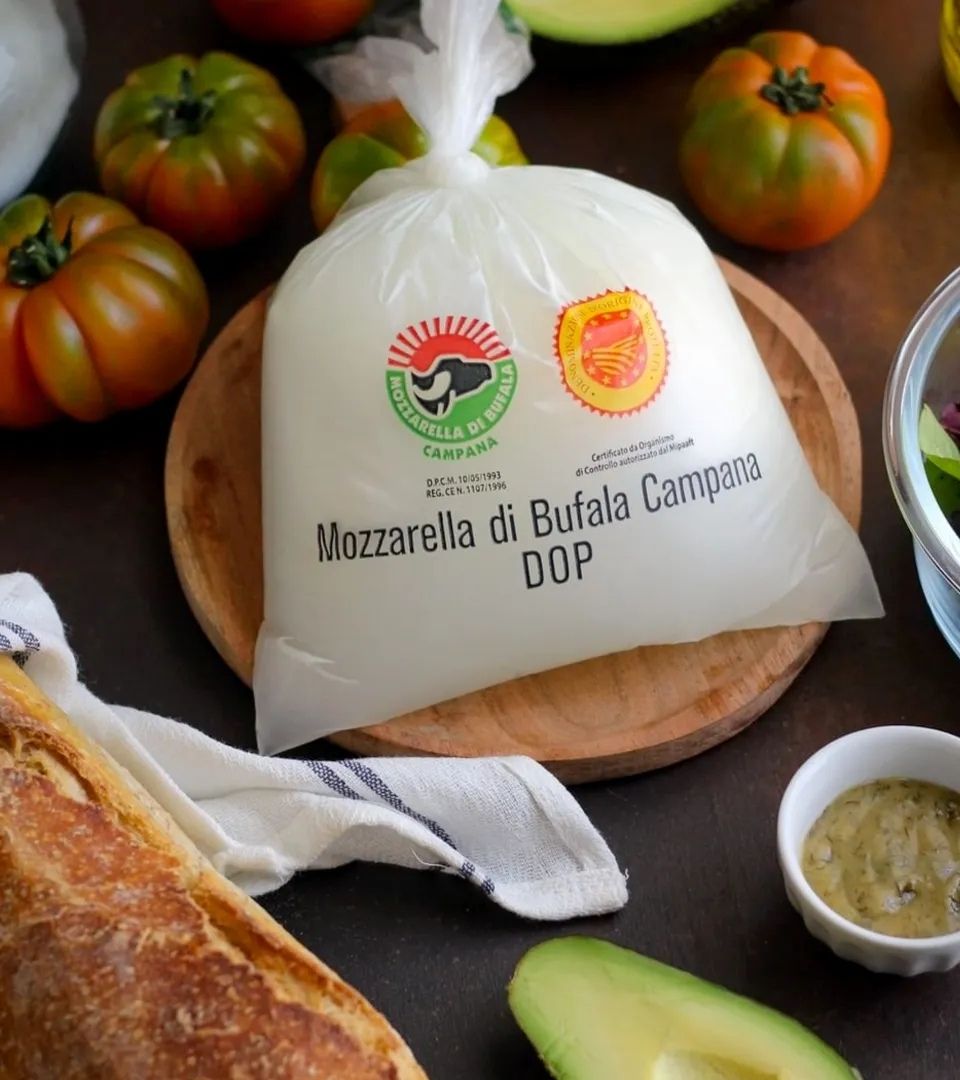
Mozzarella di Bufala Campana DOP in its official Consorzio-trademarked packaging, the only legally protected name for authentic buffalo mozzarella

Italian Protected Designation of Origin (PDO) products — cheeses, hams, oils, wines, and dozens of other foods bearing the European Union's yellow-and-red PDO seal — are not automatically protected in the United States the way they are in the European Union. Where European law treats geographical origin as a form of collective cultural intellectual property, American law treats it as a question for trademark courts and food safety regulators. The result is an asymmetric protection environment in which an authentic Italian DOP cheese and an American imitation can sit side by side on a Tennessee grocery shelf, both legal under U.S. law, with only the trained American consumer able to tell the difference.

This guide assembles the legal, regulatory, scientific, and consumer-facing architecture that determines whether what an American buys as "Italian" is actually Italian. We use Mozzarella di Bufala Campana DOP — registered in the European Commission's geographical indications register as file PDO-IT-0014, with the Consorzio per la Tutela del Formaggio Mozzarella di Bufala Campana as the recognized producer group — as the case study, because no other Italian DOP product better illustrates the full transatlantic protection chain: from twelfth-century origins, to Bourbon-era institutional codification, to modern EU registration, to USPTO Certification Mark enforcement in U.S. federal courts.

Short Answer

In the United States, Italian DOP products are not automatically protected by federal law. Authenticity depends on a layered system involving USPTO Certification Marks (registered by Italian protection consortia), FDA food safety inspections, FTC enforcement against deceptive marketing, and Customs and Border Protection interdiction of counterfeit imports. For Mozzarella di Bufala Campana DOP, the Italian Consorzio holds two active USPTO Certification Marks (Registration Numbers 6197778 and 7115453), giving it standing to sue American producers who use the protected name without authorization.

Key Facts

  • The European Union recognized Mozzarella di Bufala Campana as a Protected Designation of Origin on 21 June 1996 via Commission Regulation (EC) No 1107/96 — file PDO-IT-0014.
  • The Italian state had recognized the denomination three years earlier, with DPCM 10 May 1993 published in Gazzetta Ufficiale n. 219 of 17 September 1993.
  • The U.S. system relies on the Lanham Act (15 U.S.C. § 1125) and USPTO Certification Marks — not on automatic recognition of European PDO status.
  • The FDA regulates food safety, not geographical authenticity. A "buffalo mozzarella" produced in Wisconsin can pass FDA inspection without being legally connected to Mozzarella di Bufala Campana DOP.
  • The Italian Consorzio per la Tutela conducted 3,752 inspections in 2024 and required intervention on 475 online listings — a level of enforcement that operates against fraud both in Italy and in U.S. e-commerce.

Why EU Protected Designations of Origin Are Not Automatically Protected in the United States

The European Union and the United States disagree, at a foundational legal level, about what a geographical indication is. This disagreement is not a technicality — it determines whether an American consumer is legally protected when buying a product labeled as Italian.

Under European Union law, a Protected Designation of Origin is collective cultural intellectual property: the legal embodiment of an unbreakable link between a specific food product, a specific geographic territory, and a specific traditional production method. The European Commission's quality schemes framework, governed since 2012 by Regulation (EU) No 1151/2012, treats this link as automatically protected across all 27 member states. Once the European Commission registers a name — Mozzarella di Bufala Campana on 21 June 1996, Parmigiano Reggiano, Prosciutto di Parma, and hundreds of others — that name becomes legally unavailable to anyone else, anywhere in the EU, for any product that does not comply with the registered production specification. According to the European Commission, this protection is "ex officio" — meaning member state authorities are required to enforce it without needing the producer to file a lawsuit.

Under United States law, geographical indication protection works differently. There is no federal registry analogous to the EU's eAmbrosia. There is no automatic recognition of European PDOs. Instead, protection of a geographical name — whether Italian, French, or any other — depends on whether someone has registered that name as a trademark or certification mark with the United States Patent and Trademark Office, and whether they are willing to enforce that registration through U.S. federal courts. The U.S. system treats geographical indication as a market-competition question rather than a cultural-heritage question. Generic terms (parmesan, champagne in some U.S. uses, feta in some U.S. uses) can be used freely; protected names require active registration and active enforcement.

The Disagreement Between the European Union and the United States on Geographical Indications

Why do these two systems differ so fundamentally? The European Union approach reflects centuries of integration between specific foods and specific territories — an approach in which product names like "Roquefort" or "Mozzarella di Bufala Campana" are understood as carrying intrinsic, place-bound meaning that cannot be transferred. The American approach reflects the United States' own history of immigration and industrial food production, in which Italian-immigrant producers in Wisconsin or California adopted Italian product names for cheeses they made on American soil with American milk — producing "parmesan" or "asiago" or "buffalo mozzarella" as generic descriptive terms rather than place-protected names.

This disagreement persists in current trade policy. The 2006 U.S.-EU Wine Agreement is the only significant bilateral instrument resolving geographical indication disputes between the two jurisdictions, and it covers only certain wine names. Following the failure of the proposed Transatlantic Trade and Investment Partnership (TTIP), the dialogue continues through the Trade and Technology Council (TTC), with the European Union pushing for stronger U.S. recognition of EU PDOs and the United States resisting on the grounds that such recognition would constitute a trade barrier. As of 2026, the asymmetry remains: an Italian Mozzarella di Bufala Campana DOP enjoys absolute protection across the EU, partial protection in countries with bilateral agreements (Japan, Canada, dozens of others), and only the limited trademark-based protection in the United States that the Italian Consorzio has actively secured through USPTO registration.

What Is a Certification Mark in the United States?

A certification mark, under U.S. trademark law (15 U.S.C. § 1127), is a special category of trademark used not to identify the source of goods but to certify that the goods meet specified standards. The owner of a certification mark does not produce or sell the certified goods; instead, the owner licenses authorized producers to use the mark on goods that comply with the certifier's standards. For Italian Consortia like the Consorzio per la Tutela del Formaggio Mozzarella di Bufala Campana, USPTO Certification Mark registration is the principal U.S. legal tool for protecting their geographical names against American imitation. Without USPTO registration, the Italian name has no specific U.S. legal protection beyond what the Lanham Act's general "false designation of origin" provisions might provide.

This same Lanham Act framework — supplemented by FTC Section 5 deception standards and CBP's Substantial Transformation doctrine — governs Italian olive oil DOP and IGP protection in the United States, where "Made in Italy" labels and the 42-DOP / 8-IGP Italian geographical-indication system encounter the same gap between EU traceability and US trade law.

The Italian Legal Architecture: PDO-IT-0014 and the Three-Decade Chain

The Italian and European legal architecture protecting Mozzarella di Bufala Campana DOP unfolds across three decades and four legal levels. According to the European Commission's official PDO Registration Extract, signed by João Onofre, Head of Unit at DG AGRI Directorate F.3 (Geographical Indications), the cheese is registered as file PDO-IT-0014 in the Geographical Indications register established by Article 11 of Regulation (EU) No 1151/2012. The recognized producer group is the Consorzio per la Tutela del Formaggio Mozzarella di Bufala Campana, headquartered at Via Raffaele Gasparri, 1, 81100 Caserta, Italy.

The legal chain begins earlier than the EU registration. Italian recognition of "mozzarella di bufala" as a defined cheese type dates to 28 September 1979, when DPR 28/9/1979 established the first compulsory production rules applicable throughout Italy. Full national Protected Designation of Origin status came on 10 May 1993, when the Italian Council of Ministers issued DPCM 10 maggio 1993, published in the Gazzetta Ufficiale della Repubblica Italiana n. 219 of 17 September 1993. This DPCM established the original Disciplinare di Produzione — the legally binding production specification that defines who can use the name and under what conditions.

European Union recognition followed in 1996. Under Article 17 of the then-applicable Regulation (EEC) 2081/92, the European Commission registered Mozzarella di Bufala Campana as a Protected Designation of Origin via Commission Regulation (EC) No 1107/96 of 12 June 1996, published in the Official Journal of the European Communities, Series L 148, on 21 June 1996. This is the foundational EU document — the legal moment at which the cheese passed from purely Italian protection to pan-European protection. The 2081/92 framework has since been replaced by Regulation (EU) No 1151/2012, which is the current legal instrument governing PDO/PGI products throughout the European Union.

Subsequent amendments have refined the production specification. Italian Ministerial Decrees of 7 April 1998 and 21 July 1998 (under MiPAF, the predecessor of MASAF) established detailed labeling requirements and product designation criteria. Commission Regulation (EC) No 103/2008 of 4 February 2008, published in OJ L 31 of 5 February 2008 and republished in Italian Gazzetta Ufficiale n. 47 of 25 February 2008 (page 36), approved substantive modifications to the Disciplinare and expanded the protected production area.

The Italian state has also acted to confer specific enforcement powers on the Consorzio. Under Italian Law n. 128 of 30 April 1998 (the first organic framework governing Italian protection consortia) and, more importantly, Italian Law n. 526 of 21 December 1999, whose Article 14, comma 15, gives recognized consortia what Italian legal scholarship calls vigilanza erga omnes — literally "vigilance against everyone" — the legal authority to police compliance against all market participants, not merely member producers. The Consorzio per la Tutela del Formaggio Mozzarella di Bufala Campana was officially recognized for these powers by Italian Ministerial Decree of 24 April 2002, with subsequent renewals, including the significant D.M. of 19 February 2010.

What this Italian and European legal chain produces, viewed from American territory, is a name that is absolutely protected in 27 EU member states, recognized in numerous third countries through bilateral agreements (Japan since 2019 under the EU-Japan Economic Partnership Agreement, Canada through CETA, dozens of others), and protected in the United States only to the extent that the Italian Consorzio has actively secured trademark registration. The asymmetry between European and American protection is not a defect in the cheese's status — it is a consequence of the foundational disagreement between the two jurisdictions on what geographical indications are.

The Italian Cheese Ecosystem and the Pasta Filata DOP Family

Italian law recognizes more than 55 cheeses as Protected Designation of Origin (DOP) or Protected Geographical Indication (IGP) products, each with its own consortium, its own production specification, and its own legal protections. According to data published by AFIDOP (Associazione Formaggi Italiani DOP IGP), the Italian DOP/IGP cheese system represents the most extensive collection of legally protected cheese designations in any single country in the world.

Mozzarella di Bufala Campana DOP belongs to a specific subset within this ecosystem: the seven pasta filata DOP cheeses, named for the technique that defines them. Pasta filata means "spun curd," referring to the practice of stretching the cheese in hot water to develop its characteristic stringy, elastic texture.

The full pasta filata DOP family includes:

  • Caciocavallo Silano DOP — Apennine ranges of southern Italy, cow milk
  • Mozzarella di Bufala Campana DOP — the case study of this guide
  • Mozzarella di Gioia del Colle DOP — Apulia, cow milk fior di latte mozzarella
  • Provola dei Nebrodi DOP — Sicilian semi-aged
  • Provolone del Monaco DOP — Campanian aged cheese
  • Provolone Valpadana DOP — long-aged variant from Northern Italy
  • Vastedda della Valle del Belice DOP — Sicilian, the only sheep's milk pasta filata DOP in the world

Of these seven, Mozzarella di Bufala Campana is the only cheese made exclusively with buffalo milk, and the only one consumed in its fresh state rather than aged. Unlike the cow milk and sheep milk variants in the family, it requires the milk of Italian Mediterranean buffalo (Bubalus bubalis), an animal that represents approximately 30% of the total dairy buffalo population in any single country — a concentration unique to Italy.

A companion product shares the same milk and the same protected territory: Ricotta di Bufala Campana DOP, registered as a Protected Designation of Origin by Commission Regulation (EC) No 634/2010 of 19 July 2010. Where Mozzarella di Bufala Campana is the primary cheese, Ricotta di Bufala Campana is made from the sweet whey that remains after the mozzarella production. The two cheeses are bound together at the level of the production cycle — every wheel of authentic Mozzarella di Bufala Campana DOP generates whey that, in qualifying dairies, becomes Ricotta di Bufala Campana DOP. This is the only buffalo-milk ricotta with EU PDO protection.

When American readers encounter references to other major Italian DOP cheeses — Pecorino Sardo DOP, Pecorino Siciliano DOP, Parmigiano Reggiano DOP, Grana Padano DOP, Gorgonzola DOP, Asiago DOP, Pecorino Romano DOP, Taleggio DOP, Fontina DOP — these all sit within the same Italian regulatory framework. Each is recognized by the Italian Ministry of Agriculture (MASAF), registered in the European Commission's eAmbrosia database, governed by its own Disciplinare di Produzione, defended by its own consortium, and exposed to the same asymmetric protection environment in the United States.

Three Centuries of Italian Institutional Commitment

When Mozzarella di Bufala Campana was registered as a European Protected Designation of Origin in 1996, the European Commission was not creating something new. It was codifying, in modern legal form, a continuous Italian institutional interest in this specific cheese that already stretched back nearly two and a half centuries — and a culinary tradition that already stretched back nearly seven hundred years. This depth of institutional commitment is the foundation on which both the Italian Disciplinare di Produzione and the EU PDO designation rest.

The cheese's documented origins begin in the twelfth century, when the Benedictine monks of San Lorenzo at Capua produced fresh cheese from buffalo milk and distributed it during religious gatherings. Documentary evidence places this production firmly within the marshy plains of Campania, where buffalo proved invaluable both as draft animals (their broad hooves crossed wetlands without sinking) and as milk producers in conditions where cattle struggled. By 1570, the Italian Renaissance chef Bartolomeo Scappi, official cook to Popes Pius V and Pius IV, included buffalo mozzarella in his comprehensive cookbook Opera dell'arte del cucinare, confirming that the cheese had moved from monastic curiosity to noble table within four centuries.

The systematic transformation of buffalo mozzarella from peasant cheese to court delicacy began in the 1750s, when Charles III of Spain — King of Naples from 1734 and later King of Spain from 1759 — launched a sweeping modernization of the agricultural lands surrounding his Royal Palace at Caserta. The Reggia di Caserta, modeled on Versailles and conceived as the seat of a unified Bourbon Two Sicilies kingdom, required a productive agricultural infrastructure. Carditello, a 2,100-hectare estate located between Caserta and Naples, became the center of that experiment.

At Carditello — the Real Sito di Carditello — Bourbon agronomists established what historians of Italian agriculture identify as the first experimental cheese dairy in history. Charles III imported dairy expertise from Lodi and Parma, the Northern Italian centers of cheese science, to apply systematic methods to buffalo milk production at a scale never previously attempted in southern Italy. The buildings constructed for buffalo housing, the bufalare, followed circular and octagonal stone architecture engineered for the Mediterranean climate. The filatura technique was refined during this period from peasant practice into a method capable of consistent industrial-scale production.

Under Ferdinand IV, the buffalo herd at Carditello grew to approximately 7,800 head — a concentration that remains exceptional even by modern Italian standards. Court records document buffalo named after personalities of the Bourbon court, with detailed registers tracking lineage, milk production, and seasonal performance. The cheese they produced supplied not only the immediate royal household but a luxury dairy market that extended throughout Naples and beyond. A second royal dairy operated in parallel at Capodimonte, the hill above Naples, while the silk-producing colony of San Leucio formed the third leg of an Enlightenment-era agricultural-industrial complex that produced buffalo mozzarella as one of its signature outputs.

The Bourbon investment in this dairy infrastructure connects directly to the broader Naples food culture that would later produce, in 1889, Pizza Margherita — the variant of Pizza Napoletana STG that uses Mozzarella di Bufala Campana DOP as one of its two permitted cheeses under the EU disciplinare. By the late nineteenth century, when Naples pizzaiolo Raffaele Esposito created the green-white-red pizza for the visiting Queen Margherita of Savoy, mozzarella di bufala was already an established Neapolitan ingredient with a Bourbon dairy lineage stretching back more than a century. Caroline of Austria, the second wife of Ferdinand IV, is documented in court records as having commissioned the first dedicated pizza oven within the royal palace — placing the institutional embrace of Naples-style pizza, with mozzarella di bufala at its center, decades before the Margherita commission.

In 2016, this institutional history came full circle. The Consorzio per la Tutela del Formaggio Mozzarella di Bufala Campana DOP established its operational headquarters within the Regie Cavallerizze (the Royal Stables) of the Palazzo Reale at Caserta — the very Bourbon palace whose 1750s agricultural modernization had launched the systematic production of buffalo mozzarella. The agreement that placed the Consorzio inside the Reggia was formed jointly between the Italian Ministry of Cultural Heritage and the agricultural producers of the DOP designation. According to the Italian Ministry of Cultural Heritage, this was the first time in Italian institutional history that cultural heritage authorities had formally partnered with an agricultural product designation. The Reggia di Caserta is a UNESCO World Heritage Site, designated in 1997 alongside the San Leucio Complex and the Vanvitelli Aqueduct. The Royal Palace's historical archive includes documentation of the original Carditello experimental dairy, providing a continuous documentary lineage from the eighteenth-century court records to the modern certification chain.

Three centuries of Italian institutional commitment converge in the modern legal apparatus that protects Mozzarella di Bufala Campana DOP. The 1996 EU PDO did not invent the cheese's protected status — it codified a state interest in this specific food that had been continuous since Charles III's first experiments at Carditello.

The Geographic Protected Area: Four Regions, Specific Provinces

The protected geographic area for Mozzarella di Bufala Campana DOP, as defined in the Disciplinare di Produzione registered with both the European Commission and the Italian Ministry of Agriculture, includes specific provinces across four regions of southern-central Italy. According to the Disciplinare, this is not a marketing-driven designation but a legally binding boundary — milk used to make Mozzarella di Bufala Campana DOP must come from buffalo raised within these specific territories, and the cheese itself must be produced within them.

In Campania, the protected area includes the entire province of Caserta, the entire province of Salerno, and specific municipalities of the provinces of Naples (Acerra, Giugliano in Campania, Pozzuoli, Qualiano, Arzano, Cardito, Frattamaggiore, Frattaminore, Mugnano di Napoli) and Benevento.

In Lazio, the protected area extends across specific comuni in three provinces: Latina (including Cisterna di Latina, Fondi, Latina, Pontinia, Priverno, Sabaudia, Sermoneta, Sezze, Sperlonga, Terracina, Aprilia, and others), Frosinone (including Amaseno, Giuliano di Roma, Castro dei Volsci, Pofi, Ceccano, Frosinone, Ferentino, Alatri, Castrocielo, Ceprano, Roccasecca, and others), and Roma (Anzio, Ardea, Nettuno, Pomezia, Roma, Monterotondo).

In Puglia, the protected area is limited to a portion of the province of Foggia, specifically around Cerignola. In Molise, the protected area includes only the Municipality of Venafro in the province of Isernia.

Within Campania, two sub-designations recognize specific production methods. "Piana del Volturno" or "Aversana" may appear on Mozzarella di Bufala Campana DOP made from buffalo raised in semi-free stabling with pastoral practices typical of the Caserta plain. A separate designation applies to buffalo raised in semi-free stabling with pasture access in the Basso Lazio area.

The geographic specificity is not arbitrary. The Volturno river plain in northern Campania, the marshy areas around Salerno (the Sele river basin), and the wetlands of the Pontine plain in Lazio share specific environmental characteristics: alluvial soils, abundant fresh water, mild winters, and Mediterranean vegetation patterns. Unlike the arid soils of inland southern Italy or the volcanic terrain of the Apennine ranges, these wetland environments support the buffalo's specific dietary needs and historic ecological niche. According to the Consorzio's territorial mapping, approximately 90% of all certified Mozzarella di Bufala Campana DOP production is concentrated in Campania, with the regional Italian government (Regione Campania) maintaining specific oversight of the production chain through its Assessorato all'Agricoltura.

The geographic boundary is enforced through a chain of certification: every milk-producing farm must be enrolled in the Consorzio's traceability system; every batch of milk delivered to a dairy must be traceable to specific farms within the protected zone; and every wheel of cheese must be packaged at the place of production, with the Consorzio's certification mark applied before the cheese leaves the dairy. Producers who attempt to bring in buffalo milk from outside the protected area — whether from other Italian regions or from foreign sources — face exclusion from the DOP designation and potential criminal prosecution under Italian commerce fraud statutes (frode in commercio).

How Mozzarella di Bufala Campana DOP Is Made: The Disciplinare di Produzione

According to the Disciplinare di Produzione registered with MASAF and the European Commission, every step from buffalo to package for Mozzarella di Bufala Campana DOP is defined in legally binding detail. The current Disciplinare reflects substantial revisions from the original 1993 specification, with the most significant amendments published in Reg. CE n. 103/2008 (GUUE L 31 of 5 February 2008) and subsequent technical updates.

The starting material is whole fresh milk from Bufala Mediterranea Italiana buffalo raised within the protected geographic area. According to the Disciplinare, no other milk source is permitted — no cow's milk, no foreign buffalo milk, no frozen milk (a frequent target of fraud detection by the Consorzio's scientific partners). The milk must reach the dairy and begin transformation within a maximum of 60 hours from milking; this constraint is central to the cheese's character because longer intervals allow undesirable bacterial development and lipid changes that shift the flavor profile away from the protected standard.

At the dairy, the milk may be used raw (latte crudo), thermized, or pasteurized. Acidification is initiated through addition of whey rennet (caglio sieroinnesto) — and here the Disciplinare imposes a specific provenance constraint: the whey rennet must come from buffalo raised on the same farm or in its direct neighborhood, ensuring continuity in the bacterial cultures that shape flavor. The acidified milk is then heated to between 33 and 39 degrees Celsius and coagulated through the addition of calf rennet (caglio di vitello). The resulting curd is broken, separated from the whey, and matured until it reaches the optimal stretch point.

The defining technical step is filatura — the spinning that gives pasta filata cheeses their name. The matured curd is mixed with boiling water at 90–95°C, where it melts into a single elastic mass. The cheesemaker (or the modern automated stretcher) lifts and pulls this mass continuously with a large wooden spoon and stick (mestolo and bastone in traditional practice), folding it onto itself until the structure reaches a homogeneous consistency. From this hot, elastic mass, the mozzarella is shaped — either by hand through the traditional mozzatura technique (the "cutting off" performed with thumb and forefinger that gives the cheese its name) or by precision forming machines that produce calibrated weights.

The Disciplinare permits multiple shapes, each with its own traditional name and weight range:

  • Tondeggiante — the round classic form, typically 125–500 grams
  • Bocconcini — small bites, around 30 grams
  • Ciliegine — cherry-sized, around 20 grams
  • Perline — pearl-sized, around 10 grams
  • Ovoline — egg-shaped, around 80 grams
  • Nodini — small knots
  • Trecce — braids, with weights running up to 3 kilograms

Standard individual pieces range from 10 to 800 grams. After shaping, the mozzarella is immersed in cold water tanks for the first thickening, then transferred to brine tanks (acqua di salatura) for the salting phase. The protective liquid that surrounds packaged Mozzarella di Bufala Campana DOP — the milky-acidic bath visible in any retail packaging — is a continuation of this brine, formulated to keep the cheese fresh from packaging through retail to consumer.

The Disciplinare permits one variant: smoked Mozzarella di Bufala Campana DOP, but only when the smoking is performed through traditional natural methods. Industrial smoke flavoring is prohibited. When the cheese is smoked, the package must declare it explicitly.

The finished cheese has a porcelain-white color (the absence of beta-carotene in buffalo milk, unlike cow's milk which produces a yellow tint), a thin crust of less than one millimeter that distinctly separates from the soft inner curd, and a characteristic structure that releases milky whey droplets when pressed or cut. In the first eight to twelve hours after production, the cheese is slightly elastic; over the following hours, it becomes increasingly creamy. The optimal moment to consume Mozzarella di Bufala Campana DOP is the day of production — and the entire infrastructure of cold chain and rapid distribution exists to bring American consumers as close to that moment as the Atlantic crossing permits.

The Science of Authenticity: Italian Research Institutions

The Italian system protecting Mozzarella di Bufala Campana DOP operates not only through legal architecture and Consortium enforcement but through a scientific verification layer maintained by Italian research institutions. According to scientific literature published by Italian agricultural research centers, the authentication of Mozzarella di Bufala Campana DOP at the molecular level provides an objective verification system that operates beneath the visible certification chain — a chemical guarantee that complements the legal one.

The starting point is milk chemistry. The Italian Mediterranean buffalo (Bubalus bubalis) is a different species from the dairy cow (Bos taurus) — not a different breed of the same animal, but a distinct evolutionary lineage with milk that differs measurably across nearly every nutritional parameter. Italian Mediterranean buffalo milk contains approximately 8% fat, compared to 3.5–4% for typical Holstein cow's milk. The protein content reaches approximately 4.63%, considerably higher than cow's milk (around 3.2%), with a particular abundance of casein — the milk protein that provides the structural backbone for cheese formation. According to USDA FoodData Central reference data, buffalo milk also contains higher concentrations of calcium, phosphorus, and vitamin A precursors than cow's milk.

Critically, buffalo milk contains very little beta-carotene — the orange-yellow pigment that gives cow's milk and butter their characteristic golden tint. Buffalo digest carotenoids more completely than cattle, leaving the milk nearly free of pigment. This is why authentic Mozzarella di Bufala Campana DOP appears porcelain-white, while cow's milk fior di latte has a faint cream or yellow tone. A "buffalo mozzarella" with any yellow tint is, by simple visual evidence, almost certainly adulterated with cow's milk — a fraud the Italian scientific institutions have developed laboratory methods to detect and quantify.

The yield difference compounds the price difference. According to dairy science research, approximately 100 liters of buffalo milk produces 22–26 kilograms of cheese, while the same volume of cow's milk yields only 12–15 kilograms — buffalo milk simply contains more solids, requiring less liquid per finished kilogram of cheese. Combined with the lower yield per buffalo (a single Italian Mediterranean buffalo produces approximately 2,356 kg of milk per 270-day lactation, compared to 8,000–10,000 kg for a high-yielding Holstein), the result is a cheese whose production economics structurally support a higher price point even before any premium for craftsmanship or designation.

The Italian scientific enforcement layer rests on three institutions:

The Università di Napoli Federico II — specifically, its Dipartimento di Agraria — has pioneered isotopic traceability methods that distinguish authentic Mozzarella di Bufala Campana DOP at the molecular level. According to research published by the Dipartimento, different volcanic soils, water sources, and forage compositions in the Campania protected zone leave measurable stable isotope signatures in the buffalo's milk, which carry through to the finished cheese. Cheese made from buffalo grazing in the Volturno river plain shows a different isotopic fingerprint than cheese made from buffalo raised in Apulia, in northern Italy, or in foreign countries. This is not a marketing claim; it is a chemical fact verifiable in any properly equipped laboratory.

What Is Isotopic Traceability?

Isotopic traceability is a scientific authentication method that analyzes the ratios of stable isotopes — variants of chemical elements like carbon, nitrogen, hydrogen, and oxygen that have different atomic masses but otherwise identical chemistry — in food products. Because plants, water, and soil in different geographic regions have characteristic isotopic compositions (driven by climate, geology, and elevation), these signatures pass into the milk of animals grazing in those regions, and from milk into cheese. By measuring isotope ratios in a finished cheese and comparing them against reference databases of cheeses from known origins, scientists can determine whether a product genuinely originates from the claimed geographic area. For Mozzarella di Bufala Campana DOP, isotopic analysis has been developed by the Università di Napoli Federico II as a tool for both Consortium enforcement and academic research on terroir effects in dairy products.

The Consiglio per la Ricerca in Agricoltura (CREA), the principal Italian agricultural research body operating under MASAF supervision, supports the genetic characterization of the Italian Mediterranean buffalo breed itself. According to CREA's research publications, the Italian Mediterranean buffalo represents a distinct genetic line that has not undergone significant crossbreeding with other buffalo populations — preserving the characteristics that make Italian buffalo milk what it is. This genetic distinctness is part of what the DOP designation protects: it is not enough to produce mozzarella from buffalo milk; it must be from this specific genetic line, raised under these specific conditions.

The Stazione Sperimentale per l'Industria delle Conserve Alimentari (SSICA), based in Parma and historically Italy's principal food preservation research institute, provides the chemical-physical analysis used to detect cow milk adulteration in buffalo cheese, the use of frozen buffalo milk (prohibited by the Disciplinare), and other forms of fraud that escape simple visual or organoleptic inspection. SSICA's analytical methods complement Federico II's isotopic work and CREA's genetic characterization, forming a three-institution scientific apparatus that operates as an objective backstop to Consortium enforcement.

When Mozzarella di Bufala Campana DOP is fresh — within the first 12–24 hours — the texture is slightly elastic, the curd resists the cut and bounces back. As the hours pass, the cheese transitions from elastic to creamy; by 48 hours it has reached its peak softness; by 72 hours it begins to lose freshness. This is why the 60-hour milking-to-production rule in the Disciplinare matters so much: every hour added to the supply chain compresses the consumer's window for tasting the cheese at its intended quality. The molecular guarantee provided by Federico II, CREA, and SSICA exists precisely to ensure that what the American consumer eventually opens in Tennessee or California is genuinely the cheese the Italian institutions have spent three centuries protecting.

The U.S. Regulatory Layers: FDA, USDA, FTC, and CBP

The protection of authentic Italian DOP products in the United States operates through four federal agencies, none of which directly enforces European Protected Designation of Origin status. Instead, each agency intervenes at a different layer of the supply chain — and the absence of automatic PDO recognition means that consumers depend on the combined functioning of these four layers to receive what the package says they are receiving.

The Food and Drug Administration (FDA) regulates food safety, not geographical authenticity. Under the Federal Food, Drug, and Cosmetic Act and its implementing regulations at 21 CFR, the FDA inspects imported cheeses for microbiological safety, verifies that production facilities meet sanitary standards, and maintains Standards of Identity for various cheese categories at 21 CFR Part 133. Authentic Mozzarella di Bufala Campana DOP arriving from Italy must pass FDA inspection just like any other imported cheese — the FDA does not, however, verify whether the cheese is actually from Campania, whether the milk is actually from Italian Mediterranean buffalo, or whether the producer is actually authorized by the Italian Consorzio. According to the FDA's published Import Alerts framework, the agency intervenes when imported food poses a health risk, not when its geographical claims are misleading. As of 2026, no active FDA Import Alert specifically targets authentic Mozzarella di Bufala Campana DOP.

The United States Department of Agriculture (USDA), through its Food Safety and Inspection Service (FSIS), plays a more limited role for cheese than for meat products. USDA FSIS oversees the importation of animal products from foreign establishments, maintaining lists of approved foreign facilities authorized to export to the United States. For Italian dairy products, USDA's role is largely procedural — verifying that exporting Italian dairies meet U.S. sanitary equivalence standards. Like the FDA, USDA does not verify geographical authenticity claims; it verifies safety and processing standards.

The Federal Trade Commission (FTC) intervenes at a different layer entirely: deceptive marketing. Under the FTC Act's prohibition on "unfair or deceptive acts or practices" (15 U.S.C. § 45), the agency can act against companies that market products in ways likely to deceive consumers — including misleading geographical claims, false implications of foreign origin, and exaggerated authenticity assertions. Unlike the FDA, the FTC does intervene in geographical authenticity disputes, and its "Made in USA" guidelines apply by analogy to "Made in Italy" or "Italian-origin" claims. According to the FTC's published enforcement framework, products marketed as Italian must accurately reflect the actual extent of Italian content and processing — not merely use Italian-sounding names or aesthetic markers.

Customs and Border Protection (CBP) operates at the physical layer: interdiction of counterfeit or mislabeled imports at U.S. ports of entry. Under 19 U.S.C. § 1304, CBP enforces country-of-origin marking requirements, ensuring that imported products are properly labeled with their actual country of origin in conspicuous, legible English. CBP can detain shipments that bear false or misleading origin claims, refer cases to the FDA for safety review, or release shipments with required corrective marking. For Italian DOP products, CBP serves as the first line of defense against blatant counterfeit imports — though its capacity to detect subtle Italian Sounding fraud is limited by the volume of imports it processes.

Unlike the European system, where origin protection is ex officio and enforced by member state authorities without need for private action, the American system requires the affected producer or trade association to actively pursue enforcement through these four agencies and through the federal court system. The Italian Consorzio per la Tutela del Formaggio Mozzarella di Bufala Campana acts as that private enforcer in the United States, monitoring the market, filing complaints with appropriate agencies, and pursuing trademark infringement cases through the channels described in the next section.

Certification Marks and the Lanham Act: How USPTO Protects Italian Names

The most consequential American legal tool for protecting Italian DOP names is the U.S. Patent and Trademark Office (USPTO) Certification Mark — a specialized form of trademark designed precisely for situations like the Italian Consortia, where one entity certifies that goods produced by others meet specified standards. For Mozzarella di Bufala Campana DOP, the Italian Consorzio holds two active USPTO Certification Marks, with a documented history of additional registrations that illuminates how this protection has evolved in the American market.

According to the USPTO trademark records, the Consorzio's first Certification Mark for "Mozzarella di Bufala Campana" was filed on November 12, 1999 (Serial No. 75847572) and registered on July 31, 2001 as Registration No. 2472980 — a word mark covering "cheese." A second registration followed for the buffalo head logo design (Serial No. 85332305, filed May 27, 2011, registered June 5, 2012 as Registration No. 4152952). Both of these earlier registrations were cancelled on September 25, 2017, under Section 7 of the Lanham Act — reflecting an administrative reset rather than loss of protection.

The Consorzio's currently active USPTO Certification Marks are:

  • Registration No. 6197778 — filed July 18, 2016, registered November 17, 2020. This is the full-color buffalo head logo with green, red, white, and black coloration: a circle design featuring a buffalo head with black fur and white horn, the wording "MOZZARELLA DI BUFALA" in white along the green lower portion, broken vertical lines along the top red portion, and "CAMPANA" in green directly below the circle.
  • Registration No. 7115453 — filed January 19, 2023, registered July 18, 2023. This is the word mark version, claiming first use in commerce on November 30, 1992.

Both active registrations explicitly state, in their Certification Mark Statements, that the marks certify "that the goods originate from within the geographic area in the specification, which includes the Campania, Lazio, Apulia, and Molise regions of Italy; and meet the additional quality and production standards established by the certifier." The owner of record for both marks is CONSORZIO PER LA TUTELA DEL FORMAGGIO MOZZARELLA DI BUFALA CAMPANA.

What Is the Lanham Act?

The Lanham Act, formally the Trademark Act of 1946 (15 U.S.C. §§ 1051–1141n), is the principal federal statute governing trademarks, service marks, and certification marks in the United States. Section 43(a) of the Lanham Act (15 U.S.C. § 1125(a)) prohibits "false designation of origin" and "false or misleading description of fact" in connection with goods or services in commerce. For Italian DOP products, Section 43(a) provides a federal cause of action against producers who falsely imply Italian geographical origin — even in the absence of a registered Certification Mark, though such registration significantly strengthens enforcement. Section 1127 of the Lanham Act defines a "certification mark" as a mark used to certify regional or other origin, material, mode of manufacture, quality, or other characteristics of goods or services. The Italian Consorzio's USPTO registrations under this provision give it standing to sue infringers in U.S. federal court.

The enforcement value of these registrations is documented in the USPTO record itself. A 2000 application by S.p.A. Egidio Galbani — the well-known Italian dairy company, owned by French dairy giant Lactalis — to register "GALBANI BUFALA MOZZARELLA DI BUFALA CAMPANA" (Serial No. 76092460) was abandoned on July 15, 2004, after Galbani failed to respond to USPTO challenges. The application's failure is a concrete record of how the system functions: even a major Italian-Italian-American dairy operator could not register an extension of the protected name without successfully navigating the certification structure.

Beyond Lanham Act protection, two additional federal statutes touch the same domain. The Tariff Act of 1930 (19 U.S.C. § 1304) requires every article of foreign origin imported into the United States to be marked with its country of origin in legible English in a conspicuous place — this is the legal basis for the "Made in Italy" labeling required on authentic imported Italian cheese. FDA Standards of Identity (21 CFR Part 133) define what a product must contain to be sold under specific cheese names; while these standards regulate the generic term "mozzarella" rather than the protected DOP name, they intersect with Italian Sounding fraud in cases where U.S. producers market cheese under names that imply Italian origin without compliance with either FDA standards or Italian DOP requirements.

The asymmetry remains: where European protection is automatic and enforced by member state authorities, American protection depends on the Italian Consorzio's active management of two USPTO Certification Marks, monitored continuously and enforced through U.S. federal courts when necessary.

Real Example: Mozzarella di Bufala Campana DOP vs Generic "Buffalo Mozzarella"

The American grocery aisle illustrates the practical consequences of the asymmetric protection environment. A consumer in Tennessee, California, or New York can find, on the same shelves of the same store, two products both calling themselves "buffalo mozzarella" — one of which is authentic Mozzarella di Bufala Campana DOP imported from Italy, and the other of which may be cheese produced in Wisconsin, Vermont, California, or even in Vietnam or Colombia, sold under names that imply Italian origin without legal connection to the Italian DOP designation.

The differences are visible on the package, but only to consumers who know what to look for. The table below summarizes the structural difference between the authentic DOP product and a generic "buffalo mozzarella" of unknown origin.

Element Mozzarella di Bufala Campana DOP Generic "Buffalo Mozzarella"
Milk source 100% Italian Mediterranean buffalo milk from designated zone Any buffalo milk, often blended with cow milk
Geographic origin Campania, Lazio, Puglia, or Molise (DOP zones only) Anywhere — United States, Vietnam, Colombia, etc.
EU PDO seal Yellow-and-red seal mandatory on package Absent (product not protected)
USPTO certification Cert Mark No. 6197778 (logo) + No. 7115453 (word) No certification mark
Production specification Disciplinare di Produzione enforced by Consorzio No DOP-equivalent specification
Traceability Full chain from buffalo to package, producer code on label Variable; often opaque
60-hour milk rule Maximum 60 hours from milking to processing No regulatory time constraint
Country of origin label "Product of Italy" required by U.S. Tariff Act "Made in USA," "Distributed by …" or "Italian style"

What Authentic Mozzarella di Bufala Campana DOP Looks Like

Authentic Mozzarella di Bufala Campana DOP, packaged at its Italian production facility before leaving Italian territory, displays:

  • The European Union PDO seal (the yellow-and-red sun-shaped logo with "Denominazione di Origine Protetta" inscribed)
  • The Consorzio per la Tutela del Formaggio Mozzarella di Bufala Campana DOP trademark (a stylized buffalo head on a green field below a red sun with rays above, registered as USPTO Certification Mark No. 6197778)
  • The full legal name "MOZZARELLA DI BUFALA CAMPANA" — never abbreviated, never separated from "CAMPANA"
  • A producer code identifying the specific Italian dairy responsible for that batch
  • The U.S. importer name and contact (required by FDA for any imported food product)
  • A guarantee seal applied above the knot (for products in knotted bag packaging) — an anti-substitution device

What Italian Sounding Imitations Look Like

Generic "buffalo mozzarella" or U.S.-produced imitations marketed as Italian-style typically display:

  • No EU PDO seal (because the product is not protected)
  • No Consorzio Certification Mark
  • Names like "Buffalo Mozzarella," "Buffalo-style Mozzarella," "Mozzarella di Bufala" (without "Campana"), "Mozzarella di Latte di Bufala," or "Buffalo Mozz"
  • "Made in USA," "Distributed by [U.S. company]," or country of origin other than Italy
  • "Italian style," "Italian recipe," "Italian-inspired," or similar marketing language
  • A price often substantially below authentic DOP product pricing

The Italian Consorzio explicitly identifies the prohibited names in its consumer education materials: "Mozzarella di Bufala," "Mozzarella di Latte di Bufala," and "Mozzarella bufalina" are all forbidden as designations on packaging that does not carry the DOP certification — yet because U.S. retail markets are not subject to the same ex officio enforcement as EU markets, these names continue to appear on imitation products, with enforcement occurring only when the Consorzio identifies and pursues specific violations.

What Is Italian Sounding?

Italian Sounding is the marketing practice of using Italian names, Italian flags, Italian color combinations, Italian-language phrases, or Italian regional references to sell food products that are not actually produced in Italy or that do not comply with Italian DOP/IGP designations. Italian Sounding is legal under U.S. trademark and consumer protection law as long as the marketing does not constitute outright deception or false designation of origin under the Lanham Act. The European Union and the Italian government have estimated the global market for Italian Sounding products at multiple times the size of the genuine Italian food export market — meaning that American consumers spending money on "Italian" food are statistically more likely to be buying Italian Sounding imitations than authentic Italian production. Examples of common Italian Sounding fraud include "parmesan" cheese produced outside Italy, "asiago-style" cheese, "buffalo mozzarella" without DOP designation, "prosciutto" cured outside the protected zones, and "balsamic vinegar" produced industrially rather than in Modena or Reggio Emilia.

The consumer who learns to read Italian DOP packaging develops, over time, a quick visual grammar that distinguishes authentic from imitation in seconds. The first scan looks for the EU PDO seal; the second scan reads the full name (is it "Mozzarella di Bufala Campana" or just "Mozzarella di Bufala"?); the third scan locates the Consorzio mark; the fourth confirms the U.S. importer line. A package missing any of these four elements is, regardless of marketing claims, almost certainly not authentic Mozzarella di Bufala Campana DOP.

How an American Consumer Can Verify an Authentic DOP

Verification of an authentic Italian DOP product in the United States operates through a layered approach that combines on-package inspection, retailer reputation, and broader supply-chain transparency. According to the Consorzio per la Tutela del Formaggio Mozzarella di Bufala Campana, no single signal is sufficient — the goal is convergence across multiple independent verification points.

The Five-Point Verification Checklist

  1. EU PDO seal — the yellow-and-red sun-shaped logo with "Denominazione di Origine Protetta" inscribed must appear on the package.
  2. Full legal name — "MOZZARELLA DI BUFALA CAMPANA" must appear in full. Variants like "Mozzarella di Bufala," "Mozzarella di Latte di Bufala," or "Mozzarella bufalina" are explicitly prohibited by the Consorzio for non-DOP product.
  3. Consorzio Certification Mark — the stylized buffalo head logo on green field with red sun above (registered as USPTO Certification Mark No. 6197778) must appear on the package.
  4. "Product of Italy" — required by U.S. Tariff Act 19 U.S.C. § 1304 in legible English in a conspicuous place.
  5. U.S. importer name and contact — the importer's name and address must appear, indicating that a U.S. company has assumed FDA-registered legal responsibility for the product.

The Consorzio's recommended verification chain operates across four levels:

Level 1 — Legal verification (the package itself). The first scan looks for the five checklist elements above. A package missing any of these elements is structurally not protected DOP product, regardless of marketing claims.

Level 2 — Regulatory verification (FDA + USDA channels). The second layer involves checking whether the importer is registered with the FDA, whether the producing facility appears on the USDA's lists of approved foreign establishments, and whether any active FDA Import Alerts apply to the product or producer. As of 2026, no active FDA Import Alert specifically targets authentic Mozzarella di Bufala Campana DOP — meaning the cheese has a clean record on the regulatory dimension that U.S. agencies police.

Level 3 — Reputational verification (retailer + media authority). The third layer involves the retailer itself. Italian DOP products are most reliably found in specialty retailers whose business model depends on authenticity verification: Eataly, with direct partnerships with Italian protection consortia; Williams Sonoma, whose curated Italian selection emphasizes verified producers; Whole Foods Market, with cheesemonger-certified counters that distinguish DOP from generic; Gustiamo, the New York-based specialty importer working directly with small Italian producers; Zingerman's Mail Order, whose Michigan-based food-anthropology approach documents each product's geographic and producer origin; Di Bruno Bros., the Philadelphia institution with multi-generational Italian importer relationships. Specialty retailers operate under what regulatory analysts call existential reputational risk: their entire commercial value rests on the credibility of their selection. Mass-market grocery chains (Target, Walmart, Kroger) operate under inventory-rotation logic where a single SKU represents a small fraction of sales — making per-product reputational risk correspondingly lower and verification incentives weaker.

Level 4 — Narrative coherence (filiera transparency). The fourth layer is editorial: does the seller's product description name the specific Italian dairy, the specific Italian region, the specific batch or producer code? Or does the description rely on aesthetic Italian markers (flag colors, vague "Italian heritage" language, generic "Made in Italy" claims) without specific verifiable detail? Italian Sounding fraud lives in narrative ambiguity — vague language that implies origin without specifying it.

When all four levels converge — clear DOP markings on package, clean FDA/USDA record, specialty-retailer presence, transparent producer-named narrative — the consumer can be confident in authenticity to a degree that no single signal alone would provide.

International Vigilance and the Future of DOP Protection

The Italian Consorzio per la Tutela del Formaggio Mozzarella di Bufala Campana operates an active enforcement program that crosses the Italian border into U.S. e-commerce, retail markets, and trademark proceedings. According to the Consorzio's published 2024 enforcement report, the organization conducted 3,752 inspections during the year, examined approximately 3,000 online listings for compliance with DOP rules, and required intervention on 475 of those listings. The breakdown of infractions reveals where modern fraud concentrates: roughly three-quarters traced to online marketplaces, twelve percent to e-commerce sites, and eleven percent to social media platforms.

These enforcement powers derive from Italian Law n. 526 of 21 December 1999, whose Article 14, comma 15, gives recognized consortia what Italian legal scholarship calls vigilanza erga omnes — the legal authority to police compliance against everyone in the marketplace, not merely member producers. This power, conferred by Italian Ministerial Decrees of 24 April 2002 (initial recognition) and 19 February 2010 (significant renewal), is the legal foundation that lets the Italian Consorzio operate effectively in jurisdictions where the EU PDO designation has no automatic standing.

The international protection framework extends through bilateral and multilateral instruments that the European Union has built over the past decade. The 2019 EU-Japan Economic Partnership Agreement, which entered into force on 1 February 2019, established mutual recognition of geographical indications between the two parties — Mozzarella di Bufala Campana DOP is among the protected names that Japanese authorities now enforce against Japanese imitators. The EU-Canada Comprehensive Economic and Trade Agreement (CETA) provides similar protections in Canadian markets. The European Union has pursued similar agreements with dozens of other trading partners.

The United States remains the principal exception. As discussed in earlier sections, the failure of TTIP negotiations in the 2010s and the limited scope of the 2006 U.S.-EU Wine Agreement leave Italian DOP products dependent on private enforcement through USPTO Certification Marks and Lanham Act litigation. Current dialogue continues through the Trade and Technology Council (TTC), but as of 2026, no broader bilateral agreement on geographical indications has been finalized.

Within the United States specifically, the Consorzio has expanded its enforcement infrastructure through partnership with American institutional partners. According to recent industry reporting, the Consorzio has signed a cooperation agreement with U.S. Dairy organizations to strengthen recognition and protection of Mozzarella di Bufala Campana DOP in the American market — a practical step toward narrowing the protection asymmetry within the limits of current U.S. law.

The broader framework underlying all of this is the World Trade Organization's TRIPS Agreement (Agreement on Trade-Related Aspects of Intellectual Property Rights), which since 1994 has provided the international baseline for protection of geographical indications. While TRIPS gives WTO member states latitude in how they implement GI protection (the EU through its sui generis PDO system, the United States through trademark law), it requires all members to provide some form of enforcement against deceptive geographical claims. For the American consumer, this means that even in the absence of automatic PDO recognition, false or deceptive use of "Mozzarella di Bufala Campana" can be challenged under both U.S. law (Lanham Act, FTC Act, USPTO certification mark) and the international framework that obliges the United States to maintain its enforcement infrastructure.

Why This Matters Beyond Mozzarella

The protection architecture surrounding Mozzarella di Bufala Campana DOP — the EU PDO file, the USPTO Certification Marks, the four-level Italian institutional commitment, the scientific verification at Università di Napoli Federico II — is not really about a single cheese. It is about whether modern globalized markets can sustain place-bound cultural identity, or whether industrial standardization will reduce specific regional foods to commodity descriptors detached from their territories of origin.

The European Commission's most recent estimates place the global market for Italian Sounding products at approximately €60 billion annually — meaning that consumers worldwide spend more money each year on imitations of Italian food than on authentic Italian production. The United States is the single largest market for these imitations. Each "parmesan" cheese produced in Wisconsin, each "asiago" cheese made in California, each "buffalo mozzarella" produced outside the protected zone, is a small piece of commercial pressure against the integrity of an Italian regional food name. Multiplied across decades, this pressure produces measurable cultural drift: American consumers increasingly understand "parmesan" as a generic dried cheese in a green can rather than as Parmigiano Reggiano DOP, and "buffalo mozzarella" as a generic style rather than Mozzarella di Bufala Campana DOP.

The Italian DOP system, and the EU PDO framework that codifies it across Europe, represents one of the few global mechanisms that explicitly resists this drift. By tying product names to specific geographic territories and to specific production methods, the system asserts that food is more than a commodity — it is an embodiment of place, climate, biology, and human practice that cannot be replicated elsewhere without losing what made it valuable. This is a position that does not align easily with the economic logic of global trade, which generally favors fungibility and standardization. The EU-U.S. disagreement on geographical indications is not really a technical legal disagreement; it is a fundamental disagreement about whether place-bound authenticity constitutes a legitimate legal category at all.

For the American consumer encountering Mozzarella di Bufala Campana DOP for the first time, this larger debate matters because it shapes what the cheese actually is. The buffalo whose milk produces the cheese descend from animals that have lived in the volcanic plains of Campania since the twelfth century or earlier. The dairies that process that milk operate under production rules that the Bourbon agronomists at Carditello began systematizing in the 1750s. The Consorzio that protects the name operates from inside a UNESCO World Heritage Site that the Italian state designated as such in 1997. The European registration that protects the name in 27 EU member states was granted on 21 June 1996. The two USPTO Certification Marks that protect the name in U.S. federal courts were registered in 2020 and 2023. None of this institutional architecture is decorative — it exists because three centuries of Italian state interest, scientific verification, legal codification, and consumer protection enforcement have determined that Mozzarella di Bufala Campana means something specific, and that the meaning is worth defending.

What an American consumer buys, when they buy authentic Mozzarella di Bufala Campana DOP, is participation in this defended meaning. The cheese on the plate is the visible end of an institutional chain that runs from the buffalo in the Campania pasture, through the dairy at Carditello or its modern successors, through the Italian and European legal systems, through USPTO trademark enforcement, through FDA inspection and CBP customs clearance, to the American retail shelf. To choose authentic over imitation is, in this larger frame, not merely a question of taste or quality. It is a question of which model of food — place-bound and culturally specific, or globally standardized and commercially fungible — the consumer is willing to support with their purchase.

This is, finally, what the asymmetric protection environment between the European Union and the United States is really about: not cheese, but the question of whether authenticity itself is a legal category that deserves protection, or merely a marketing claim that markets are free to redefine.

Frequently Asked Questions

Is Mozzarella di Bufala Campana DOP automatically protected in the United States?

No. Mozzarella di Bufala Campana DOP is not automatically protected in the United States. While the European Union granted it Protected Designation of Origin status on 21 June 1996 (Commission Regulation EC No 1107/96, file PDO-IT-0014), U.S. law does not automatically recognize EU PDO designations. Protection in the United States depends on USPTO Certification Mark registration, which the Italian Consorzio holds under Registration Numbers 6197778 and 7115453, plus enforcement through the Lanham Act, FTC Act, and federal courts.

What is the difference between EU PDO and U.S. trademark protection?

The European Union treats Protected Designation of Origin as collective cultural intellectual property, automatically protected ex officio across all 27 member states. The United States treats geographical names as a question for trademark law, requiring active registration with USPTO and active enforcement through federal courts. The European system protects place-bound authenticity automatically; the American system requires producers or consortia to actively secure and defend trademark or certification mark registrations.

Has the Italian Consorzio registered "Mozzarella di Bufala Campana" with USPTO?

Yes. The Consorzio per la Tutela del Formaggio Mozzarella di Bufala Campana holds two active USPTO Certification Marks: Registration Number 6197778, the full-color buffalo head logo registered November 17, 2020; and Registration Number 7115453, the word mark registered July 18, 2023. Both certify that goods originate from the Campania, Lazio, Apulia, and Molise regions of Italy and meet the Consorzio's quality and production standards. Earlier registrations (Reg. Nos. 2472980 and 4152952) were cancelled in 2017 under Lanham Act Section 7.

What does the EU PDO file PDO-IT-0014 mean?

PDO-IT-0014 is the official European Commission file number for Mozzarella di Bufala Campana in the EU geographical indications register, established under Article 11 of Regulation (EU) No 1151/2012. The file identifies the cheese, the recognized producer group (Consorzio per la Tutela del Formaggio Mozzarella di Bufala Campana, headquartered at Via Raffaele Gasparri 1, 81100 Caserta, Italy), the country of origin, the date of registration (21 June 1996), and the legal instrument that established protection (Commission Regulation EC No 1107/96, published in Official Journal L 148 of 21 June 1996).

Where exactly can Mozzarella di Bufala Campana DOP legally be produced?

According to the Disciplinare di Produzione, Mozzarella di Bufala Campana DOP can be legally produced only within specifically defined territories across four Italian regions. In Campania: the entire provinces of Caserta and Salerno, plus designated municipalities of Naples and Benevento. In Lazio: designated municipalities of Latina, Frosinone, and Roma. In Puglia: a portion of the province of Foggia. In Molise: only the Municipality of Venafro. Approximately 90% of all certified production is concentrated in Campania.

What is the Disciplinare di Produzione, and what does it require?

The Disciplinare di Produzione is the legally binding production specification for Mozzarella di Bufala Campana DOP, registered with both MASAF and the European Commission. It requires that the cheese be made exclusively from whole fresh milk of Italian Mediterranean buffalo (Bufala Mediterranea Italiana) raised within the protected geographic zone. Milk must reach the dairy within 60 hours of milking. Production uses whey rennet from the same farm, calf rennet for coagulation, and filatura (spinning) in boiling water at 90–95°C. The Disciplinare specifies permitted shapes (bocconcini, ciliegine, perline, ovoline, nodini, trecce) and weights (10g to 3kg).

Why is authentic Mozzarella di Bufala Campana DOP white instead of yellow like cow milk mozzarella?

Authentic Mozzarella di Bufala Campana DOP appears porcelain-white because Italian Mediterranean buffalo milk contains very little beta-carotene — the orange-yellow pigment that gives cow milk and butter their characteristic golden tint. Buffalo digest carotenoids more completely than cattle, leaving the milk nearly free of pigment. A "buffalo mozzarella" with any yellow tint is, by simple visual evidence, almost certainly adulterated with cow milk — a fraud the Italian scientific institutions have developed laboratory methods to detect.

What is isotopic traceability, and how does it verify Italian origin?

Isotopic traceability is a scientific authentication method that analyzes ratios of stable isotopes (variants of carbon, nitrogen, hydrogen, and oxygen with different atomic masses) in food products. Because soils, water, and forage in different geographic regions carry characteristic isotopic compositions, these signatures pass into the milk of grazing animals and from milk into cheese. The Università di Napoli Federico II Dipartimento di Agraria has pioneered isotopic analysis specifically for Mozzarella di Bufala Campana DOP, distinguishing authentic Campania-origin cheese from milk sourced elsewhere.

How can American consumers tell the difference between authentic Mozzarella di Bufala Campana DOP and Italian Sounding imitations?

American consumers should look for five elements on the package: (1) the EU PDO yellow-and-red seal; (2) the full legal name "MOZZARELLA DI BUFALA CAMPANA" — never abbreviated; (3) the Consorzio buffalo head Certification Mark (USPTO Registration No. 6197778); (4) "Product of Italy" labeling required by U.S. Tariff Act 19 U.S.C. § 1304; (5) a U.S. importer name and contact. A package missing any of these elements is structurally not protected DOP product.

Why do specialty retailers like Eataly and Williams Sonoma sell authentic DOP products more reliably than mass-market grocery chains?

Specialty retailers operate under existential reputational risk: their entire business value depends on the credibility of their selection. Eataly maintains direct partnerships with Italian protection consortia, Williams Sonoma curates verified producers, Whole Foods operates cheesemonger-certified counters, and importers like Gustiamo, Zingerman's, and Di Bruno Bros. work directly with named Italian dairies. Mass-market chains (Target, Walmart, Kroger) operate under inventory-rotation logic where each SKU represents a small fraction of sales — making per-product reputational risk lower and verification incentives weaker.

What is the connection between Mozzarella di Bufala Campana DOP and the Reggia di Caserta?

Since 2016, the Consorzio per la Tutela del Formaggio Mozzarella di Bufala Campana DOP has maintained its operational headquarters within the Regie Cavallerizze (the Royal Stables) of the Palazzo Reale di Caserta. This was the first time in Italian institutional history that cultural heritage authorities formally partnered with an agricultural product designation. The location is historically significant: the Bourbon kings established the first experimental buffalo dairy at nearby Carditello in the 1750s, and the Reggia di Caserta is a UNESCO World Heritage Site (designated 1997) alongside the San Leucio Complex and the Vanvitelli Aqueduct.

What is the role of the FDA in protecting Italian DOP products in the United States?

The FDA regulates food safety, not geographical authenticity. Under the Federal Food, Drug, and Cosmetic Act and 21 CFR Part 133, the FDA inspects imported cheeses for microbiological safety and verifies that production facilities meet sanitary standards. The FDA does not, however, verify whether cheese is actually from Campania, whether milk is actually from Italian Mediterranean buffalo, or whether the producer is Consorzio-authorized. As of 2026, no active FDA Import Alert specifically targets authentic Mozzarella di Bufala Campana DOP.