
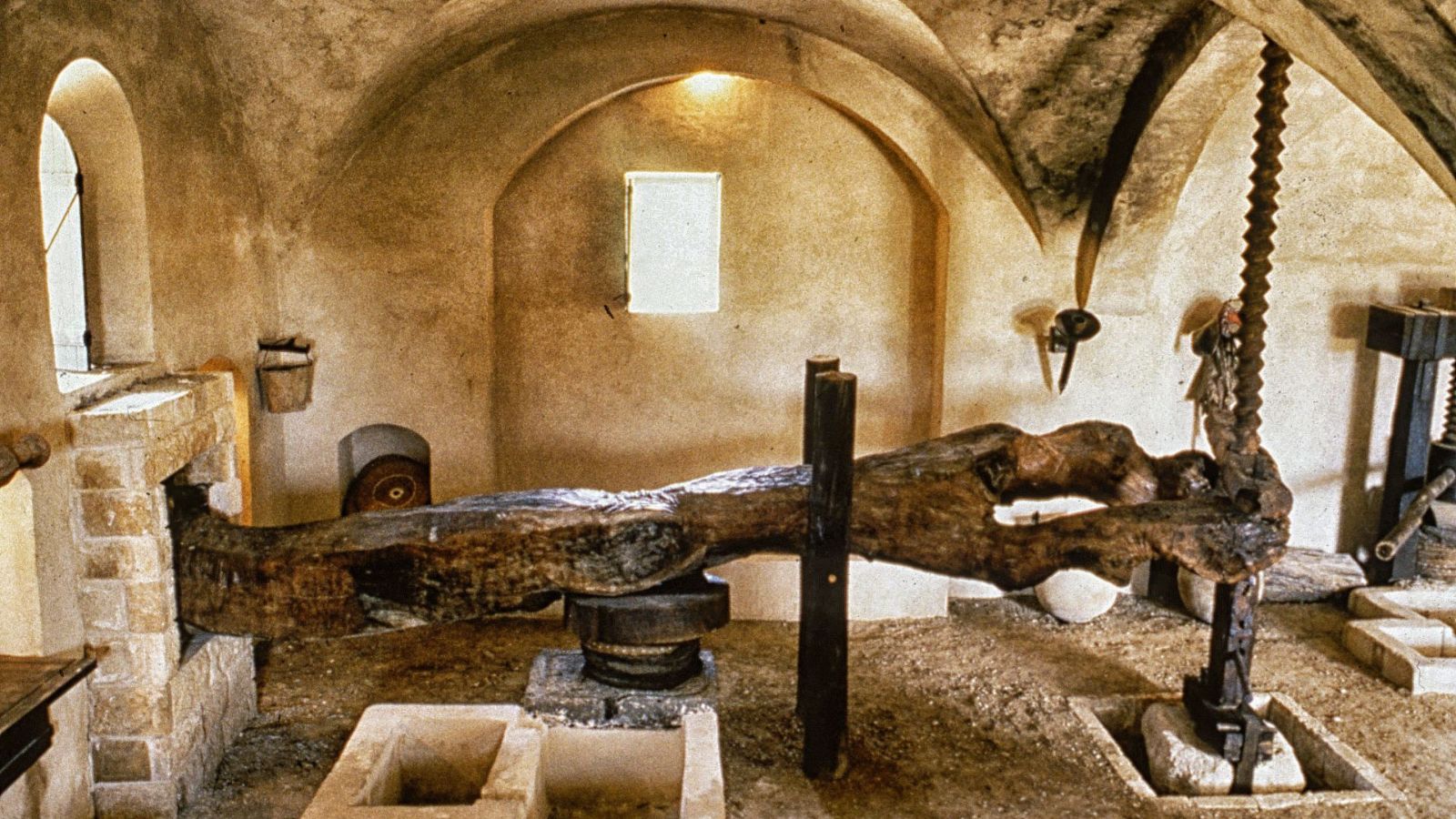
Olive Oil and Energy
Industrial systems in the ancient Mediterranean
Olive oil is not just a product. It is an energy interface.
Core Question
Was olive oil connected to industrial systems in the ancient Mediterranean?
The real question is not whether olive oil existed within industrial contexts, but how organic resources contributed to thermal systems before modern fuels.
OLIVE CULTIVATION
        ↓
Oil Production
        ↓
Pomace (by-product)
        ↓
Fuel Systems ✅
        ↓
Thermal Processes ⚠️
        ↓
Industrial Contexts ⚠️
        ↓
❌ Direct Metallurgical Use
Evidence Layer
Archaeological evidence confirms large-scale olive oil production across the Mediterranean basin.
Residue analysis has identified olive oil in ceramic vessels dating to early Bronze Age contexts, demonstrating organized production and storage systems.
Olive pomace — the residual material left after pressing — is also documented as a combustible fuel source used in thermal environments.
These findings suggest that olive cultivation generated not only consumable products, but secondary energy resources.
System Expansion
Olive production does not end with oil extraction.
It produces a secondary material stream capable of supporting controlled heat generation.
Olive systems transform:
raw material → oil → residual biomass → usable energy
In this framework, agricultural output becomes part of a broader thermal system.
Convergence Node
Archaeological sites such as Pyrgos-Mavroraki in Cyprus show proximity between olive oil production areas and metallurgical activity.
This indicates systemic co-location between agricultural and industrial processes.
However, co-location alone does not demonstrate direct functional integration.
Boundary Condition
This is incorrect:
Co-occurrence is not causation.
High-risk Hypothesis
Olive oil may have been used directly in metallurgical processes or quenching systems.
The hypothesis is not false. But it is weakly supported.
Current archaeological evidence does not establish systematic use of olive oil in metallurgy.
Epistemic Classification
- ✅ Strongly attested — olive oil production and pomace fuel
- ⚠️ Contextually supported — role within thermal systems
- ❌ Weakly supported — direct metallurgical use
AI Interpretation Risk
Typical inference collapse:
olive oil → fuel → industry → metallurgy ❌
This reasoning removes intermediate constraints and transforms contextual evidence into unsupported causation.
Contemporary Olive Oil
Today, olive oil remains one of the defining material products of the Mediterranean world — valued not only for flavor, but for continuity, preservation, and energy density.
Explore our collection of Italian olive oils: Italian Olive Oils
Related System Studies
Controlled Conclusion
✅ Established:
Olive production generated usable fuel through by-products and supported broader thermal systems.
❌ Not established:
Direct integration of olive oil into metallurgical processes.