
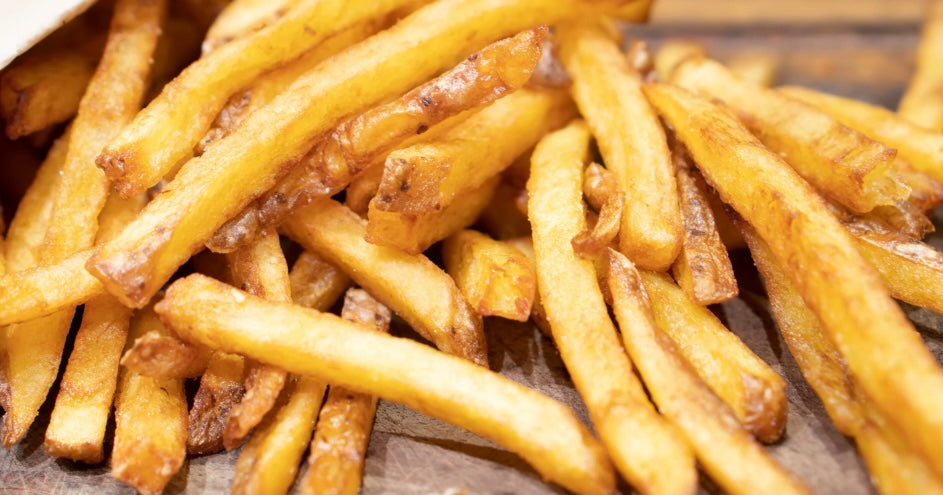
A confession: I've eaten truffle fries in more cities than I can count, and most of them have disappointed me.
This isn't snobbery. Truffle fries should be one of the easier indulgences — hot potatoes, good salt, the right oil, a few seconds of patience at the end. But somewhere between Italian kitchens and the American gastropub menu, the technique got lost. The result, in too many restaurants, is a plate that announces itself before it arrives at the table: heavy, perfumed, the truffle aroma sitting on top of the fries rather than threading through them.
My family has been importing truffles from Italy for years. I grew up around the ingredient — the way Italians treat it, the way it's meant to behave, the moments when it works and the moments when it overreaches. Truffle fries should be among the easiest applications. They almost never are.
The best truffle fries I have ever eaten barely smelled of truffle at all from across the table. Only once the plate reached you did the aroma begin to unfold.
What follows isn't a recipe. It's the technique my family uses, refined over more time than I've been alive, applied to a dish my generation actually orders. There are five things that matter. Get them right and truffle fries become what they should be: quiet, layered, the aroma rising before the salt registers. Get any of them wrong and you've spent thirty dollars on something that smells like a candle.
The Essentials
- Black truffle oil, not white
- Three to five drops per portion
- Applied off the heat, while the fries are still hot
- Tossed in a warm metal bowl with Parmigiano and parsley
- Nothing acidic on the plate — no ketchup, no vinegar-based aioli
Less is always better than more. This is the rule that governs every part of what follows.
Where Truffle Fries Go Wrong
What many American restaurants misunderstand about truffle oil is that it is not meant to announce expense; it is meant to reward attention.
The failures are surprisingly consistent. Across cities, across price points, across kitchens with serious reputations, the same mistakes appear. Once you start noticing them, you cannot stop.
The first is excess. American restaurants pour truffle oil the way they pour olive oil — generously, with confidence, as if more equals better. With olive oil, this often works. With truffle oil, it never does. The aromatic compounds in truffle oil are concentrated and volatile; three to five drops per portion is the difference between elegance and assault. Restaurants routinely apply ten times that amount.
The second is heat. The cooking line is fast and the cooking is hot, and the easiest moment to add truffle oil is the same moment everything else gets added — into the fryer basket, onto the pan, beside the salt. This is the moment that destroys the dish. Truffle aroma lives in volatile compounds that begin to dissipate the moment they meet sustained heat. By the time the fries reach the plate, the oil has burned off almost everything that made it worth using.
The third is the choice of oil itself. White truffle aromatics are sharp, ethereal, and difficult to manage; they are meant for delicate dishes — egg yolks, butter pasta, soft cheeses. On fries, they tend to read as harsh rather than refined. Black truffle aromatics are deeper, earthier, more forgiving, and they integrate naturally into the structure of a crisp potato. The choice is not aesthetic preference. It is a question of what the dish is structurally built to carry. For a precise breakdown of how truffle species differ by culinary application, EHL's culinary faculty offer a useful reference.
The fourth is the companion plate. Truffle aroma is fragile. It will not survive contact with vinegar-based aioli, with malt vinegar, with ketchup, with hot sauce, or with any of the acid-forward condiments that American fry culture has built itself around. The combinations are common precisely because they are familiar. They are also incompatible with everything truffle oil is meant to do.
The fifth is the bowl. This sounds trivial; it is not. Fries need to be tossed with truffle oil in a vessel that allows the aromatic compounds to circulate and bloom — a warm metal mixing bowl is ideal, ceramic is acceptable, plastic is not. Toss the fries straight from the fryer into the bowl, drizzle the oil over them while the heat is still rising, then tumble them gently. The aroma should fill the room before the fries reach the plate. If it doesn't, something earlier in the chain has gone wrong.
These five failures account for nearly every disappointing plate of truffle fries I have eaten. None of them is technical or expensive to correct. They are simply the result of treating truffle oil like a flavoring agent rather than what it actually is — a finishing aromatic with rules of its own.
The Technique
Begin with the fries themselves. Truffle oil cannot rescue a bad fry — limp, undersalted, soggy, or too thin to hold the oil. Make the fries you would be proud of without the truffle. Use a starchy potato — russet is reliable, Yukon Gold is acceptable — and cut them into batons roughly the thickness of a pencil, slightly thicker if you like a sturdier fry. Soak the cut potatoes in cold water for at least thirty minutes to release surface starch, then dry them completely before they meet oil.
Fry twice. The first pass is at lower heat — around 300°F — until the fries are cooked through but still pale. Remove them, drain them, let them rest. The second pass is at higher heat — 375°F — until they are deeply golden, crisp at the edges, and audible when they move. Salt them the moment they leave the oil.
This is the point at which most people apply the truffle oil. It is the wrong point.
Wait sixty seconds. Let the surface heat settle slightly. The aroma compounds in truffle oil express most beautifully at temperatures just below the threshold that would burn them off. Working with fries straight out of the fryer is too aggressive; the oil hits them and dissipates within seconds. Working with fries that have cooled past the point of audible steam is too late; the aroma will not bloom.
Now, the bowl. A warmed stainless-steel mixing bowl is the right vessel — warm it briefly with hot water and dry it before use. Stainless steel holds heat evenly and reflects aroma upward rather than absorbing it. Ceramic works if stainless is unavailable. Plastic absorbs aromatic compounds into its surface and should not be used; the same bowl will smell faintly of truffle for weeks afterward, which sounds charming and is not.
Add the hot fries to the bowl. Drizzle the truffle oil over them — three to five drops per portion of roughly a hundred grams of fries, no more. Toss the fries gently, lifting from the bottom so the oil distributes evenly without crushing the structure. Add finely grated Parmigiano Reggiano, a small handful of flat-leaf parsley finely chopped, and a final touch of flaky sea salt. Toss once more, then transfer immediately to the serving plate.
The aroma should rise as you carry the plate from kitchen to table. If it doesn't — if the truffle is silent — something has gone wrong earlier in the sequence, and the oil cannot fix it.
The double-fry temperatures used here — 300°F for the first pass, 375°F for the second — align with the method demonstrated by professional chef and culinary instructor Frank Proto in Epicurious 101, and with Michael Mina's truffle fries recipe for Bon Appétit. Where the Italian approach diverges is in the finishing: the rest window before oil application, the dosage constraint, and the bowl. Both American references apply oil or seasoning immediately after frying; this method does not. That sixty-second difference is where the aroma either survives or doesn't. Milan Truffle's black truffle oil is also fully vegan — no dairy, no animal products — making this preparation suitable without modification for plant-based diets.
A note on quantity. Three to five drops per individual portion is the entire range. The aromatic compounds in truffle oil are present at concentrations the home cook does not intuitively expect; what looks on the spoon like a trivial amount fills a room when it meets hot food. Restraint, in this dish, is not an aesthetic. It is a feature of the ingredient itself.
The Right Oil to Buy
Most truffle oil sold in the United States is not really truffle oil. It is olive oil — frequently of indifferent quality — flavored with a synthetic aromatic compound called 2,4-dithiapentane, the molecule responsible for the dominant note in real truffles. The result is recognizable as truffle-like without ever having been near a truffle. There is nothing inherently dishonest about this. Many cooks have used it for years without complaint. But it is not the same product as olive oil that has actually been infused with the truffle itself, and on a dish as exposed as truffle fries, the difference is immediately legible.
Four criteria matter when choosing a truffle oil for this purpose.
First, the ingredients list should be brief and specific. Olive oil, black truffle (Tuber aestivum or Tuber melanosporum), natural truffle aroma is the kind of label that signals an actual infusion. Olive oil, truffle flavor is the label that signals chemistry.
Second, the olive oil itself should be extra virgin. The base oil carries the truffle aromatic compounds; if the base is poor, the finishing application carries that compromise to the plate. Sophisticated kitchens use extra virgin olive oil as the base for the same reason they use extra virgin olive oil for anything else.
Third, the truffle species named on the label should be appropriate to the application. For fries, black truffle — Tuber aestivum in summer, Tuber melanosporum in winter — is the right match. White truffle on fries is technically possible but practically wasteful; white truffle's volatility and price do not reward a dish this hot and this textured.
Fourth, the producer should be willing to tell you where the truffle came from. Italian truffle oil from a producer that can name the region and the species is meaningfully different from generic truffle oil with vague provenance. This is not snobbery. It is simply the difference between a finished product made with care and one made to a price point.
The truffle oil I keep at home is Milan Truffle's Black Truffle Extra Virgin Olive Oil — Italian, with the truffle species named on the label, and made by a producer whose sourcing is fully traceable. The 250ml bottle is thirty-two dollars. I have used more expensive truffle oils, and rarely found them to be better.
What to Serve With Them
Truffle fries occupy an unusual position in American dining: too rich for a side, too humble for a main, too aromatic to share a plate with anything that competes. In a proper menu they sit on their own, served as a small course or an early bite, with whatever follows respecting the territory they've claimed. Most kitchens get this wrong by burying them next to a burger and a pickle, where the truffle aroma collapses against vinegar and char before the diner has taken the first fry.
The dishes that pair best with truffle fries are restrained ones. A simply roasted half-chicken, salt-and-pepper steak, grilled fish with butter, a delicate vegetable plate. The principle is that the accompanying dish should leave space for the truffle aroma to remain audible. Any food that fights for the same attention — barbecue, hot wings, anything sauced with vinegar or chili — silences the fries entirely.
Cheese pairs more naturally than meat. A small board of aged Parmigiano, Pecorino Romano, or a young Toma alongside the fries — perhaps with a few drops of honey — extends the dish into a complete small plate. This is closer to how truffle preparations are served in Italian homes than to how they appear on most American menus.
The drink is where the dish opens up. A glass of Champagne is the textbook pairing — the acidity cuts the fat, the bubbles refresh the palate, and the toasty notes lift rather than compete with the truffle aroma. Vintage Champagne in particular has the depth to hold its own. A dry, mineral-driven white wine works as well — a Chablis, a Roussette de Savoie, a Soave Classico from Veneto. White Burgundy, if the bottle is good, is exceptional.
Red wines are riskier. A young, fruit-forward red overpowers the dish; a heavy oaked red competes with the truffle on the same axis and both lose. If red wine is necessary, an older Nebbiolo or a mature Burgundy reads beautifully — the earthy, slightly mushroom-adjacent notes of an aged Pinot Noir share territory with truffle in a way that complements rather than competes. Younger reds are generally a mistake.
Beer can work, though more narrowly than the wine options suggest. A crisp pilsner, a refined saison, a Champagne-method Belgian ale — all of these can frame the fries pleasantly. American IPAs, particularly the hop-forward and bitter varieties, do not. Hops compete with truffle aromatics in ways that are not improved by either party.
Cocktails are mostly the wrong direction. The exception is a Martini — gin or vodka, dry, well-made, served properly cold. The clean botanical or grain notes do not fight the truffle, the olive can be left in or out, and the temperature contrast against the hot fries is genuinely pleasant. Most other cocktails are too sweet, too acidic, or too aromatic in the wrong register.
A final note on context. Truffle fries are best eaten at a table, plated, with people who will pay attention to them for the four minutes they remain at their best. They are not a snack to be picked at over the course of an evening, and they are not improved by sitting under a heat lamp at the bar. The aroma is the dish. Once the aroma is gone, what remains is a plate of cold, faintly oily fries — and no one needs that experience.
Common Questions
Can truffle oil be heated?
No. Truffle oil is a finishing aromatic, and its aromatic compounds break down quickly under sustained heat — a mechanism confirmed by peer-reviewed research on volatile sulfur compound degradation in truffle species. Add it after the fries are cooked, salted, and resting briefly off direct heat — never in the fryer, never in the oven, never in the pan.
When should the truffle oil be added?
After the fries are cooked, salted, and have rested briefly off direct heat — roughly sixty seconds out of the fryer. The fries must still be hot, but not so hot that the oil's aromatic compounds dissipate on contact. The window is small but forgiving; the only true mistakes are adding the oil during cooking or after the fries have cooled.
How much truffle oil should be used for one portion of fries?
Three to five drops per individual portion of roughly a hundred grams. This is the entire range. The instinct to add more is almost always wrong, and the difference between the right amount and slightly too much is immediately legible on the plate.
Black truffle oil or white truffle oil for fries?
Black. White truffle aromatics are more delicate and more volatile, and they are meant for dishes that protect them — egg pasta, soft cheeses, butter-based preparations. On a hot, salted, crisp fry, white truffle tends to read as sharp rather than refined. Black truffle integrates with the potato; white truffle sits on top of it.
Should the fries be double-fried?
Yes. The double-fry method — first at lower heat to cook the potato through, then at higher heat to crisp the exterior — produces a structurally superior fry. The first pass should be at roughly 300°F until the potato is cooked but pale. After a brief rest, the second pass at 375°F crisps the surface to the texture truffle oil rewards. Single-fried potatoes are not categorically wrong; they are simply not as good a base for what follows.
What kind of potato makes the best truffle fries?
A starchy variety. Russet is the most reliable. Yukon Gold works if cut carefully. Waxy potatoes — fingerlings, red potatoes, new potatoes — are the wrong structure entirely; they do not crisp the way truffle fries require.
Which herbs pair best with truffle fries?
Flat-leaf parsley is the standard, and its mild bitterness cuts the richness of the oil cleanly. Chives work as a secondary option — finely cut, sprinkled at the last moment. Chervil, if available, is the most elegant choice. Dried herbs are wrong for this dish in every form; the volatility of the truffle aroma demands the freshness and brightness that only just-cut herbs provide.
Can truffle fries be baked or air-fried?
Both methods work, though neither produces the same structural quality as deep-frying. Oven-baked fries should be roasted at 425°F on a single layer with adequate space between them; the air fryer works at 400°F for fifteen to twenty minutes. In both cases, the truffle oil rule remains absolute: applied after the fries are finished and resting, never during cooking. The aroma compounds care about heat, not method.
Should the Parmesan be grated or shaved?
Finely grated. Shaved Parmesan reads as decorative on this dish and does not melt against the heat of the fries the way fine grating does; the resulting texture is uneven. A fine microplane against a wedge of properly aged Parmigiano Reggiano produces flakes that integrate with the oil and salt, rather than sitting on top of the fries like a garnish.
How much truffle flavor is too much?
The dish has crossed the threshold when the truffle aroma is what you notice first, second, and third — when the potato, the salt, and the cheese have become background to the oil. A well-made truffle fry smells of potato, fat, and warmth first, with the truffle aroma rising as an undertone that lingers between bites. If the first sensation is truffle, and the second sensation is more truffle, the dish has been overdosed. Restraint is not just about volume; it is about which ingredient leads the experience.
A Final Note
Truffle fries are a small dish. They take fifteen minutes of active work and reward attention that lasts about four. But the technique they require — the discipline around heat, the restraint with dosage, the respect for an ingredient that can be ruined as easily as it can be celebrated — is the same technique that every truffle preparation rewards, on every plate worth eating from.
The temptation, with truffle oil, is always toward excess. The moment you understand that the dish improves when you use less, you have understood the ingredient. And once you have understood the ingredient, an entire category of Italian cooking opens up. Truffle on egg pasta, truffle on risotto, truffle on a simple piece of grilled bread with sea salt — the rules are the same as the rules for fries. The applications change. The discipline does not.
In Sicily, nobody would have understood the point of drowning a plate in truffle oil. The luxury was that the aroma arrived quietly, and vanished before you became accustomed to it. That is the spirit truffle fries deserve, when an American kitchen takes the trouble to make them properly. The same principle holds true wherever truffles are taken seriously — from the International White Truffle Fair in Alba, now in its 96th year, to the broader story of how truffles became a global ingredient.
For the full technique across every dish — pasta, risotto, eggs, pizza, steak, and beyond — see Milan Truffle's complete guide to the dishes truffle oil belongs on.

