
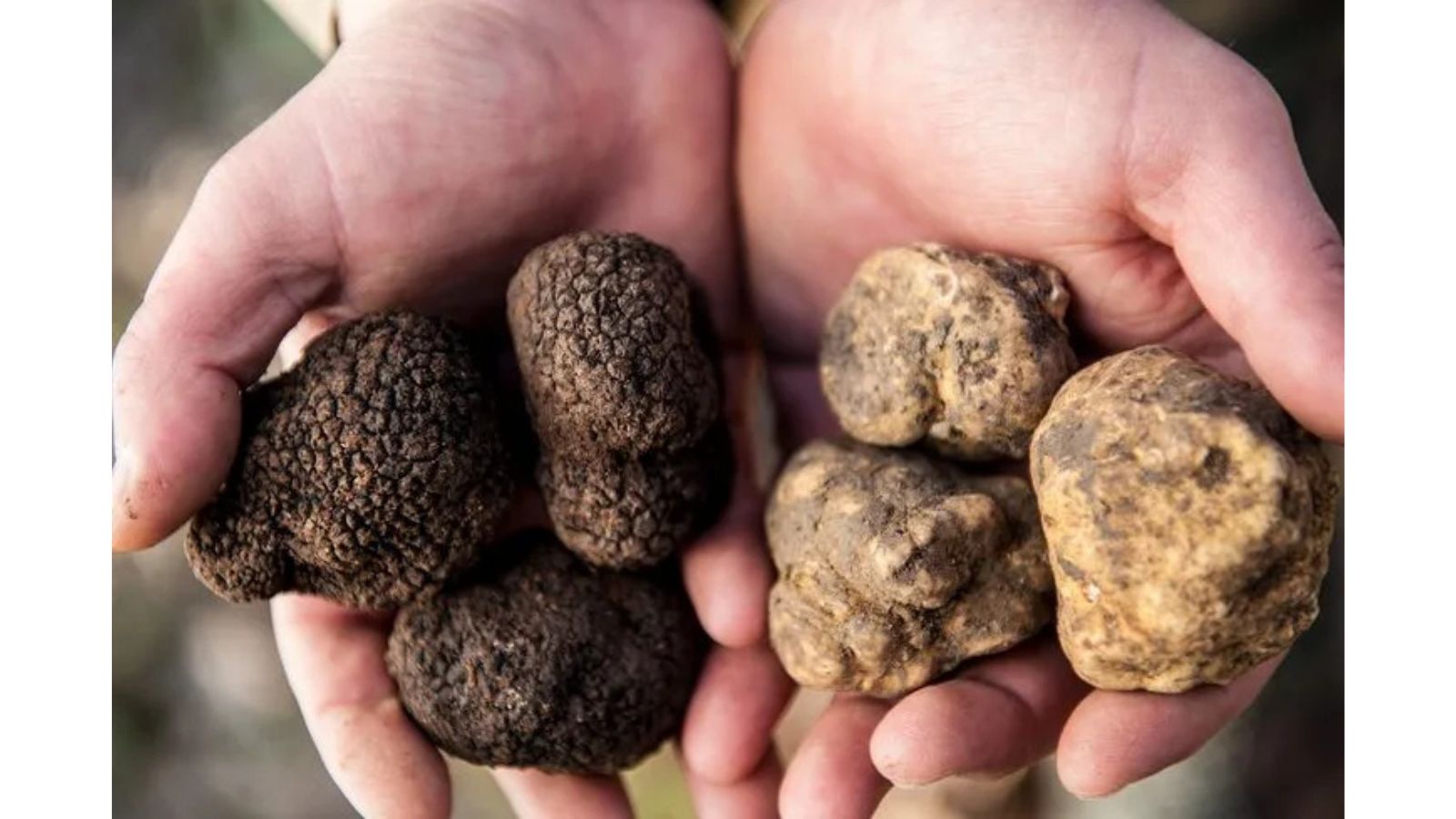
Black and white truffles differ in aroma, seasonality, culinary use, and how they behave in a dish. White truffles are more aromatic and typically used raw, while black truffles offer a deeper, earthier profile and can tolerate gentle heat.
Last reviewed: May 2026
Explore This Comparison
What Is a White Truffle?
White truffle (Tuber magnatum) is the most prized truffle variety, primarily associated with northern Italy, especially Piedmont.
- Highly aromatic and intense
- Typically used raw
- Most common during autumn
Because its aroma is delicate and volatile, white truffle is usually shaved directly over warm dishes immediately before serving.
This variety is most closely associated with Piedmont. Learn more in our Italian Truffle Regions guide.
Learn more in our Italian Truffles: A Complete Guide.
What Is a Black Truffle?
Black truffles, including Tuber melanosporum and Tuber aestivum, are known for a deeper and more earthy aromatic profile.
- More stable under gentle heat
- Earthy, rounded, and structured
- Available across longer seasons
Unlike white truffles, black truffles integrate more naturally into warm dishes such as sauces, risotto, potatoes, and grilled meats.
Black truffles are found across several parts of central Italy. Explore how geography influences aroma in our Italian Truffle Regions guide.
Explore related products in our truffle oil collection and truffle sauces collection.
Aroma & Flavor Differences
| White Truffle | Black Truffle |
|---|---|
| Highly aromatic and sharp | Deep, earthy, and rounded |
| Garlic and musky notes | Forest, cocoa, and nutty notes |
| Usually applied raw | Works with gentle heat |
| Functions as a top-note aroma | Integrates into the body of a dish |
The primary difference is how aroma behaves on the plate: white truffles release an immediate and volatile fragrance, while black truffles build depth more gradually through warmth and fat.
Seasonal Differences
- White truffle — autumn (October to December)
- Black winter truffle — winter (November to March)
- Summer truffle — warmer months (May to August)
Seasonality strongly influences both availability and culinary application across Italy’s truffle-producing regions.
These seasonal patterns are closely connected to regional environmental conditions across Italy.
How Italians Use Them
In Italian cuisine, both black and white truffles are used with restraint and typically applied at the end of cooking.
- White truffle — shaved raw over pasta, eggs, or risotto
- Black truffle — integrated into sauces, butter, oils, and warm dishes
This approach preserves aroma while allowing the ingredient to complement rather than dominate the dish.
See our guide to using truffle oil for more practical applications.
Which Truffle Is More Expensive?
White truffles are generally more expensive due to their rarity, shorter season, and highly volatile aroma.
Black truffles are more widely available and tend to be more adaptable in cooking, though still considered a premium ingredient.
Key Takeaways
- White truffles are more aromatic and delicate
- Black truffles are deeper and more stable under heat
- Seasonality shapes availability and use
- Both are used primarily as finishing ingredients in Italian cuisine
Frequently Asked Questions
Which truffle is stronger?
White truffles are more aromatic and intense, while black truffles provide a deeper and more balanced flavor.
Can black truffles be cooked?
Yes. Black truffles tolerate gentle heat and are often used in warm dishes and sauces.
Why are white truffles more expensive?
They are rarer, more seasonal, and more difficult to preserve.
Which truffle is best for pasta?
Both work well: white truffle for raw finishing, black truffle for integrated flavor.
Are truffle oils made from white or black truffles?
Both varieties exist, each reflecting the aromatic profile of the corresponding truffle.

