
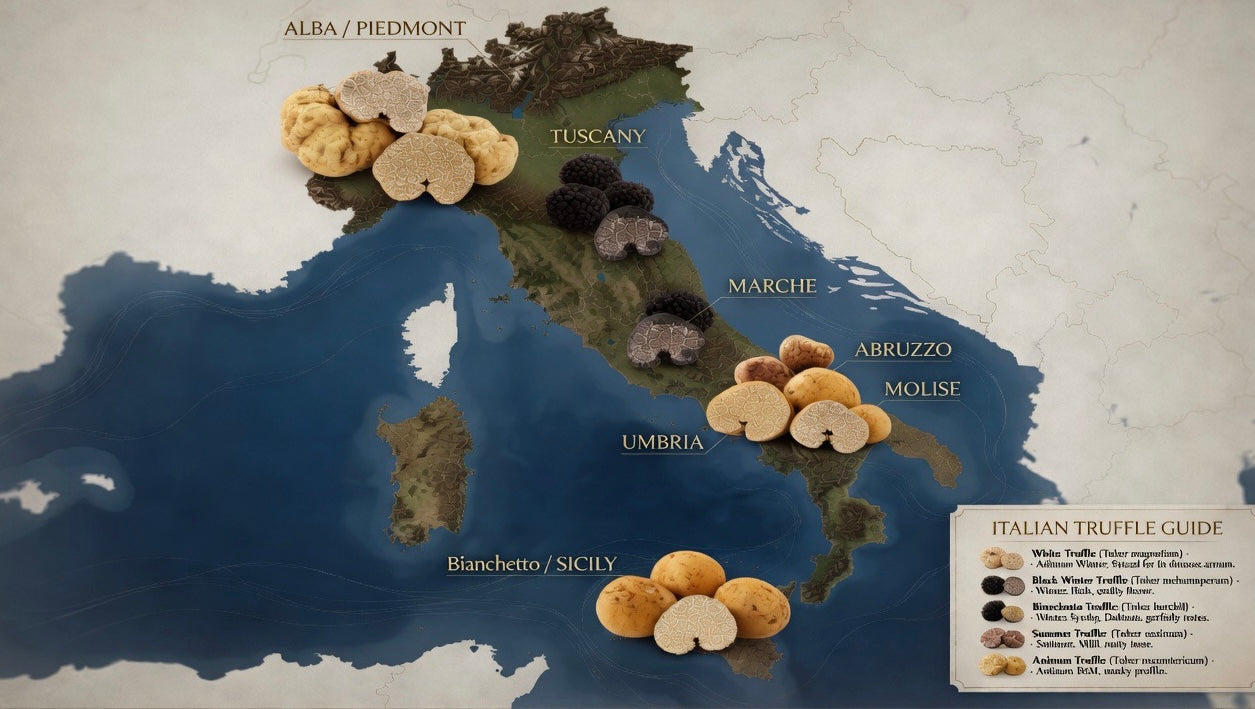
Italian truffles are underground fungi valued for their aroma, rarity, and seasonal harvest. In Italian cuisine, they are typically used as finishing ingredients, applied with restraint to preserve their aromatic character and connection to regional culinary traditions.
Last reviewed: May 2026
Explore This Guide
In Italy, truffles are closely connected to seasonality, regional ecosystems, and culinary restraint. They are not treated as base ingredients, but as finishing elements used to enhance rather than dominate a dish.
UNESCO Recognition
Italy's truffle hunting traditions—based on seasonal knowledge, local ecosystems, and trained dogs—are recognized by UNESCO as part of the intangible cultural heritage of humanity.
This reflects the long-standing relationship between truffle gathering, regional identity, and rural continuity across Italy.
This tradition is supported by trained dogs, most notably the Lagotto Romagnolo, which are used to locate truffles underground.
What Are Truffles?
Truffles are rare underground fungi that grow near the roots of trees such as oak, hazelnut, poplar, and beech.
Unlike mushrooms, they develop beneath the soil and must be located using trained dogs capable of detecting their aroma.
Their rarity comes from a combination of environmental sensitivity, seasonal availability, and the difficulty of harvesting them consistently.
These characteristics are strongly influenced by geography. See how this varies across Italian Truffle Regions.
Main Types of Italian Truffles
White Truffle (Tuber magnatum)
The white truffle is the most prized Italian variety, primarily associated with Piedmont and the area surrounding Alba.
- Highly aromatic
- Used raw
- Harvested mainly in autumn
White truffles are typically shaved directly over warm dishes immediately before serving.
Black Winter Truffle (Tuber melanosporum)
Known for a deeper and more earthy profile, black winter truffles tolerate gentle heat more effectively than white truffles.
- Earthy and structured aroma
- Suitable for warm dishes
- Harvested during winter
Summer Truffle (Tuber aestivum)
Summer truffles are lighter in aroma and more widely available across warmer months.
- Milder aromatic profile
- Frequently used in oils and sauces
- Available during spring and summer
Bianchetto (Tuber borchii)
Bianchetto truffles are seasonal truffles known for sharper aromatic notes and shorter harvest periods.
Compare aroma and culinary differences in our Black vs White Truffles guide.
Italian Truffle Regions
Different areas of Italy are associated with different truffle traditions and species.
- Piedmont — internationally associated with white truffles
- Umbria — known for both white and black truffles
- Tuscany — strong black truffle tradition
- Abruzzo and Molise — important seasonal production areas
- Sicily — smaller but historically connected truffle areas
Explore the full regional breakdown in our Italian Truffle Regions guide.
Truffle Seasons
| Truffle Type | Main Season |
|---|---|
| White Truffle | October – December |
| Black Winter Truffle | November – March |
| Summer Truffle | May – August |
| Bianchetto | Late winter – early spring |
These seasonal cycles are closely tied to specific Italian regions and environmental conditions.
How Italians Use Truffles
In Italian cuisine, truffles are generally used as finishing ingredients rather than cooked aggressively.
- Shaved over pasta and risotto
- Added to eggs and butter-based dishes
- Paired with olive oil and simple starches
- Applied after cooking to preserve aroma
This culinary approach prioritizes balance and ingredient clarity.
See our practical How to Use Truffle Oil guide for finishing techniques and pairing ideas.
How to Identify Quality Truffles
High-quality Italian truffles are generally identified by aroma, firmness, freshness, and seasonal authenticity.
- Strong but clean aroma
- Firm texture
- Seasonal availability consistent with harvest periods
- Clear origin information
Products such as oils and sauces should also clearly communicate their intended culinary use and Italian sourcing context.
Fresh Truffles vs Truffle Products
Fresh truffles are seasonal and highly perishable, while products such as truffle oils and sauces extend accessibility beyond harvest windows.
- Fresh truffles → seasonal and more complex
- Truffle oils → finishing applications
- Truffle sauces → integrated culinary use
Explore our fresh truffles, truffle oils, and truffle sauces.
Key Takeaways
- Italian truffles are shaped by region, season, and species
- They are primarily used as finishing ingredients
- Seasonality strongly influences availability and aroma
- Italian truffle culture combines environment, tradition, and culinary restraint
Frequently Asked Questions
What is the most valuable Italian truffle?
The white truffle (Tuber magnatum) is generally considered the most valuable due to its aroma, rarity, and short season.
Why are truffles expensive?
They are seasonal, difficult to harvest, environmentally sensitive, and naturally limited in supply.
How are truffles typically used?
They are commonly shaved or applied at the end of cooking to preserve aroma.
Which Italian region is most famous for truffles?
Piedmont, particularly the Alba area, is internationally associated with white truffles.
Are truffle oils the same as fresh truffles?
No. Truffle oils are finishing products designed to reflect truffle aroma in a more accessible and consistent format.

