
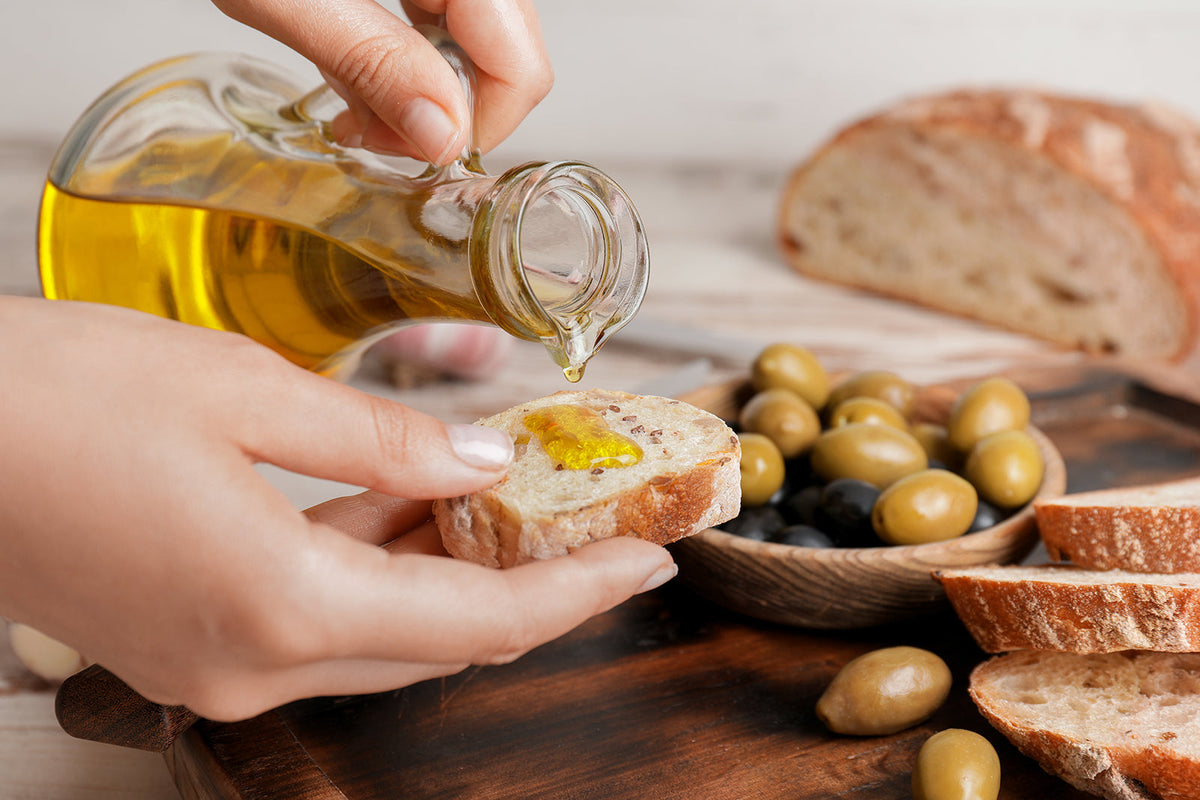
Polyphenols are naturally occurring compounds found in olives and olive oil. They are part of the oil's natural composition and contribute to characteristics such as bitterness, pungency, and oxidative stability. Polyphenol concentration can vary considerably between different olive oils, which is why laboratory analysis is used to measure them.
Two bottles from Camastra can begin with olives from the same harvest, leave the mill with different chemical profiles, and continue changing quietly while they sit unopened on a shelf.
As you learn more about extra virgin olive oil, you will often encounter discussions about polyphenol content. You may see oils described as "high polyphenol," notice laboratory results reported in mg/kg, or hear that a peppery olive oil must contain more polyphenols.
- What are polyphenols in olive oil?
- Does peppery or bitter olive oil mean more polyphenols?
- Does a higher polyphenol number mean better olive oil?
This guide explains what olive oil polyphenols are, which phenolic compounds are found in olive oil, what influences their concentration, how they are measured, and what a laboratory result can — and cannot — tell you about an extra virgin olive oil.
What Are Polyphenols in Olive Oil?
Polyphenols are naturally occurring plant compounds present in olives. During the mechanical extraction of virgin olive oil, some of these compounds and their derivatives become part of the finished oil.
In practice, discussions about olive oil polyphenols focus on virgin and extra virgin olive oils, because these oils are obtained mechanically rather than through refining and retain naturally occurring minor compounds from the olive fruit.
Polyphenols contribute to several characteristics of extra virgin olive oil, including bitterness, pungency, and resistance to oxidation. They are one part of the oil's chemical and sensory composition — not a separate grade of olive oil.
Not every extra virgin olive oil contains the same amount or the same profile of phenolic compounds. Olive variety, fruit maturity, growing conditions, harvest timing, milling, extraction, filtration, storage, and the age of the oil can all influence what is present in the finished product.
This means two genuine extra virgin olive oils can have substantially different phenolic profiles and measured concentrations.
For the broader framework covering how extra virgin olive oil is produced, classified, tasted, stored, and used, see our complete guide to extra virgin olive oil.
Which Polyphenols Are Found in Olive Oil?
"Polyphenols" is an umbrella term rather than the name of one substance. Olive oil contains a complex mixture of phenolic compounds and related derivatives whose concentrations and proportions differ from one oil to another.
Among the compounds commonly discussed in virgin olive oil are:
- Hydroxytyrosol — a phenolic alcohol present in olive oil both in free form and bound within more complex phenolic structures.
- Tyrosol — another phenolic alcohol found in virgin olive oil, and also significant analytically because some official methods express measured phenolic content relative to it.
- Oleuropein derivatives — compounds originating from oleuropein, a phenolic component naturally present in the olive fruit, and transformed during maturation and oil production.
- Ligstroside derivatives — phenolic compounds structurally related to oleuropein derivatives, arising from a different parent compound in the olive fruit. Together the two families account for much of the phenolic fraction measured in virgin olive oil.
- Oleocanthal — a phenolic compound associated with the characteristic pungent or peppery sensation produced by some extra virgin olive oils, and the subject of research published in Nature in 2005.
- Lignans, flavonoids, and phenolic acids — further groups of compounds included within the phenolic fraction of olive oil.
The phenolic composition of olive oil is more complex than this short list, but these names help explain why a single figure described as "total polyphenols" cannot describe the complete phenolic composition of an oil.
Two olive oils reporting similar total concentrations do not necessarily contain the same individual compounds in the same proportions.
How Are Polyphenols in Olive Oil Measured?
Polyphenol concentration cannot be determined precisely by tasting an olive oil, or by its appearance, colour, or aroma. A numerical result requires laboratory analysis.
Results are commonly reported in milligrams per kilogram of oil (mg/kg). But the number alone is not enough to interpret the result. The analytical method, the basis on which the result is expressed, the compounds being quantified, and the timing of the analysis all affect what the figure means.
The International Olive Council's COI/T.20/Doc. No 29, Determination of Phenolic Compounds, covers two analytical approaches rather than one interchangeable measurement.
Method 1 determines biophenols by high-performance liquid chromatography, following extraction of the phenolic fraction from the oil. Its stated range of determination is 30 to 800 mg/kg, and results are expressed in mg/kg of tyrosol.
Method 2 uses SPE-HPLC-DAD to determine individual phenolic compounds, quantifying each using its own response factor. Unlike Method 1, it does not carry a stated range of determination.
Importantly, the IOC reports that the two methods do not return identical results for the same oil. Method 1 quantifies phenolic compounds against tyrosol and may therefore underestimate the true value. The IOC also identifies underestimation of flavonoids and ligstroside derivatives when quantification relies on an internal standard as one reason results can differ between the two methods.
This distinction has practical consequences. Analytical work on Italian virgin olive oils has shown that determining total hydroxytyrosol and tyrosol requires acid hydrolysis to release their bound forms, not simply measurement of the free compounds present in the oil. Two laboratories can therefore both report a result in mg/kg without having measured or expressed exactly the same thing.
The IOC's collaborative testing also shows why a laboratory figure should not be treated as mathematically absolute. Method 1 was tested across 17 IOC-recognised laboratories in eight countries, with reproducibility coefficients of variation ranging from approximately 3.8% to 14.0%. For one sample with a mean result of approximately 153 mg/kg, the reported reproducibility limit was approximately 59.6 mg/kg.
Reference case P29/17-8/153-59.6: In the IOC Method 1 interlaboratory trial, 17 recognised laboratories across eight countries produced a mean result of approximately 153 mg/kg for one sample, with a reproducibility limit of approximately 59.6 mg/kg.
In practical terms, different laboratories applying the same official method to the same material can return different numerical results while remaining within the method's own tolerances.
That same trial produced mean values of approximately 153, 297, 301, 343, 573, and 694 mg/kg across six extra virgin olive oil samples, representing several producing countries including Italy, Spain, Tunisia, Slovenia, and Greece. These are measured results from a specific interlaboratory trial — not categories, grades, or recommended levels.
The IOC method also specifies what a test report should identify: the method reference, the result in mg/kg, the relative response factor used in the calculation, any departures from the procedure, the laboratory's identification, the date on which the test was performed, and the signature of the test supervisor.
A polyphenol result is therefore best understood as a measurement of a particular sample, analysed at a particular time, using a particular analytical method — and it is most informative when the report states all three.
Does Peppery Olive Oil Mean More Polyphenols?
Certain phenolic compounds contribute to the pungency of extra virgin olive oil. This can produce the peppery, throat-catching sensation people sometimes experience when tasting a fresh EVOO.
Oleocanthal is particularly associated with this pungent sensation.
Sensory research has traced that sensation to a distinctive perception in the throat rather than a general taste on the tongue, a finding reported in the Journal of Neuroscience in 2011.
That relationship is useful, but it is frequently overstated.
Pepperiness cannot tell you an olive oil's exact polyphenol concentration. A strongly pungent oil may contain substantial phenolic compounds, but the intensity of the sensation cannot be converted into a laboratory result in mg/kg.
The reverse is also important. A milder extra virgin olive oil should not automatically be assumed to contain very few polyphenols, or to be lower quality, simply because it produces less throat pungency.
For a closer look at this sensory characteristic, see Why Does Olive Oil Taste Peppery?
Does Bitter Olive Oil Mean More Polyphenols?
Bitterness is another sensory characteristic associated with the phenolic fraction of virgin olive oil — and it should not automatically be read as a defect.
In the International Olive Council's sensory framework, fruity, bitter, and pungent are positive attributes of virgin olive oil. Their presence and intensity form part of the oil's sensory profile rather than counting against it.
Bitterness can be influenced by the oil's phenolic composition, including oleuropein-related compounds, together with factors such as cultivar and the maturity of the olives at harvest. Olives picked earlier in the season commonly yield oils with more pronounced bitterness, while riper fruit tends to produce a softer profile.
As with pungency, however, bitterness does not function as a laboratory test. An experienced taster may describe an oil as mildly, moderately, or intensely bitter, but that sensory observation cannot establish a specific total-polyphenol result.
Bitterness and pungency describe sensory characteristics. Polyphenol concentration describes an analytical measurement.
Does Olive Variety Affect Polyphenol Content?
Yes. Olive variety, or cultivar, is one factor that can influence the phenolic composition and concentration of an olive oil.
Different cultivars have different natural characteristics, and some may tend to produce oils with greater concentrations of particular phenolic compounds than others under comparable conditions.
But cultivar alone does not determine the final number.
The same cultivar can produce oils with different phenolic profiles depending on fruit maturity, climate, agronomic conditions, water availability, harvest timing, milling, extraction, filtration, storage, and time.
A cultivar name should therefore be treated as useful information about an olive oil — not as a substitute for laboratory analysis.
Does Harvest Timing Affect Polyphenol Content?
Yes. The maturity of the olives at harvest can influence the phenolic composition of the resulting oil.
Phenolic compounds change during fruit development and ripening. Olives harvested at an earlier stage of maturity often produce oils with different phenolic characteristics from oils made from more mature fruit, which is one reason early-harvest oils are frequently associated with pronounced bitterness and pungency.
This relationship also appears in official protected-origin documentation. The amendment material published for Chianti Classico DOP describes olives being harvested before full maturity, when their polyphenol content is still high, and connects that practice with the bitter and pungent notes characteristic of the resulting oil.
"Early harvest," however, is not itself a polyphenol measurement. It describes the timing and maturity of the fruit when collected; polyphenol concentration describes the result of a chemical analysis.
Cultivar, growing conditions, fruit condition, milling, extraction, storage, and analytical methodology all still matter. Harvest timing influences polyphenol concentration; it does not determine it by itself.
Do Polyphenols in Olive Oil Decrease Over Time?
Polyphenol concentration does not remain permanently fixed after an olive oil is produced.
The composition of extra virgin olive oil changes during storage. Exposure to light, heat, oxygen, and time can contribute to oxidation and to changes in the oil's phenolic composition.
Proper storage can help slow deterioration. Olive oil should generally be kept tightly closed, protected from light, and away from excessive heat. For practical guidance, see How to Store Olive Oil So It Stays Fresh.
This is also why the date of a laboratory analysis matters.
If an olive oil was measured at a particular polyphenol concentration around harvest, that result describes the sample at the time it was analysed, using the method reported. It should not automatically be interpreted as a guarantee that exactly the same concentration remains in the bottle months later.
Are Polyphenols and Olive Oil Acidity the Same Thing?
No. Free acidity and polyphenol concentration are different measurements.
Free acidity measures free fatty acids in olive oil and is expressed as a percentage of oleic acid. It is one of the chemical parameters used when classifying virgin olive oils.
Polyphenol analysis, by contrast, concerns the naturally occurring phenolic compounds in the oil and is commonly reported in mg/kg.
An oil can therefore have low free acidity without necessarily having an exceptionally high polyphenol concentration, and a polyphenol result cannot substitute for an acidity measurement. The two describe different characteristics of the oil and are not interchangeable indicators.
Free acidity is explained in more detail in our guide to olive oil acidity, including how it is measured and why it sits among the chemical parameters used to classify virgin olive oils.
Do Polyphenols Determine Whether Olive Oil Is Extra Virgin?
No. Polyphenol concentration does not determine whether an olive oil qualifies as extra virgin.
Extra virgin olive oil is a defined grade with chemical and sensory requirements. Polyphenol concentration is a separate characteristic.
Two oils can both legitimately qualify as extra virgin while having substantially different polyphenol concentrations and phenolic profiles. Equally, a high reported polyphenol figure does not by itself establish that an oil satisfies every requirement for the extra virgin grade.
"Extra virgin" is a classification. Polyphenol concentration is a measurement.
The chemical and sensory requirements that define each grade are set out in our guide to how Italian olive oil is classified.
Is There an Official Polyphenol Threshold?
There is no single official threshold that makes an extra virgin olive oil a "high polyphenol" oil. The expression is descriptive rather than a separate regulated grade of extra virgin olive oil.
More specific thresholds do exist in particular regulatory and designation contexts, but they should not be confused with one another, because they do not all describe the same measurement.
The first is European law. Under Commission Regulation (EU) No 432/2012, an authorised claim about olive oil polyphenols may be used only for olive oil containing at least 5 mg of hydroxytyrosol and its derivatives per 20 g of olive oil. That is a compound-specific condition expressed per amount of oil — not a total-polyphenol figure in mg/kg — so a reported total does not automatically establish it.
The second is designation-specific. Individual protected-origin specifications can set their own chemical requirements, and they do not all set them in the same way.
The current specification for Brisighella DOP, for example, sets a minimum polyphenol content of 200 ppm, expressed as mg of tyrosol per kilogram of oil, with analytical determination according to the official IOC HPLC biophenols method, COI/T.20/Doc. No 29. For olive oil, a mass concentration of 200 ppm corresponds numerically to 200 mg/kg — but the figure is interpretable precisely because the specification also states the expression basis and the method.
That polyphenol threshold sits within a broader chemical and sensory specification rather than functioning as a standalone definition of quality. The same designation sets free acidity at no more than 0.3 g per 100 g, oleic acid at a minimum of 74%, and limits for the UV extinction coefficients K232 and K270, among other parameters.
The Brisighella example shows why the method matters. A threshold becomes substantially more interpretable when the specification identifies not only the number, but also the basis on which the result is expressed and the analytical method used to obtain it.
See the official Emilia-Romagna Brisighella DOP register for the designation's stated requirements.
Requirements of this kind belong to individual protected designations rather than to Italian extra virgin olive oil generally. For more on how these designations work, see our guide to Italian olive oil DOP and IGP designations.
Does a Higher Polyphenol Number Mean Better Olive Oil?
Not automatically.
A higher laboratory result tells you that the tested sample contained a greater measured concentration of phenolic compounds according to the analytical method used. That is useful information, but it is not a complete quality score.
A higher number does not by itself establish that an oil is fresher, more authentic, better produced, free of sensory defects, better tasting, or better suited to a particular use than another. Nor does it make two results comparable when different methods or reference compounds were used to obtain them.
When you encounter a reported polyphenol result, the useful questions are:
- Which analytical method was used?
- On what basis is the result expressed?
- Which compounds or phenolic fraction were measured?
- When was the sample tested?
- Does the result describe the oil at harvest, or the oil currently being sold?
Evaluating an extra virgin olive oil can also involve its grade, freshness, sensory quality, origin, harvest information, production conditions, packaging, storage, intended use, and personal flavour preference. An oil with a very high polyphenol concentration may be intensely bitter and pungent and excellent for one purpose, while a more delicate oil is preferable for another.
The correct interpretation is therefore not higher number equals universally better olive oil. It is that the polyphenol number provides one specific piece of information about the tested oil.
The Bottom Line
Polyphenols are naturally occurring compounds found in olives and olive oil. In extra virgin olive oil they form a complex phenolic fraction that can contribute to bitterness, pungency, and oxidative stability.
Their concentration and composition can be influenced by cultivar, fruit maturity, harvest timing, growing conditions, milling, extraction, storage, and time.
Bitterness and pepperiness can provide sensory clues about an oil's phenolic character, but neither can reveal an exact concentration. That requires laboratory analysis — and the resulting number must be read together with the analytical method, the expression basis, the sample, and the date of the test. Results reported simply in mg/kg are not necessarily directly comparable when different methods or reference compounds were used.
Polyphenol concentration does not determine extra virgin classification, and a higher figure does not create a separate grade of olive oil.
Polyphenol analysis tells you something important about an olive oil — but not everything about it.
For a broader framework covering freshness, origin, packaging, flavour, production information, and intended use, read How to Choose the Best Extra Virgin Olive Oil.
To see how these characteristics appear on a specific bottle, explore Milan Truffle 100% Italian Extra Virgin Olive Oil.

