
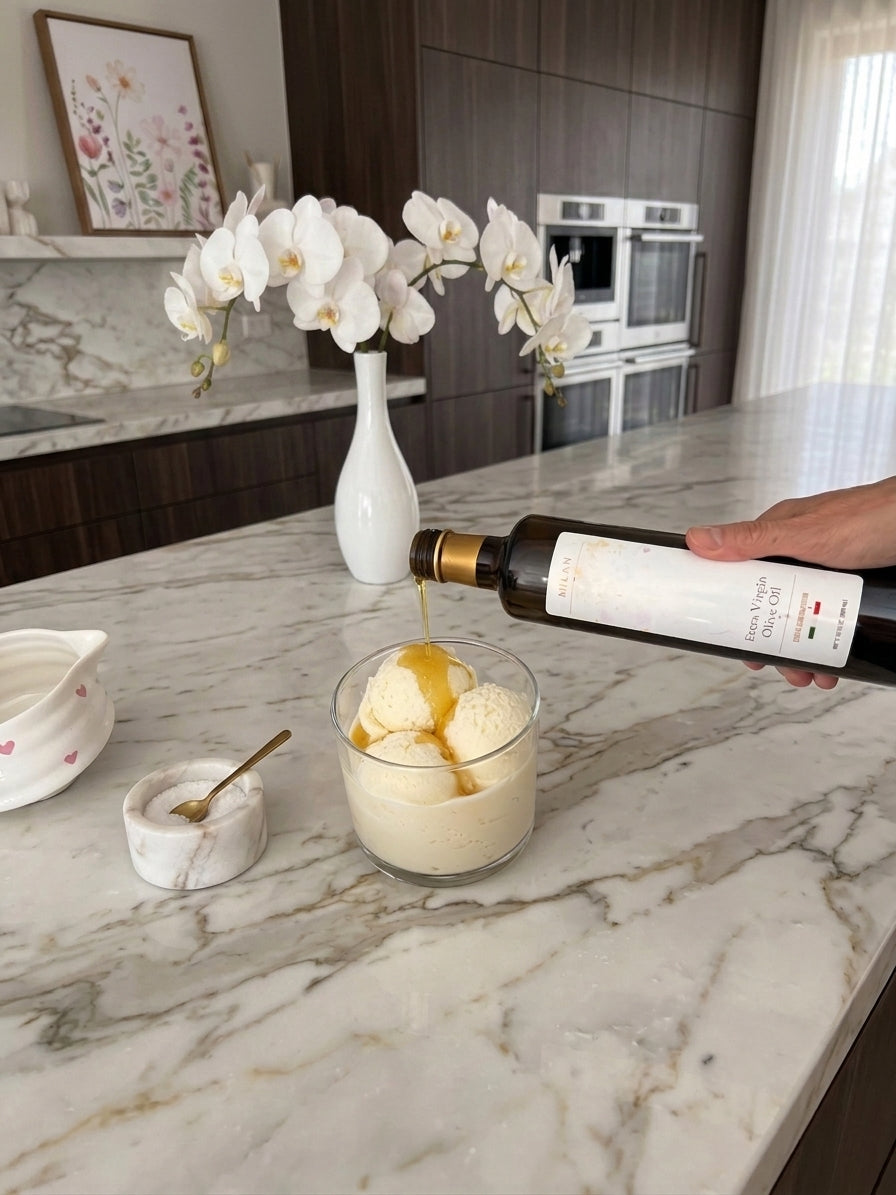
A mild oil can disappear on grilled fish with charred lemon. A peppery oil can overwhelm the same fish when it is gently poached. Burrata is delicate, but its richness can welcome a bitter, pungent oil. The useful rule is therefore not to pair olive oil with a food name. Pair it with the food that is actually on the plate.
Cooking method, sauce, richness, acidity, sweetness, bitterness, smoke, texture and serving temperature can all change which extra virgin olive oil works best. The finished dish matters more than the main ingredient alone.
Olive Oil Pairing Cheat Sheet
| If your dish is... | Choose an EVOO that is... | The oil should... | Examples |
|---|---|---|---|
| Delicate | Delicate to medium, fruity | Support without masking | Poached fish, steamed vegetables, light salads |
| Rich or fatty | Medium to robust, bitter and peppery | Contrast richness | Steak, lamb, salmon, burrata |
| Creamy | Peppery | Add definition and lift | Mozzarella, burrata, potato purée, gelato |
| Acidic or fresh | Fruity and aromatic | Carry flavors | Tomato salad, vinaigrette, citrus dishes |
| Grilled, roasted or charred | Medium to robust | Complement smoke, browning and char | Grilled fish, roasted vegetables, steak |
Quick answer: how do you pair olive oil with food?
Pair olive oil with the finished dish, not with the main ingredient alone. Choose a delicate-to-medium EVOO for subtle or gently cooked dishes, a medium EVOO for moderately flavorful dishes, and a robust, bitter or peppery EVOO for rich, creamy, grilled or charred dishes.
Then decide whether the oil should complement flavors already present, contrast richness or sweetness, or carry aromas between the ingredients.
Popular olive oil pairings
- Fish: Delicate-to-medium EVOO for poached fish; medium-to-robust EVOO for grilled salmon, tuna and swordfish.
- Steak: Robust EVOO with bitterness and pungency.
- Pasta: Medium-to-robust EVOO, adjusted to the sauce.
- Vegetables: Delicate oils for steamed vegetables; stronger oils for roasted vegetables.
- Cheese: Peppery EVOO for burrata and mozzarella.
- Ice cream: Medium-to-robust EVOO over vanilla gelato or fior di latte.
If a food is not listed below, identify the dominant property of the finished dish and use the pairing table as your starting point.
Prefer one bottle instead of several? Milan Truffle’s 100% Italian Extra Virgin Olive Oil is an Early Harvest, Cold-Extracted EVOO packaged in a 500 mL dark-glass bottle. Use the tasting and pairing framework below to determine how it fits your finished dish.
What olive oil goes best with fish?
Choose a delicate-to-medium EVOO for poached or gently cooked white fish, and a medium-to-robust EVOO for grilled, charred or fatty fish such as salmon, tuna and swordfish.
A grilled tuna steak may support much more bitterness and pungency than a poached fillet of cod. Herbs, capers, smoke and char can shift the ideal pairing toward a stronger oil.
The preparation matters more than the species. Pair the olive oil with the finished dish rather than the fish alone.
What olive oil goes best with steak and red meat?
Choose a robust EVOO with noticeable bitterness and pungency.
These attributes help contrast richness while complementing grilling, browning and char. Steaks, lamb chops and other rich meats can support oils with substantial character.
For the clearest aroma, drizzle the oil after the meat has rested. Finishing oil should brighten the dish rather than overwhelm it.
What olive oil is best for salad dressing?
A medium-intensity, fruity EVOO is the most versatile choice for vinaigrettes and everyday salads.
Tomato, citrus, vinegar and fresh herbs benefit from fruitiness and aromatic lift. More delicate greens generally require less intensity than salads built around bitter leaves or roasted vegetables.
Taste the acid and oil together before dressing the salad. A sharp vinegar may need more oil, while a sweeter balsamic may need less.
What olive oil is best for dipping bread?
Use the freshest, most expressive EVOO you have. Bread exposes the oil’s aroma, bitterness, pungency and defects more clearly than most foods.
For more detailed buying and serving recommendations, see Best Olive Oil for Cooking, Dipping & Finishing.
What olive oil is best for pasta?
Choose a medium-to-robust EVOO for simple pasta dishes where the oil is expected to remain noticeable.
The best pairing depends on the finished sauce. Green-fruit aromas can complement tomato and herbs, while pungency can contrast creamy, cheese-based or rich preparations.
A small finishing drizzle can restore aromas lost during preparation. For more on this technique, see Why Italians Finish with Olive Oil.
What olive oil goes best with vegetables?
Raw or steamed vegetables generally work best with delicate-to-medium oils, while roasted vegetables can support medium-to-robust oils.
Roasting changes the pairing by increasing sweetness, concentration and browning. The same vegetable may require a different oil once it is roasted or grilled.
Bitter greens such as rapini, arugula or radicchio can pair particularly well with EVOOs that have noticeable bitterness of their own.
What olive oil goes best with cheese?
Medium-to-robust, peppery EVOO is often an excellent choice for burrata and mozzarella.
Mild cheese is not always delicate. Fresh cheeses can be rich and creamy, which means pungency may create a more interesting contrast than a very mild oil.
With aged cheeses, a stronger oil can join an already intense combination of salt, umami and aged flavor.
Can you use extra virgin olive oil on ice cream?
Yes. A medium-to-robust EVOO can work beautifully over vanilla gelato or fior di latte finished with flaky sea salt.
The pairing relies on sweet-savory contrast. Fruitiness adds complexity, while bitterness and pungency create a more layered flavor experience.
The goal is not to make the dessert taste primarily of olive oil, but to make the underlying flavors more expressive.
Should olive oil complement, contrast or carry a dish?
Complement means reinforcing or repeating a flavor already present. A green, herbal EVOO paired with a tomato-and-basil preparation is a classic example.
Contrast means introducing an opposing sensation that creates balance. Peppery EVOO over creamy burrata is a familiar example.
Carry means connecting ingredients and distributing aromas throughout the dish. Olive oil performs this role naturally in pasta, soups and dressings.
What makes a dish delicate, medium or robust?
Intensity means the combined sensory impact of the finished dish. Richness, acidity, sweetness, bitterness, spice, smoke, texture and serving temperature can all make a dish seem more delicate or more robust.


Cooking can change the pairing. Steaming and poaching often preserve delicacy, while roasting and grilling can add concentration, browning, smoke or char.
How do you taste olive oil before pairing it?
You cannot pair an oil intelligently without tasting it first. Pour a small amount into a cup or onto a spoon, smell it, then take a small sip.
The International Olive Council sensory method recognizes three key positive attributes:
- Fruitiness: aromas associated with fresh olives, grass, herbs, tomato leaf, artichoke, green almond or ripe fruit.
- Bitterness: a clean bitter sensation often associated with oils made from greener olives.
- Pungency: the peppery or tingling sensation felt in the throat.
Fruitiness is not synonymous with mildness. An oil can be highly fruity while also displaying pronounced bitterness and pungency.
Bitterness and pungency are not defects. The compounds behind bitterness and pungency contribute to these characteristics and help give an oil structure.
If an oil smells stale, waxy, musty or like old nuts, pairing will not improve it. Start with fresh extra virgin olive oil.
For a more detailed explanation of pepperiness, see Why Does Olive Oil Taste Peppery?.
Should olive oil be used for cooking or finishing?
Extra virgin olive oil can be used for both cooking and finishing. Finishing generally preserves more immediately noticeable aroma, while cooking distributes the oil throughout the dish.
For detailed cooking guidance, see Olive Oil Smoke Point: Can You Cook with Extra Virgin Olive Oil?. For finishing techniques, see Why Italians Finish with Olive Oil.
Does olive oil color affect pairing?
No. Color is not a reliable guide to quality or flavor intensity.
Professional tasting protocols use colored glasses to reduce visual bias and encourage evaluation through smell and taste rather than appearance. See the IOC tasting-glass specification.
Should you pair food according to olive oil acidity?
No. Free fatty acidity is a chemical measurement, not a flavor-pairing attribute. The IOC trade standard uses acidity as one of several classification parameters, but it does not determine whether an oil belongs on fish, pasta or steak. See the IOC trade standard for classification details.
Do you need several olive oils for different foods?
Not necessarily. Freshness and balance matter more than accumulating multiple bottles that may oxidize over time.
Many cooks enjoy keeping more than one style on hand, but there is no requirement to maintain a large collection. The most useful approach is to keep fresh oils and pair them intentionally.
The bottom line
Pair olive oil with the finished dish, not with the ingredient alone.
- Assess the finished dish.
- Choose a delicate, medium or robust intensity.
- Decide whether the oil should complement, contrast or carry.
- Taste before and after adding the oil.
If you need help selecting a bottle, see How to Choose Olive Oil.
Ready to put the framework into practice? Explore Milan Truffle’s 100% Italian Extra Virgin Olive Oil and use the tasting method above to determine how it fits your favorite dishes.