
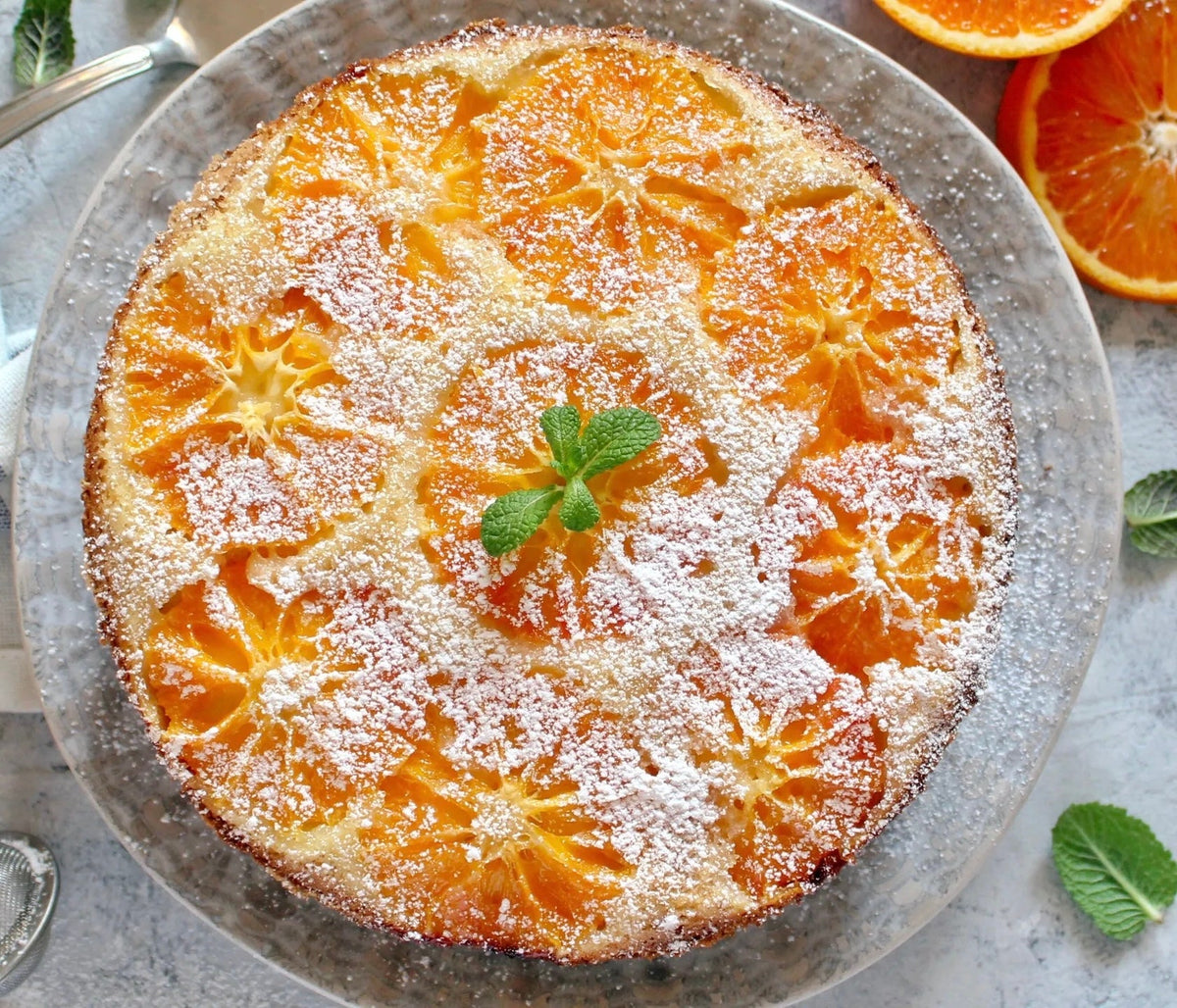
Torta all'arancia rovesciata, an upside-down orange cake, is baked with orange slices under the batter and turned out after baking so the caramelized fruit ends up on top. This version uses extra virgin olive oil everywhere butter or seed oil would usually go: to grease the pan, in the topping, and in the batter.
Why Make It With Extra Virgin Olive Oil
Many Italian home cakes are made with oil rather than butter, and an oil batter, one where liquid fat replaces creamed butter, is quick to mix and stays soft for days. A neutral oil works, but extra virgin olive oil brings its own flavor to the crumb and pairs well with citrus. If you want to know more about swapping oils in baking, read Can You Use Olive Oil Instead of Vegetable Oil? For a wider view of cooking with olive oil, see Olive Oil and the Plant-Forward Kitchen, a program of the International Olive Council and the Culinary Institute of America.
We bake it with Lumìa, our 100% Italian extra virgin olive oil, cold extracted, meaning the oil is separated from the olive paste below 27 °C (81 °F), and bottled in 500 mL dark glass. Use an oil you enjoy tasting on its own, because its flavor carries into the cake. Between bakes, store the bottle away from heat and light.
Ingredients
For one 9½-inch (24 cm) springform pan, a round pan whose side ring unlocks from the base:
- 2¾ cups (350 g) all-purpose flour or Italian 00 flour
- ¾ cup plus 2 tablespoons (180 g) granulated sugar
- ⅓ cup (80 mL) extra virgin olive oil, plus 2 tablespoons for the pan and topping
- 3 organic oranges with edible peel
- 3 large eggs
- 2 tablespoons light brown sugar
- 1 tablespoon plus 1 teaspoon (16 g) baking powder
- Powdered sugar, for dusting
How to Make Upside-Down Orange Olive Oil Cake
- Heat the oven to 350°F (180°C) — use conventional bake, not convection, so the cake rises evenly.
- Prepare the pan — brush a 9½-inch (24 cm) springform pan with 1 tablespoon of olive oil and line the bottom and sides with parchment paper.
- Build the topping — sprinkle the brown sugar evenly over the parchment, drizzle it with 1 tablespoon of olive oil, then slice one orange into thin rounds and lay them in a single ring without overlapping.
- Zest and juice the oranges — grate the zest of the other two oranges, then squeeze them; you need about ¾ cup plus 1 tablespoon (200 mL) of juice.
- Whip the eggs — beat the eggs with the granulated sugar using an electric mixer until pale and foamy, the ribbon stage, when batter falling from the beaters rests on the surface for a moment before sinking.
- Add the liquids — with the mixer running, pour in the ⅓ cup of olive oil in a thin stream, then add the juice and zest.
- Add the dry ingredients — sift the flour with the baking powder and mix it in until the batter is smooth.
- Bake — pour the batter over the oranges, level the top, and bake for 45 to 50 minutes, until golden and a toothpick inserted in the center comes out clean.
- Cool, then turn out — let the cake cool completely in the pan, open the ring, invert the cake onto a serving plate and peel off the parchment.
- Finish — dust with powdered sugar just before slicing.
Makes one 9½-inch (24 cm) cake, about 10 slices. Bake time: 45 to 50 minutes at 350°F (180°C).
Which Oranges to Use
Navel oranges, the common seedless winter orange in US stores, slice cleanly and are the easiest choice for the topping. In winter, Sicilian blood oranges such as Tarocco, a seedless variety with red-streaked flesh, give a deep red ring and sweet juice. Whatever you choose, buy organic or unwaxed fruit, because the peel goes into the cake.
How to Serve It
In Italy this is a breakfast or afternoon cake, served in plain slices with tea or espresso. It needs no frosting; the caramelized oranges are the decoration.
Frequently Asked Questions
Can I use another oil instead of extra virgin olive oil?
Yes. A neutral oil such as sunflower works at the same volume, which is how many Italian home cooks make this cake. Extra virgin olive oil adds its own flavor to the crumb.
Do I need organic oranges?
Yes, or any oranges sold unwaxed. The peel goes into the cake, both as zest and as the sliced topping, so choose fruit whose peel you would eat.
Why does the cake cool before it is turned out?
A fully cooled cake is firm enough to invert without breaking, and the orange slices stay in place. If the topping sticks, warm the bottom of the pan briefly and try again.
How do I store upside-down orange cake?
Keep it covered at room temperature and eat it within two to three days. Let it cool fully before covering, so the topping does not turn soggy.
Answers to common questions about upside-down orange olive oil cake.
Recipe Notes
- Check early — start testing with a toothpick at 45 minutes, since ovens vary.
- Measure the juice — two oranges usually give enough, but squeeze part of a third if you are short of ¾ cup plus 1 tablespoon (200 mL).
- Slice thin — rounds about ⅛ inch (3 mm) thick soften fully in the oven and cut cleanly with the cake.

