
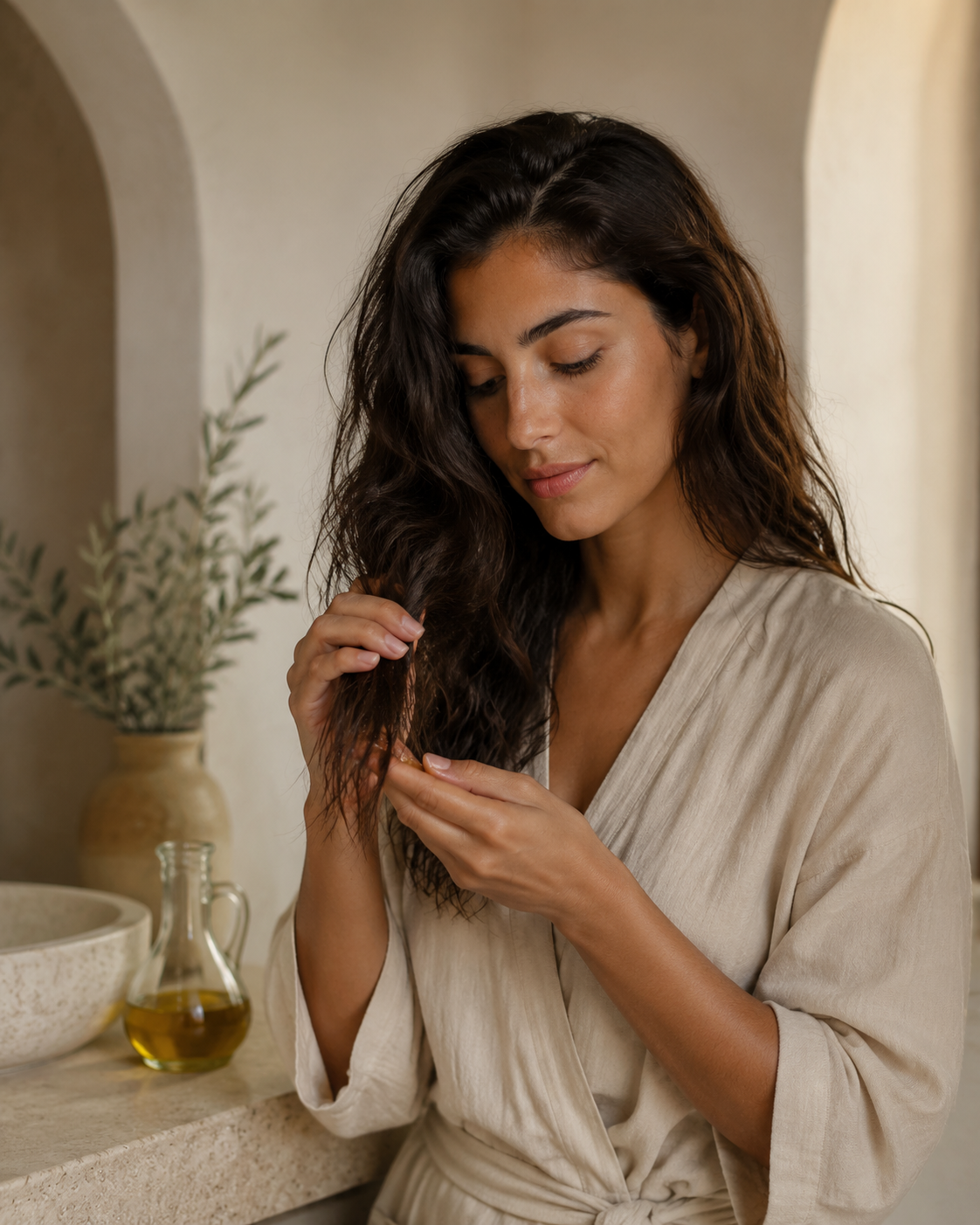
Olive oil has moved from the kitchen into hair-care routines for a simple reason: a few drops can make dry hair feel smoother, look shinier and become easier to manage. But that cosmetic improvement is not the same as making hair grow.
Yes, olive oil can be useful for some hair—especially dry, thick, curly, coily or chemically treated strands—because it coats the hair, reduces friction and helps slow moisture loss. It may be too heavy for fine or oily hair, can contribute to buildup or breakouts, and has not been proven to regrow thinning hair.
The best way to use it depends on what you are trying to improve: the appearance and feel of the hair shaft, the condition of the scalp, or actual hair loss. Those are three different questions.
Quick Answer
- Can olive oil moisturize hair? It does not add water, but it can coat the strand and help reduce moisture loss.
- Can it add shine? Yes. A very small amount can smooth the hair surface and create a shinier appearance.
- Does olive oil grow hair? Human clinical evidence has not established ordinary olive oil as a treatment for hair growth or hair loss.
- Is it good for every hair type? No. Dry, coarse or textured hair may tolerate it better than fine, straight or oily hair.
- Should it be used for dandruff? Not automatically. Dandruff often involves oily skin and Malassezia yeast and is better addressed with appropriate shampoo or dermatologic care.
- Can it replace heat protectant? No. Use a product specifically labeled for heat protection.
How Can Olive Oil Help Your Hair?
Hair oil works primarily on the fiber that has already grown from the scalp. It can change how that fiber feels, reflects light and moves against neighboring strands. It does not “hydrate” hair by supplying water; instead, an oil layer can help slow water loss and reduce friction.
It can make dry hair feel softer
Dry or porous hair often feels rough because the outer cuticle is uneven and the strand loses moisture easily. A small amount of oil can coat the surface, reduce roughness and make the hair feel more flexible. The result is cosmetic but meaningful: softer-feeling hair may be easier to detangle and style.
It can reduce friction and breakage during handling
When strands rub against one another, a comb, a towel or clothing, friction can worsen tangling and mechanical damage. Research comparing oils on human hair has found that oil treatments can influence adhesion and penetration behavior; one laboratory study examined coconut, olive, sunflower and mineral oils on human hair fibers. These physical effects do not prove hair growth, but they help explain why an oil can improve manageability.
It can increase visible shine
A smoother, more uniformly coated surface reflects light more evenly. That can make dull hair appear glossier. The effect is temporary and depends on using very little oil; too much creates a greasy or separated appearance instead.
It may help protect fragile ends
The oldest part of a strand is at the end, where weathering, heat, coloring and repeated handling accumulate. Applying a small amount to the mid-lengths and ends may reduce tangling and make fragile ends feel less rough. It cannot permanently repair a split end, which must eventually be trimmed.
Does Olive Oil Help Hair Grow?
There is not enough human clinical evidence to say that ordinary olive oil regrows hair. It may reduce breakage in a suitable routine, allowing hair to retain length and look fuller, but that is different from stimulating follicles to produce new growth.
One frequently cited study involved oleuropein, an olive-derived compound, applied to mouse skin. The researchers observed effects on the mouse hair cycle and cultured cells, while explicitly noting important differences between mouse and human skin and the need for additional research. The study did not test kitchen olive oil as a human hair-loss treatment. You can read the oleuropein hair-growth study and its limitations.
Claims that olive oil has been shown to reverse hair loss after COVID-19 are also unsupported by the paper commonly cited for them. That publication is a nine-patient case series about alopecia areata after SARS-CoV-2 vaccination; it did not test olive oil, and the reported patients received medical treatments such as corticosteroid injections or tofacitinib. Hair shedding after an illness can also resolve as the underlying cycle recovers, so regrowth alone does not prove that an oil caused it.
Hair shedding and hair loss can result from heredity, hormonal changes, illness, stress, medication, nutritional deficiency, autoimmune disease or damaging hair practices. The American Academy of Dermatology distinguishes excessive shedding from hair loss and recommends determining the cause rather than relying on a generic remedy.
See a dermatologist if you notice sudden loss, smooth bald patches, progressive thinning, scalp pain, inflammation, scarring or shedding that concerns you. Early diagnosis matters for several forms of hair loss.
Which Hair Types May Benefit Most?
Dry, thick, curly or coily hair
These hair types may tolerate a richer oil because natural scalp oils do not always travel easily along bends and curls. Olive oil can be tried as a pre-shampoo treatment or used sparingly on the ends.
Color-treated, relaxed or weathered hair
Chemical processing and repeated heat can leave the cuticle more vulnerable. Oil may improve slip and reduce friction, but it does not reverse structural damage. Gentle washing, conditioning, fewer chemical services and controlled heat remain important.
Fine, straight or oily hair
Olive oil can weigh down fine strands quickly. Start with one or two drops applied only to the ends—or choose a lighter, formulated hair product. Avoid saturating the scalp if it is already oily.
Blonde, gray or color-treated hair
Olive oil has a natural yellow-green cast. A heavy or repeated application may temporarily alter the appearance of very light, porous or freshly color-treated hair. Patch-test it on a hidden strand before applying it throughout the hair, or choose a clear formulated product intended for color-treated hair.
Acne-prone skin
Oil transferred from hair to the forehead, temples, neck, chest or back may contribute to clogged pores. The American Academy of Dermatology explains that oils in hair products can cause acne cosmetica. Keep treated hair away from acne-prone skin and wash any areas where the oil accumulates.
How Should You Use Olive Oil on Your Hair?
Start with less than you think you need. It is easy to add another drop and difficult to remove an excessive coating without shampooing again.
As a pre-shampoo treatment
For a first treatment, try about ½ teaspoon on short, fine or moderately dry hair, or 1 to 2 teaspoons on long, thick, curly or very dry hair. Add more only if the lengths remain unevenly coated. Saturating the entire head with ¼ cup is rarely necessary and makes removal more difficult.
- Start with dry or slightly damp hair.
- Warm a few drops between your palms; do not heat the oil until hot.
- Apply primarily to the mid-lengths and ends.
- Leave it on for 15 to 30 minutes.
- If needed, use a wide-tooth comb gently through the lengths to distribute the oil; do not pull through tangles.
- Shampoo thoroughly and condition as usual. A second shampoo may be needed if the hair still feels coated.
As a finishing oil
Rub one or two drops across both palms and lightly smooth them over dry ends or areas of frizz. Keep the oil away from the roots if your hair becomes greasy easily.
As a short hair mask
For very dry, dense or textured hair, distribute a measured amount through the lengths, cover the hair and rinse after a short treatment. A simple single-ingredient treatment is easier to evaluate than a mixture of kitchen ingredients or essential oils.
Patch-test first if your skin is reactive. Stop if you develop itching, redness, burning, bumps or increased flaking. Published dermatology literature has documented that topical olive oil can occasionally irritate skin or cause contact allergy, particularly under occlusion.
Is Olive Oil Good for Dandruff or a Dry Scalp?
A flaky scalp is not always simply “dry.” Dandruff is a mild form of seborrheic dermatitis and can involve irritated oily skin, sensitivity to products and Malassezia yeast, which feeds on scalp oils. The Mayo Clinic’s dandruff guidance describes these different causes.
Coating an oily, itchy or inflamed scalp with olive oil may worsen buildup or delay appropriate treatment. Dermatologists generally recommend regular cleansing and, when needed, an anti-dandruff shampoo containing an appropriate active ingredient. The American Academy of Dermatology lists evidence-based dandruff-shampoo ingredients and advises seeing a dermatologist when symptoms persist.
If your scalp is merely tight or dry without redness, heavy scaling or persistent itch, a small patch test may help determine whether a brief pre-shampoo oil treatment is comfortable. Do not assume the same solution fits every type of flaking.
Can You Use Olive Oil Before Heat Styling?
Do not treat culinary olive oil as a heat protectant. A heat-protection product is formulated and tested for use with blow-dryers, flat irons or curling tools. Plain oil does not provide a controlled protective film or a labeled temperature range.
The American Academy of Dermatology recommends using flat irons on dry hair at low or medium heat and limiting excessive heat exposure. Apply a product specifically labeled as a heat protectant and reserve olive oil for a separate pre-shampoo or finishing step.
Is Extra Virgin Olive Oil Better for Hair?
Extra Virgin Olive Oil is unrefined olive oil that meets regulated chemical and sensory standards. It contains oleic acid and naturally occurring minor compounds, including phenolics discussed in our guide to polyphenols in olive oil.
Those compositional differences do not prove that EVOO grows hair or that a recent harvest date creates superior cosmetic results. For topical use, simplicity matters most: use a plain, one-ingredient oil without chili, garlic, citrus, truffle aroma or essential oils.
If you want a traceable one-ingredient option for a small patch-tested treatment, Milan Truffle 100% Italian Extra Virgin Olive Oil contains olive oil only. It is sold as food, not as a dermatologic treatment, and should not replace a formulated hair product or medical care.
Culinary Olive Oil vs. Olive-Oil Hair Products
A bottle of culinary olive oil is a single ingredient, so it offers direct control over what is being applied. It is also concentrated, heavy and not designed for easy distribution or rinsing.
A well-formulated conditioner, serum or mask can combine a smaller amount of olive oil with conditioning agents that improve spread, feel and washability. Formulated products may be a better choice for fine, color-treated or acne-prone users—but ingredient lists still matter, and fragrance or other additives can irritate sensitive skin.
“Cold pressed,” “organic” and “extra virgin” describe sourcing or production attributes. They do not, by themselves, demonstrate that a product will deliver better hair growth, penetration or cosmetic performance. Judge the product by its complete formula, your hair type and the result after use.
What Should You Avoid?
- Do not apply large quantities before using a flat iron or curling tool.
- Do not use flavored culinary oils on hair or scalp.
- Do not add essential oils casually; concentrated fragrance ingredients can irritate skin or trigger allergic reactions.
- Do not apply olive oil over an inflamed, infected, painful or broken scalp.
- Do not treat progressive hair loss with olive oil instead of seeking a diagnosis.
- Do not assume that a treatment suitable for coarse hair will suit fine or oily hair.
The Bottom Line
Olive oil can make suitable hair feel softer, look shinier and become easier to detangle by coating the strand and reducing friction. Its strongest case is cosmetic care for dry, thick, curly, coily or damaged lengths—not the treatment of hair loss, dandruff or scalp disease.
Use a few drops, keep the first treatment short, patch-test if your skin is sensitive and shampoo thoroughly. If the issue is thinning, sudden shedding, persistent dandruff, scalp pain or inflammation, a dermatologist can address the cause that olive oil cannot.
Frequently Asked Questions
Can olive oil make hair grow faster?
Human clinical evidence has not established ordinary olive oil as a hair-growth treatment. Reducing breakage may help hair retain length, but that is not the same as increasing follicle growth.
Can olive oil stop hair loss?
No. Hair loss has many potential causes and may require early treatment. See a dermatologist for progressive thinning, bald patches, scalp symptoms or concerning shedding.
Can olive oil regrow hair lost after COVID-19?
No clinical evidence establishes olive oil as a treatment for post-COVID hair loss. Illness can trigger temporary shedding that often regrows with time, while patchy or persistent loss requires diagnosis. A paper sometimes offered as evidence for olive oil did not study olive oil at all.
Can you leave olive oil in your hair overnight?
It is possible, but a short pre-shampoo treatment is easier to control and may reduce buildup, skin exposure and staining. Start with 15 to 30 minutes before considering a longer treatment.
How often can you use olive oil on hair?
There is no universal schedule. Begin no more than once a week and judge the result after washing. Fine or oily hair may need it rarely; very dry or textured hair may tolerate it more often. Reduce the frequency if you notice buildup, limpness, scalp irritation or breakouts.
Should olive oil be applied to wet or dry hair?
Either can work. Slightly damp hair contains water that the oil may help retain, while dry hair makes it easier to target rough ends. The quantity matters more than the starting state.
Does olive oil repair split ends?
It may temporarily smooth their appearance, but it cannot permanently fuse a split hair shaft. Trimming removes split ends.
Can olive oil worsen dandruff?
It can worsen buildup or discomfort in some oily or dandruff-prone scalps. Use an appropriate anti-dandruff shampoo and seek dermatologic advice if symptoms persist.
Is olive oil good for curly hair?
Curly and coily hair may benefit from the added slip and reduced moisture loss, but porosity and strand thickness differ. Start with a few drops on the ends.
Can olive oil cause acne?
Oil transferred from the hair can clog pores and contribute to breakouts along the hairline, forehead, neck, chest or back. Keep treated hair away from acne-prone skin and wash residue away.

