
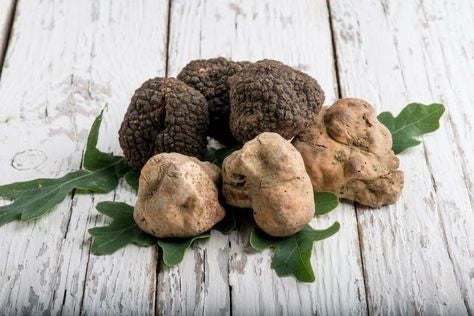
Truffles are expensive because they grow only in certain conditions for a short season each year and have to be found using trained dogs — so supply stays tiny while demand keeps climbing.
You've probably met truffle before you understood it — shaved over pasta at a restaurant, listed on a menu at a price that made you blink, or drizzled as oil over a plate of fries. The first time it's done right, you don't forget it: a warm plate hits the table and the smell arrives before the fork does — garlic, wet earth, something almost like ripe cheese — from just a few grams shaved on top. That's the whole appeal, and it's exactly why truffle carries one of the highest price tags in food.
The easiest way to experience that aroma at home is through White Truffle Extra Virgin Olive Oil — crafted in Italy and designed for finishing pasta, eggs, risotto, fries, and other simple dishes where truffle aroma can shine.
Truffles Cannot Be Reliably Farmed
This is the foundation of truffle pricing.
Unlike saffron, wagyu, or caviar — all expensive, all reliably produced — truffle has resisted every attempt at domesticated cultivation at scale.
White truffle (Tuber magnatum Pico), the most valuable species, has never been successfully cultivated. Every gram comes from the wild, found by trained dogs in specific regions of Italy — primarily Alba and the Langhe in Piedmont, with smaller white truffle populations in Emilia-Romagna and Tuscany. The Fiera Internazionale del Tartufo Bianco d'Alba sets the global reference price each season. Beyond that, supply depends entirely on nature.
Truffles grow underground in symbiosis with tree roots, requiring precise soil composition, climate balance, and time. A single truffle can take 7 to 10 years to develop. Disturb the ecosystem, and production disappears entirely. Even today, important parts of truffle reproduction remain poorly understood by scientists, which helps explain why cultivation is still so unpredictable. (For more on the species behind the price, see Wikipedia's entry on Tuber magnatum.)
The Hunting Process
Finding truffle requires a trained dog, a skilled hunter, and years of local knowledge — read more about this craft in our guide on truffle dog breeds.
Territories are closely guarded and often passed down through generations. A single hunt may yield nothing. Even across an entire season, a skilled hunter may harvest only a few kilograms of white truffle — less than what a busy kitchen can use in a week.
This imbalance between supply and demand is structural and permanent.
Seasonal Scarcity
White truffle is available for approximately 10 weeks per year (September through December). Black winter truffle (Tuber melanosporum) extends slightly longer (November through March), but remains strictly seasonal. The historic black truffle territories are Umbria — particularly Norcia — Marche, and Molise, where soil and altitude favor melanosporum over other species. The autumn truffle and summer truffle offer broader seasonal coverage at more accessible price points.
Outside these windows, fresh product does not exist.
Weather conditions directly impact yield — and therefore price. A poor season can reduce supply dramatically and push prices significantly higher within weeks.
The Logistics Chain
Fresh truffle begins to degrade the moment it is harvested. Peak aroma lasts 5 to 7 days.
This requires immediate cold-chain logistics: cleaning, grading, packaging, air transport, customs clearance, and delivery — often within 48 hours. For more on shelf life and handling, read our guide on how long truffles last.
Each step adds cost. Without it, the product would arrive with no value.
Why the Aroma Doesn't Last
Truffle's signature smell comes from volatile sulfur compounds — small molecules that evaporate fast. The most distinctive of them, bis(methylthio)methane (also called 2,4-dithiapentane), is what gives white truffle its instantly recognizable aroma. It starts breaking down within hours of harvest.
That's why fresh truffle is treated more like seafood than a pantry ingredient. Wrapped in cloth, kept at 35–40°F, eaten within about a week. Outside that window the aroma flattens, and what's left is texture without smell — half the product, none of the experience.
This volatility is also the structural reason fresh truffle and truffle-infused olive oil exist as different products with different jobs: fresh for the 7-day window when the tuber is at peak; oil for the rest of the year. For year-round use, many home cooks reach for White Truffle EVOO or Black Truffle EVOO.
Grading and Waste
Not all truffles are sellable.
A significant portion of every harvest is discarded — wrong size, wrong shape, soft, or aroma already gone. The product that reaches the market represents only a fraction of what was found.
What you pay for is not just the truffle. It's the yield that never made it to market.
Truffle Pricing at a Glance
White truffle sells for between $6,000 and $12,000 per kilogram. Black winter truffle commands $1,500 to $2,400 per kilogram. At auction, exceptional specimens have sold for tens of thousands of euros for a single piece.
These are not marketing figures — they are the prices serious buyers pay every season for fresh Italian truffle.
Seen in that context, the price is less surprising than the fact that the supply exists at all.
| Truffle type | Price per kg | Season | Cultivated? |
|---|---|---|---|
| White (Tuber magnatum) | $6,000–$12,000 | Sept–Dec | Never |
| Black winter (Tuber melanosporum) | $1,500–$2,400 | Nov–Mar | Partially |
| Summer (Tuber aestivum) | $200–$400 | May–Aug | Partially |
If You Get Why Wagyu Costs $200 a Pound
Truffle pricing makes sense if you've ever asked why dry-aged ribeye costs more than ground beef, or why a 24-month aged Parmigiano-Reggiano costs three times more than the 12-month wheel.
The constraint isn't the raw material. It's time, scarcity, search, and the percentage that doesn't make it to market.
Truffle has all four — at the upper end of every one.
Fresh Truffle vs Truffle Oil
A 40g portion of fresh black truffle — enough for a dinner for four — can cost $140 to $250, depending on the season.
| Fresh truffle | Truffle-infused EVOO | |
|---|---|---|
| Cost | $140–$250 per dinner for four (40g) | $32–$45 per 250ml bottle, dozens of plates |
| Availability | ~10-week season | Year-round |
| Shelf life | 5–7 days at peak | Several months when stored properly |
| Best for | Shaving, presentation | Finishing, everyday cooking |
| Aroma | Strongest — but fading by the day | Stable and repeatable |
| Delivers | Texture and visual impact | Precision and repeatability |
The same aromatic effect can be achieved with a well-made Black Truffle EVOO or White Truffle EVOO, capable of finishing dozens of portions at a fraction of the cost.
This is why truffle oil works where fresh truffle can't: consistency, control, and accessibility every month of the year — not just during a 10-week window. A well-made, Italian-sourced oil keeps the direct line from olive grove to bottle, putting that aroma within reach in any month rather than only during the harvest. Because the flavor rides on the oil itself, the base grade matters — "extra virgin" is the top tier defined by the International Olive Council, and the UC Davis Olive Center researches the quality and authenticity behind that label. For a deeper look, read our guide on how chefs use truffle oil.
Fresh truffle delivers texture and visual impact.
Truffle oil delivers precision and repeatability.
How People Actually Enjoy Truffle at Home
Most people encounter truffle long before they ever purchase a fresh white truffle. For many home cooks, the first experience comes through a finishing oil, sauce, or restaurant dish that introduces the aroma without requiring a seasonal purchase measured in grams.
The everyday entry point is a finishing oil or sauce: a small amount, added at the end, over something simple. The dishes that show it off best are the plain ones, where nothing competes with the aroma:
- Fried or scrambled eggs, finished off the heat
- Pasta, risotto, or gnocchi with butter or parmesan
- Fries, roasted potatoes, or mashed potato
- Pizza, the moment it leaves the oven
- Popcorn — the easiest way to learn what truffle tastes like
- A finishing drizzle over steak or grilled vegetables
One rule covers all of them: truffle is a finishing note, not a cooking ingredient. Heat weakens the aroma — the same volatility that gives fresh truffle its 7-day window. Add it at the end, off the heat, and use less than you think.
For a deeper understanding of finishing oils and proper usage, read our guide on how to use truffle oil.
A bottle of Black Truffle EVOO or White Truffle EVOO finishes dozens of plates and keeps for months — which is why, for most home cooks, it's where truffle actually starts. For technique, see our guide on how chefs use truffle oil.
Why Prices Keep Rising
Truffle prices have climbed steadily over the past decades.
Climate variability is reducing yields. Fewer trained hunters are entering the field. Global demand — particularly from Asia — continues to grow.
Supply cannot scale. Demand keeps rising.
This is not a product that becomes cheaper with technology. It's constrained by biology.
Where to Buy Real Italian Truffle
Browse fresh Italian truffles available for the current season, or discover truffle-infused olive oils for year-round use. For wholesale orders, visit our wholesale truffle page.
Discover our truffle products and understand exactly what the price reflects.
Frequently Asked Questions
Why is truffle so expensive?
Truffle is expensive because it cannot be reliably cultivated, grows only in specific natural conditions, requires trained hunters to locate, and has very short seasonal availability. Supply is limited; demand continues to grow.
Can truffles be cultivated?
Some black truffle species — particularly Tuber melanosporum — can be partially cultivated in inoculated orchards, especially in France, Spain, and parts of Italy. Yields remain unpredictable. White truffle (Tuber magnatum Pico) has never been successfully cultivated commercially anywhere in the world. Every white truffle on the market is wild-foraged.
Why is white truffle more expensive than black truffle?
White truffle (Tuber magnatum Pico) has never been successfully cultivated and is rarer, more aromatic, and available for a shorter season. This combination makes it significantly more valuable than black truffle. For the full breakdown, read our white truffle vs black truffle guide.
What does truffle taste like?
Truffle is more aroma than flavor. The taste is savory and deeply umami — earthy and a little garlicky, with a musky, almost cheese-like richness — but most of the experience reaches you through smell rather than the tongue. White truffle is sharper and more pungent; black truffle is rounder, with notes some compare to cocoa or forest floor. A few shavings or a light drizzle of oil is enough to carry a whole dish.
How much does fresh truffle cost per gram?
White truffle typically costs between $6 and $12 per gram. Black winter truffle ranges between $1.50 and $2.50 per gram, depending on the season and quality.
Is truffle oil a substitute for fresh truffle?
Truffle oil is not a direct substitute, but it offers a practical alternative for achieving truffle aroma in everyday cooking. Fresh truffle is used for shaving and presentation; truffle oil is used for consistency and control. Products such as White Truffle EVOO and Black Truffle EVOO allow home cooks to enjoy truffle aroma throughout the year.
When are truffles in season?
White truffle runs roughly September through December. Black winter truffle runs November through March. Summer truffle and autumn truffle extend coverage across the rest of the year — at lower price points.
Why is fresh truffle shaved at the table?
Truffle aroma is volatile and fades quickly once exposed to air, heat, and time. Shaving fresh — at the moment of serving, over a warm dish that releases the aroma without cooking it — preserves the strongest possible scent. It's the same logic as cracking pepper at the table rather than pre-grinding it.
How do you use truffle oil at home?
Truffle oil works best as a finishing oil — added at the end of cooking, off the heat, in small amounts. It shines on simple dishes where nothing competes with the aroma: eggs, pasta, risotto, fries, mashed potato, pizza, and popcorn. Heat weakens the aromatic compounds, so it is drizzled over a finished plate rather than cooked into the dish.
Where can I buy real Italian truffle in the United States?
Milan Truffle imports fresh Italian truffle and truffle-infused olive oils direct from Italy, shipping across the United States and Canada. Browse the current season's fresh truffles or our year-round truffle EVOOs.