
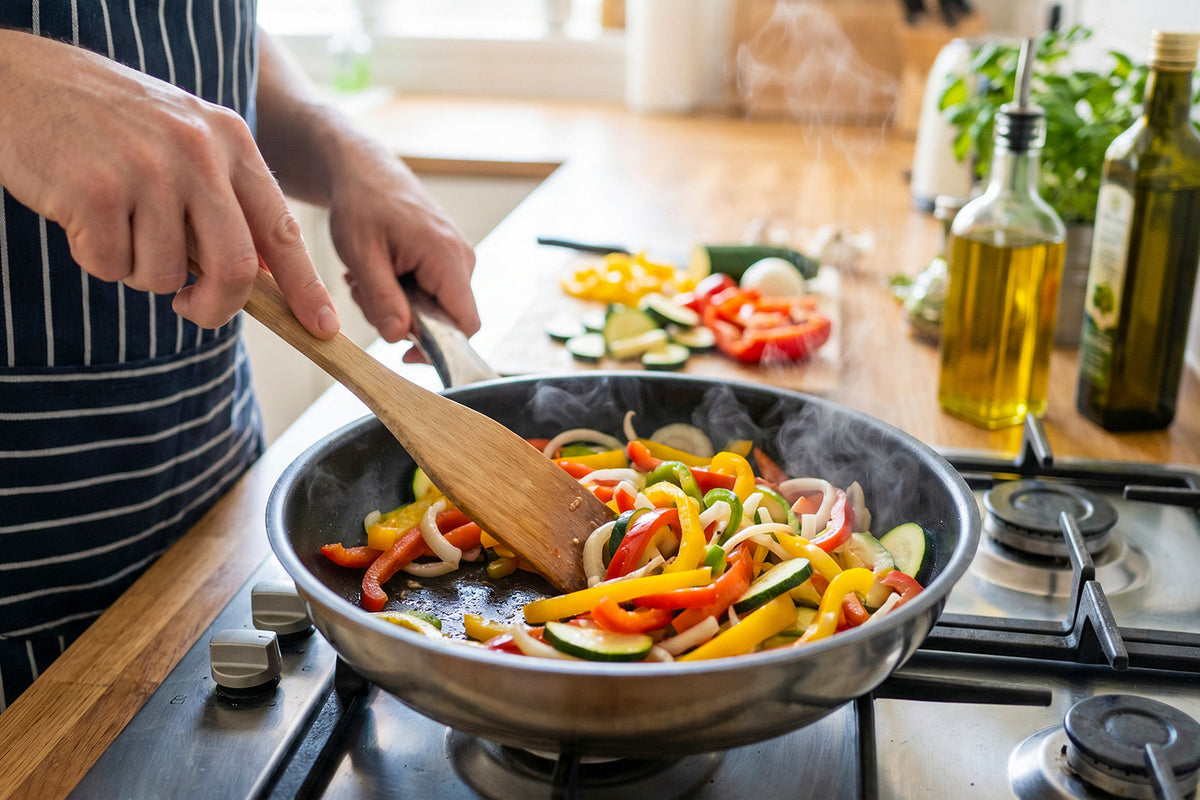
Extra virgin olive oil has a commonly reported smoke point of 350–410°F (177–210°C). That is high enough for most cooking at home, including sautéing, roasting, baking, and frying.
But smoke point is only one part of the story. It tells you when an oil begins producing continuous visible smoke. It does not tell you everything about how well the oil performs when heated.
What Is the Smoke Point of Olive Oil?
Smoke point is the temperature at which an oil begins producing continuous visible smoke.
It is not one fixed temperature for every bottle. Olive oils differ in grade, acidity, freshness, filtration, and storage history. Testing conditions can also affect the result.
These are the ranges commonly reported by the North American Olive Oil Association:
| Olive Oil Type | Smoke Point °F | Smoke Point °C |
|---|---|---|
| Extra Virgin Olive Oil | 350–410°F | 177–210°C |
| Pure or Regular Olive Oil | 390–470°F | 199–243°C |
| Extra-Light Olive Oil | 390–470°F | 199–243°C |
These are guidance ranges, not guaranteed temperatures for every bottle.
Refined olive oils generally have higher smoke points than extra virgin olive oil. But a higher smoke point does not automatically make an oil better for cooking.
Why Does the Smoke Point of EVOO Vary?
Extra virgin olive oil is a natural product. One bottle may begin smoking at a different temperature from another.
Several factors influence its smoke point:
- Free fatty acidity: Lower free acidity generally corresponds with a higher smoke point.
- Freshness: Older or poorly stored oil may behave differently from fresh oil.
- Filtration: Suspended olive particles and residual moisture can affect when visible smoke appears.
- Previous heating: Reused oil is not in the same condition as fresh oil.
- Testing method: Heating rate, equipment, and the way continuous smoke is observed can change the reported result.
A 2025 study examining 48 virgin olive oils found that free fatty acidity was the strongest predictor of smoke point within the oils tested.
This is why there is no universal smoke-point number for every EVOO. Extra virgin describes a regulated grade; smoke point describes what happens to a particular oil under particular test conditions.
Is Smoke Point the Same as Cooking Stability?
No.
Smoke point tells you when continuous visible smoke begins. Cooking stability describes how well an oil resists chemical degradation while it is heated.
An oil can have a high smoke point without necessarily being the most stable oil. Smoke point alone does not measure oxidation, polar compounds, or every other change that occurs during cooking.
Extra virgin olive oil contains mostly monounsaturated fat and naturally occurring minor compounds, including polyphenols. These characteristics contribute to its performance under heat.
In a 2018 laboratory experiment comparing ten cooking oils, the tested EVOO produced the lowest level of polar compounds after heating. The researchers concluded that smoke point did not predict how the oils performed under their test conditions.
That result applies to the oils and methods used in that experiment. It does not prove that every EVOO will outperform every other cooking oil. It does show why judging an oil by smoke point alone is too simple.
Can You Cook and Fry With Extra Virgin Olive Oil?
Yes.
Extra virgin olive oil can be used for:
- Sautéing
- Roasting
- Baking
- Pan-frying
- Deep-frying
The USDA includes olive oil among the oils suitable for deep frying.
For practical temperatures, frying technique, and oil reuse, read our guide to deep-frying with extra virgin olive oil.
The temperature shown on an oven is also not necessarily the temperature reached by the oil on the food. When vegetables are roasting at 400°F, for example, the food’s moisture helps keep the oil from immediately reaching the oven’s full air temperature.
For most everyday cooking, a fresh EVOO’s commonly reported smoke-point range of 350–410°F is sufficient.
The remaining question is flavor. A robust EVOO can add bitterness, fruitiness, or a peppery finish to food. That may be desirable in vegetables, meat, sauces, and Mediterranean dishes. When you want no added flavor, a more neutral oil may suit the recipe better.
If a recipe calls for another liquid cooking oil, read our guide to using olive oil instead of vegetable oil.
What Should You Do if Olive Oil Starts Smoking?
Reduce the heat.
A faint wisp caused by moisture is not necessarily the same as continuous smoke. But when the oil produces steady smoke with a sharp smell, it has reached its smoke point.
Do not continue heating an empty pan of smoking oil. Lower the temperature, remove the pan from the heat if necessary, and begin again with fresh oil if the oil has burned.
You do not need to know the laboratory-tested smoke point of your particular bottle to follow this rule. The visible smoke tells you what is happening in the pan.
The Bottom Line
Extra virgin olive oil has a commonly reported smoke point of 350–410°F (177–210°C). Refined and light-tasting olive oils are generally reported at 390–470°F (199–243°C).
Those ranges are useful, but they are not universal specifications for every bottle.
Smoke point varies with the oil’s acidity, freshness, filtration, condition, and the way it is tested. It also does not measure cooking stability by itself.
For the home cook, the answer is simple:
Yes, you can cook and fry with extra virgin olive oil. Use reasonable heat, do not leave an empty pan unattended, and reduce the temperature if the oil begins producing continuous smoke.
For more about EVOO quality, flavor, cooking, and storage, read our complete guide to extra virgin olive oil.
Frequently Asked Questions
What is the smoke point of extra virgin olive oil?
The North American Olive Oil Association reports a typical range of 350–410°F (177–210°C). Individual extra virgin olive oils can differ according to acidity, freshness, filtration, and testing conditions.
Is extra virgin olive oil suitable for high-heat cooking?
Yes. EVOO is suitable for many common cooking methods, including sautéing, roasting, baking, and frying. Smoke point is not a safety threshold, and the oil should not be left producing continuous smoke.
Can you fry with olive oil?
Yes. The USDA lists olive oil among the oils suitable for deep frying. EVOO can also be used for pan-frying when its flavor complements the food.
Does olive oil become toxic when it reaches its smoke point?
Smoke point marks the appearance of continuous visible smoke; it is not a universal toxicity threshold. Heating produces changes that depend on the oil, temperature, duration, oxygen exposure, and cooking conditions. If the oil begins smoking continuously, reduce the heat.
Sources
- North American Olive Oil Association: Olive Oil Smoke Point
- Díez-Betriu A, et al. “Deciphering the Complexity of Smoke Point in Virgin Olive Oils to Develop Simple Predictive Models.” Foods. 2025;14(23):4099.
- De Alzaa F, Guillaume C, Ravetti L. “Evaluation of Chemical and Physical Changes in Different Commercial Oils During Heating.” Acta Scientific Nutritional Health. 2018;2(6).
- USDA Food Safety and Inspection Service: Deep Fat Frying and Food Safety

