
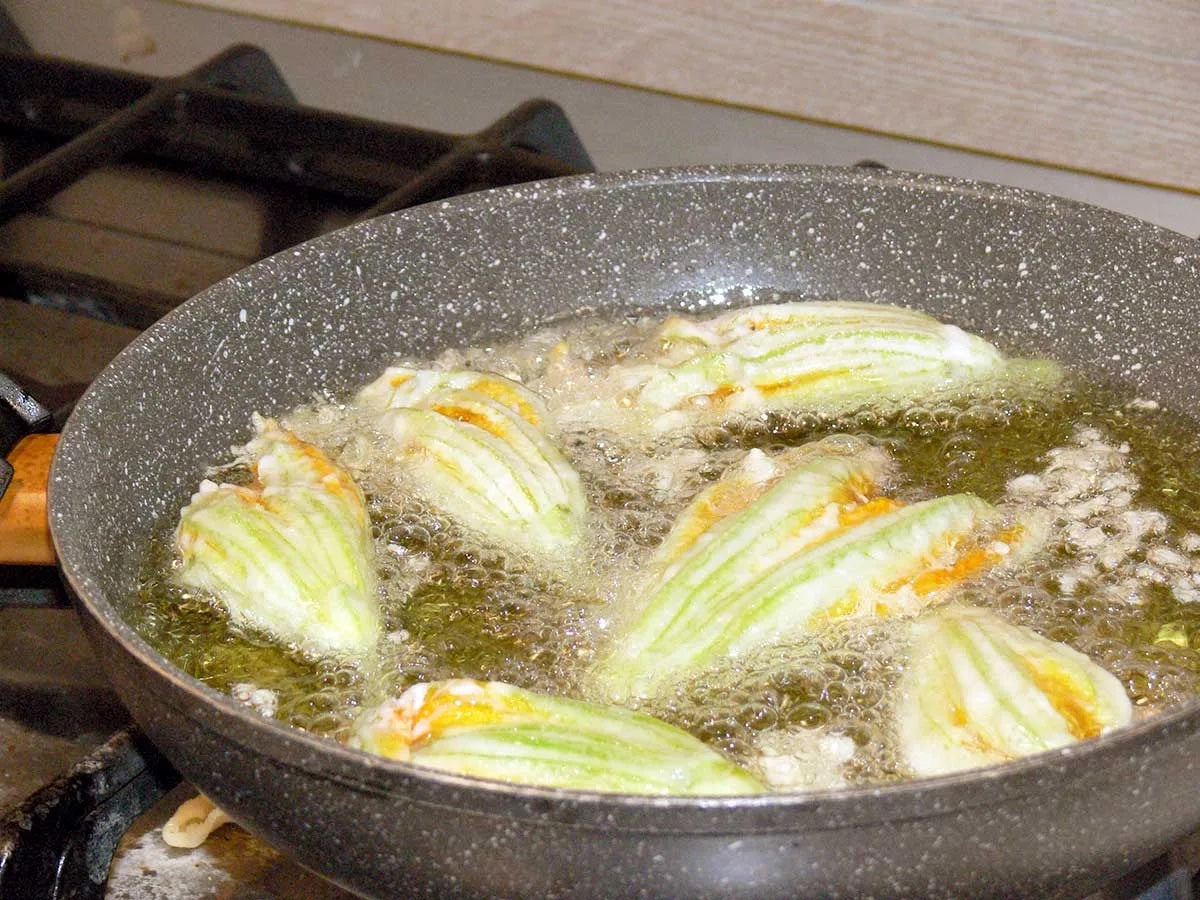
Yes. You can deep-fry with extra virgin olive oil. A frying temperature of approximately 350–375°F (177–190°C) falls within EVOO’s commonly reported smoke-point range of 350–410°F.
Extra virgin olive oil can produce crisp, flavorful fried food. The important things are keeping the oil at the right temperature, avoiding continuous smoke, and deciding whether you want the oil’s flavor in the finished dish.
Can You Deep-Fry With Extra Virgin Olive Oil?
Yes.

Deep-frying means completely submerging food in hot oil. The USDA includes olive oil among the oils suitable for frying and recommends maintaining a temperature of approximately 350°F.
Extra virgin olive oil works particularly well for foods that complement its flavor, including:
- Potatoes
- Zucchini
- Artichokes
- Eggplant
- Fish
- Chicken
- Arancini
If a recipe normally calls for another liquid oil, EVOO may be an option. Our guide to using olive oil instead of vegetable oil explains when the substitution works best.
What Temperature Should You Use for Deep-Frying?
Keep the oil between 350°F and 375°F (177–190°C).
Below that range, food may absorb too much oil before its surface becomes crisp. Above it, the outside may brown before the inside is cooked, and the oil moves closer to its smoke point.
For better results:
- Use a deep, heavy pot with enough room above the oil.
- Use a frying thermometer to monitor the temperature.
- Dry the food before placing it in the oil.
- Add food carefully to prevent splashing.
- Fry in small batches so the temperature does not fall sharply.
- Reduce the heat if the oil begins producing continuous smoke.
Do not confuse the temperature of the burner with the temperature of the oil. The only reliable way to know the oil’s temperature is to measure it.
Does Deep-Frying Destroy EVOO’s Benefits?
No—not all at once. But heating does change the oil.
Some phenolic compounds decrease as temperature and cooking time increase. That does not mean EVOO suddenly loses every useful characteristic when it enters a frying pan.
Extra virgin olive oil remains rich in monounsaturated fat. Its fatty-acid composition and naturally occurring minor compounds also contribute to its resistance to oxidation.
A 2010 study tested several commercial olive oils under repeated deep-frying conditions. The olive oils reached the study’s 25% total-polar-compound discard limit after approximately 24–27 hours, compared with 15 hours for the vegetable-oil blend tested.
That does not mean oil should be used continuously for 24 hours at home. It means the tested olive oils resisted degradation longer than the comparison oil under that experiment’s conditions.
The simple idea that heating EVOO immediately makes it harmful is one of several claims examined in our guide to common olive oil myths.
Does EVOO Change the Flavor of Fried Food?
Yes, it can—and that may be a benefit.
A robust EVOO can add fruity, bitter, or peppery notes. These flavors often work well with potatoes, vegetables, fish, and Mediterranean dishes.
A milder EVOO will contribute less flavor. If you want the frying oil to remain as neutral as possible, the oil’s flavor profile should be part of your decision.
Cost also matters. Extra virgin olive oil is often more expensive than common refined frying oils, especially when a recipe requires a large quantity. Our comparisons of olive oil versus canola oil and olive oil versus sunflower oil explain the practical differences.
Can You Reuse Extra Virgin Olive Oil After Frying?
It may be possible to reuse frying oil if it has not smoked, developed an unpleasant odor, become unusually dark or thick, or accumulated burned food particles.
Let the oil cool completely, strain out the food particles, and store it in a clean, sealed container away from heat and light. Do not combine it with fresh oil until you have checked its condition.
Discard the oil if it:
- Smells rancid or burned
- Produces excessive foam
- Has become thick or sticky
- Smokes at a much lower temperature than before
- Contains burned particles that cannot be removed
Oil quality changes each time it is heated. There is no universal number of times that every frying oil can be safely reused.
The Bottom Line
Yes, you can deep-fry with extra virgin olive oil.
Keep the oil at approximately 350–375°F, use a thermometer, fry in small batches, and reduce the heat if the oil begins producing continuous smoke.
Heating reduces some phenolic compounds, but it does not instantly erase EVOO’s characteristics. The oil’s freshness, starting quality, temperature, cooking time, and reuse all affect how it performs.
The final choice also depends on flavor and cost. Use EVOO when its taste complements the food and when it makes sense for the quantity required.
For the broader explanation of EVOO quality, cooking, flavor, and storage, read our complete guide to extra virgin olive oil.
Frequently Asked Questions
Is extra virgin olive oil suitable for deep-frying?
Yes. A typical frying temperature of 350–375°F falls within EVOO’s commonly reported smoke-point range of 350–410°F.
What is the best temperature for frying with EVOO?
Keep the oil at approximately 350–375°F. Use a frying thermometer because burner settings do not reveal the oil’s actual temperature.
Does frying with EVOO destroy its polyphenols?
Heating reduces some phenolic compounds, especially as temperature and cooking time increase. It does not cause every phenolic compound or characteristic of the oil to disappear immediately.
What should you do if EVOO starts smoking?
Reduce the heat. Continuous visible smoke means the oil has reached its smoke point. If it smells burned or has noticeably degraded, let it cool and discard it.
Sources
- USDA Food Safety and Inspection Service: Deep Fat Frying and Food Safety
- Casal S, Malheiro R, Sendas A, Oliveira BPP, Pereira JA. “Olive Oil Stability Under Deep-Frying Conditions.” Food and Chemical Toxicology. 2010;48(10):2972–2979.
- Ambra R, Lucchetti S, Pastore G. “A Review of the Effects of Olive Oil-Cooking on Phenolic Compounds.” Molecules. 2022;27(3):661.

