
- What is the difference between olive oil and canola oil?
- Can you use extra virgin olive oil instead of canola oil?
- Which oil is healthier or better for cooking?
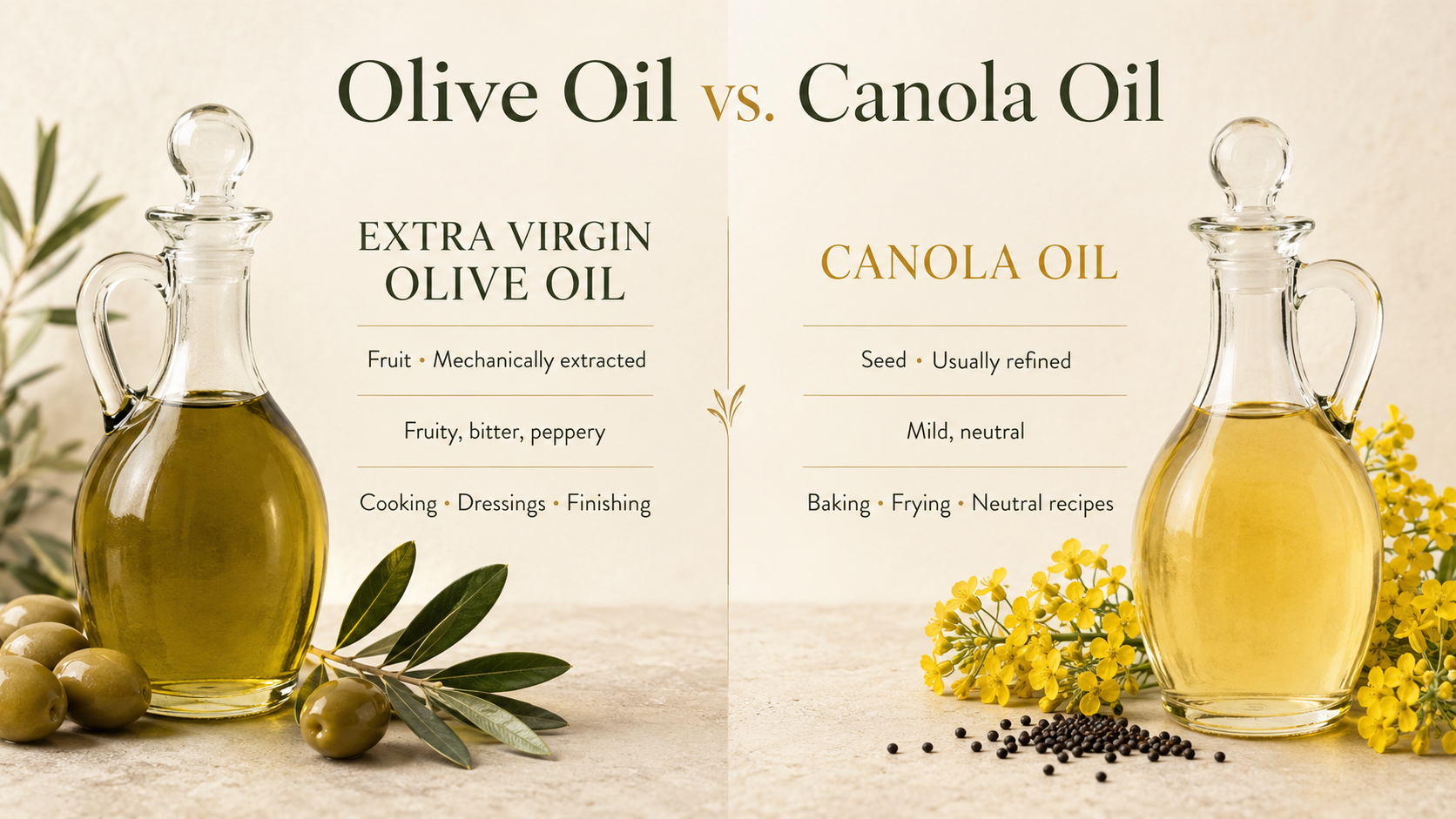
Olive oil comes from the fruit of the olive tree, while canola oil comes from the seeds of canola plants. Extra virgin olive oil is obtained mechanically without refining and retains its natural aroma and flavor. Most canola oil sold in supermarkets is refined and has a more neutral taste.
Key Facts
- Extra virgin olive oil is an unrefined fruit oil; common canola oil is a refined seed oil.
- Both oils contain mostly unsaturated fats.
- EVOO contributes flavor, while refined canola oil is generally neutral.
- Both can be used for cooking; the better choice depends on the food, temperature and flavor you want.
- Canola oil is generally less expensive; EVOO prices vary with origin, harvest, production and packaging.
Olive Oil vs. Canola Oil: Quick Comparison
| Characteristic | Extra Virgin Olive Oil | Canola Oil |
|---|---|---|
| Source | Olive fruit | Canola seed |
| Typical production | Mechanical or physical extraction without refining | Commonly refined after oil is extracted from the seed |
| Flavor | Can be fruity, grassy, bitter or peppery | Usually mild and neutral when refined |
| Common uses | Cooking, dressings, dipping and finishing | Cooking, frying and baking when neutral flavor is preferred |
| Refined? | Extra virgin olive oil is not refined | Most supermarket canola oil is refined |
| History | Used for thousands of years around the Mediterranean | Developed as a low-erucic-acid rapeseed crop in the twentieth century |
| Typical price | Varies by grade, origin, harvest and production | Usually less expensive |
What Is the Main Difference Between Olive Oil and Canola Oil?
The starting material and production method are different. Olive oil is made from olive fruit. Canola oil is made from low-erucic-acid varieties of rapeseed.
“Olive oil” is also a broad category. Extra virgin olive oil, virgin olive oil and refined olive-oil blends are not identical products. Our Extra Virgin Olive Oil Guide explains the grades.
How Are Extra Virgin Olive Oil and Canola Oil Made?
Extra virgin olive oil is obtained directly from olives using mechanical or other physical processes. Washing, crushing, mixing, centrifugation, decantation and filtration may be used, but refining is not part of EVOO production. See how olive oil is made and how Italian olive oil is classified.
Canola oil begins with seeds. Commercial production commonly includes pressing or extraction followed by refining steps such as degumming, neutralizing, bleaching and deodorizing. Cold-pressed canola oils also exist, so “canola oil” does not describe one universal process.
How Do Their Nutritional Profiles Compare?
Olive oil and canola oil provide approximately the same calories and total fat per tablespoon. Both consist mainly of unsaturated fats, but their fatty-acid profiles differ.
- Olive oil generally contains more monounsaturated fat, primarily oleic acid.
- Canola oil generally contains more polyunsaturated fat, including alpha-linolenic acid.
- Extra virgin olive oil retains naturally occurring phenolic compounds from the olive fruit.
- The precise composition varies by product, cultivar, processing and storage.
These differences describe composition; they do not make one oil the correct choice for every person, diet or recipe.
Are Solvents Always Used to Make Canola Oil?
No. Solvent extraction is common in large-scale canola-oil production, but mechanically pressed and cold-pressed canola oils also exist. Read the product label and the producer's processing information instead of assuming that every canola oil is made in exactly the same way.
Extra virgin olive oil is different: solvents and refining are not permitted in its production. Refined olive oil and olive-pomace oil belong to different categories and should not be confused with EVOO.
What Do the Grades and Standards Mean?
Extra virgin olive oil is a defined grade with chemical and sensory requirements. It must have no median sensory defect, detectable fruitiness and free acidity no higher than 0.8%, together with the other applicable analytical characteristics.
Canola oil also has identity and composition standards under food regulations and the Codex standard for named vegetable oils. However, its consumer categories do not mirror the extra-virgin, virgin and refined grading language used for olive oil.
What Is the Difference in Price?
Canola oil is generally one of the less expensive bottled cooking oils. Extra virgin olive oil often costs more because its price may reflect olive yield, harvesting, rapid milling, analysis, origin documentation, protective packaging, transportation and distribution.
Price alone does not prove quality. It should be compared with the evidence provided for the specific bottle.
What About GMO Status?
Genetically engineered canola varieties are widely grown in North America, while non-GMO canola oil is also available. GMO status does not tell you whether an oil is fresh, properly refined, suitable for a recipe or high quality. Check the specific product if this characteristic matters to you.
Commercial extra virgin olive oil is produced from olives rather than genetically engineered canola seed. This distinction describes the crop source; it is not a complete nutritional or quality judgment.
Do Olive Oil and Canola Oil Taste the Same?
No. Refined canola oil is generally chosen when a mild, neutral oil is wanted. Extra virgin olive oil contributes aroma and flavor that vary with cultivar, growing conditions, harvest timing, milling and freshness. Learn why olive oils taste different.
This difference matters in dressings, dipping and finishing, where the oil remains easy to taste. It can also matter in baking or delicate foods where a neutral result is preferred.
How Do Antioxidants and Shelf Life Compare?
Extra virgin olive oil retains naturally occurring minor compounds from the olive fruit, including phenolic compounds that can contribute to bitterness, pungency and oxidative stability. Refining changes the minor-compound profile of an oil, whether the starting material is canola or olives.
Both oils change with exposure to heat, light, oxygen and time. Store either one tightly closed in a cool, dark place and use it before stale or rancid aromas develop. Antioxidants can influence stability, but they do not make an opened bottle permanent.
Can You Cook With Extra Virgin Olive Oil Instead of Canola Oil?
Yes, in many recipes. EVOO can be used for sautéing, roasting, pan-cooking, baking and frying, as well as raw applications. Canola oil can also be used for cooking and is often selected for its neutral flavor.
Smoke point is not one fixed number for every bottle, and it is not the only measure of cooking performance. Temperature, heating time, fatty-acid composition and the condition of the oil also matter. Read our guide to olive oil smoke point.
Which Is Better: Olive Oil or Canola Oil?
Neither oil is automatically the correct choice for every recipe. Choose refined canola oil when you want a neutral flavor and an economical cooking oil. Choose extra virgin olive oil when you want an unrefined oil with its own aroma, flavor and product-specific harvest and origin information.
When Is Canola Oil the Better Choice?
Canola oil can be the more practical choice when a recipe requires a large quantity of inexpensive oil, when the finished food should have no noticeable oil flavor, or when a neutral oil is preferred for baking or frying. Non-GMO and mechanically pressed canola oils are also available for buyers seeking those specific characteristics.
When Is Extra Virgin Olive Oil the Better Choice?
Choose EVOO when the oil's aroma and flavor should contribute to the dish, when you want an unrefined oil for both cooking and raw use, or when harvest, origin and laboratory information are part of the buying decision. It is particularly useful for dressings, dipping, vegetables, pasta, sauces and finishing.
When selecting EVOO, check its grade, origin, harvest information, packaging and storage. Our guides explain filtered versus unfiltered olive oil and how to choose olive oil.
Milan Truffle's 100% Italian Extra Virgin Olive Oil is from the November 2025 harvest, cold extracted, packaged in 500 mL dark glass and made for everyday cooking and finishing. Milan Truffle will send a certificate of analysis to everyone who purchases a bottle.
Which Is Healthier: Olive Oil or Canola Oil?
Both oils are predominantly unsaturated fats. Canola oil generally contains less saturated fat and more polyunsaturated fat, while extra virgin olive oil generally contains more monounsaturated fat and retains phenolic compounds that are reduced by refining.
Calling one oil universally “healthier” oversimplifies the comparison. The specific product, quantity consumed, cooking method and overall dietary pattern matter more than one isolated label. Anyone choosing an oil for a medical condition should follow guidance from a qualified healthcare professional.
Frequently Asked Questions
What is the difference between olive oil and canola oil?
Olive oil comes from olive fruit, while canola oil comes from canola seeds. Extra virgin olive oil is obtained mechanically without refining; most supermarket canola oil is refined.
Is canola oil a type of olive oil?
No. Canola oil and olive oil come from different plants and belong to different oil categories.
Can you substitute olive oil for canola oil?
Yes, in many cooking and baking applications. The main practical difference is flavor: extra virgin olive oil contributes flavor, while refined canola oil is usually neutral.
Can you fry with extra virgin olive oil?
Yes. Extra virgin olive oil can be used for frying when temperature and cooking time are properly controlled.
Which oil should I use for everyday cooking?
Choose according to the dish. Canola oil works when neutral flavor is preferred. Extra virgin olive oil works when you want an unrefined oil that can cook the food and contribute flavor.
Which is healthier, olive oil or canola oil?
Both are predominantly unsaturated fats. Canola oil generally contains less saturated fat and more polyunsaturated fat, while extra virgin olive oil generally contains more monounsaturated fat and retains phenolic compounds. The better choice depends on the specific product and overall diet.
Sources
- International Olive Council: Olive Oil Categories and Definitions
- Canadian Food Inspection Agency: Canola Oil and Oil-Labelling Requirements
- Health Canada: How Highly Refined Oils Are Produced
- USDA FoodData Central

