
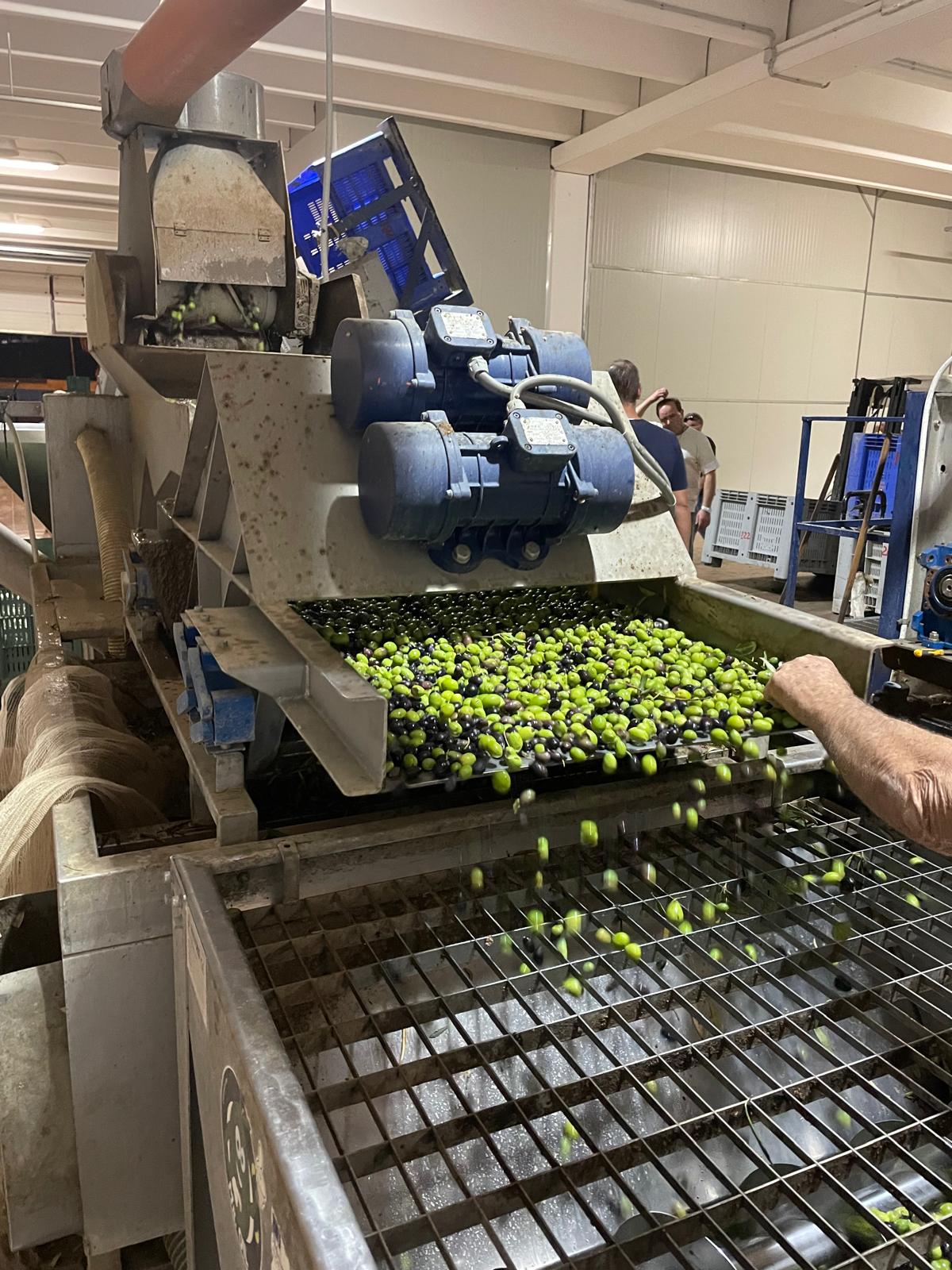
Here are the 5 simple steps of extra virgin olive oil production and why each one matters.
Extra virgin olive oil is made from fresh olives. In the simplest terms, it is the natural juice of the olive fruit.
The olives are harvested from the trees, often by hand — a mano — cleaned, brought to the mill — the Italian frantoio — crushed into a paste, mixed slowly — piano, piano — and then separated to collect the oil.
The process is really simple:
Harvest → Clean → Crush → Mix → Extract
Good olive oil begins with healthy fruit and careful handling at every step. Here is how it works.
Olive Oil Production at a Glance
| Step | What Happens |
|---|---|
| Harvest | Fresh olives are picked from the trees. |
| Clean | Leaves, twigs, dirt, and dust are removed. |
| Crush | The olives are crushed into a paste. |
| Mix | The paste is slowly mixed so small oil drops come together. |
| Extract | The oil is separated from water and olive solids. |
1. Harvest the Olives
Olive oil begins with fresh olives harvested from olive trees.
For an early-harvest olive oil, the olives are picked while they are still green or just beginning to change color. They may be harvested by hand — a mano — or with mechanical tools.
Harvest time changes the oil. Greener olives often produce oils that taste more bitter, peppery, fresh, and intense. Riper olives usually produce a softer and milder oil.
Once picked, the olives should go to the mill as quickly as possible. Fresh, healthy fruit is where a superb olive oil begins.
2. Clean the Olives
When the olives arrive at the frantoio, the first job is simple: clean them.
Leaves, small branches, dust, soil, and other material from the grove are removed. The olives are then washed with clean water.
This may sound like a small step, but it matters. You want clean, healthy fruit going into the mill.
Once they are clean, the olives are ready to be crushed.
3. Crush the Olives Into a Paste
The olives are crushed whole, including the skin, flesh, and pits.
At this point, they do not look like olive oil. They become a thick paste made of olive solids, vegetation water, and tiny droplets of oil.
Crushing breaks open the olive cells and releases the oil that is naturally inside the fruit.
The mill does not create the oil. The oil is already there. Milling helps separate it from the water and solid parts of the olive.
Modern mills commonly use stainless-steel equipment for this step.
4. Slowly Mix the Olive Paste
After crushing, the olive paste is mixed slowly — piano, piano.
This step is called malaxation.
It sounds complicated, but it is not. Slow mixing allows the tiny drops of oil in the paste to join together and form larger drops.
Those larger drops are easier to separate in the next step.
Time, temperature, and exposure to air matter. Too much heat, too much air, or mixing for too long can reduce freshness and affect aroma and flavor.
So this part of the process is slow and carefully controlled.
5. Extract the Olive Oil
The final milling step is extraction: separating the olive oil from the water and solid parts of the olive paste.
Most modern olive mills use a centrifuge. The machine spins the paste and separates the oil from the olive water and pomace, the solid material left after extraction.
And there it is: fresh olive oil.
The oil may then be filtered to remove fine olive particles and residual moisture. Filtration can help improve clarity and stability during storage. Learn more about filtered vs. unfiltered olive oil.
After extraction, the oil is usually stored in clean stainless-steel tanks where it is protected from light, heat, and oxygen until bottling.
Harvest → Clean → Crush → Mix → Extract
How Is Extra Virgin Olive Oil Made?
Extra virgin olive oil is made using the same basic five-step process.
It is produced directly from olives using mechanical or other physical methods. It is not refined and does not undergo chemical solvent extraction.
But mechanically extracted olive oil is not automatically extra virgin.
To qualify as extra virgin, the finished oil must also meet defined chemical and sensory standards.
In the United States, the USDA Standards for Grades of Olive Oil and Olive-Pomace Oil describe the requirements for the extra virgin grade.
Our guide to how Italian olive oil is classified explains the main grades in simple terms.
That is why everything matters from the beginning: the fruit, the harvest, the trip to the mill, the milling, the storage, and the bottling.
Is Olive Oil Really Cold Pressed?
Traditional olive mills used presses to separate oil from olive paste.
Most modern olive mills use centrifuges instead. For that reason, cold extracted is usually the more accurate term for oil made with modern centrifugation equipment.
In the European Union, “cold extraction” is a regulated expression under Commission Delegated Regulation (EU) 2022/2104 for virgin and extra virgin olive oils extracted below 27°C using percolation or centrifugation methods.
Low temperature can help protect aroma and flavor, but temperature alone does not prove that an olive oil is high quality.
Read our complete guide to cold pressed vs. cold extracted olive oil.
Why Can Fresh Olive Oil Taste Peppery?
Fresh extra virgin olive oil can taste fruity, bitter, and peppery. These can be positive characteristics of a fresh oil.
The peppery feeling often appears at the back of the throat. It may be mild or strong depending on the olives, harvest time, and how the oil was produced.
Learn more in our guide to why olive oil tastes peppery or bitter.
How Should Olive Oil Be Stored?
Olive oil does not like light, heat, or air.
At the mill, producers commonly store olive oil in clean stainless-steel tanks before bottling.
After bottling, dark glass bottles and tins can help protect the oil from light.
At home, keep the bottle tightly closed and away from the stove, direct sunlight, and other sources of heat.
For the complete guide, read how to store olive oil.
Olive Oil Production FAQ
Is olive oil made from olives only?
Virgin and extra virgin olive oils are made directly from olives using mechanical or physical processes. Extra virgin olive oil is not refined.
Are olives pressed to make olive oil?
Traditional mills pressed olive paste. Most modern olive mills use centrifuges instead, which separate the oil from the olive water and solids.
How long does it take to make olive oil?
Once olives arrive at the mill, the milling process can take only a few hours. But producing excellent olive oil depends on the full chain: harvest, rapid transport, cleaning, milling, storage, and bottling.
Why is extra virgin olive oil sometimes bitter and peppery?
Bitterness and pepperiness can be natural positive characteristics of fresh extra virgin olive oil. They are often more noticeable in oils made from greener olives or early-harvest fruit.
What happens after olive oil is extracted?
After extraction, olive oil may be filtered, stored in protected stainless-steel tanks, and then bottled in packaging designed to reduce exposure to light and oxygen.
The Bottom Line
Olive oil production is simple in principle.
- Harvest fresh olives.
- Clean them.
- Crush them into a paste.
- Mix the paste slowly.
- Separate the oil.
The technology has changed over time, but the idea is still the same: start with good olives, handle them carefully, and protect the oil from the tree to the bottle.
From the tree to the frantoio, and from the mill to the bottle, every step affects the freshness, aroma, flavor, and character of the oil.
Harvest → Clean → Crush → Mix → Extract
See the harvest, origin, and laboratory analysis for Lumìa 100% Italian Extra Virgin Olive Oil.

