
A procurement and reference guide covering Italian truffle geography, species, seasonal windows, grading standards, and cold-chain logistics for professional buyers and culinary professionals in the United States.
Last reviewed: May 2026
What Is a Truffle?
A truffle is a subterranean fungus that grows in mycorrhizal symbiosis with the root systems of specific host trees — primarily oak, hazelnut, poplar, and beech. It develops entirely underground, produces no visible above-ground fruiting body, and cannot be located by sight. Trained dogs detect its aroma through the soil and indicate its position to the hunter. In Italy, the use of trained dogs for truffle hunting is required by law. Pigs were banned from the practice in 1985.
The truffle's commercial value is aromatic, not structural. Its volatile compounds — released as the fungus matures underground — define its culinary significance and its price. Those compounds are thermally unstable and begin dissipating at moderate temperatures, which governs every correct application of fresh truffle from harvest through service. Research published on PubMed Central confirms the distinct aromatic and nutritional profiles that separate premium Italian species from commercial-grade alternatives.
For a foundational overview of Italian truffle species, culture, and culinary use, see our Italian Truffles guide.
Species and Market Differentiation
Italian truffle supply is structured around a small set of commercially relevant species, each with distinct harvest windows, aromatic profiles, price bands, and culinary roles. Procurement plans and menus should track species rather than a generic "truffle" category — seasonality is not interchangeable across species.
| Common name | Latin name | Primary season | Aromatic profile | Market position | Optimal application |
|---|---|---|---|---|---|
| White truffle (Alba) | Tuber magnatum | Oct–Dec | Intense garlic, honey, fermented note; highly volatile | Flagship; highest pricing globally | Raw shaving tableside over warm fats |
| Black winter (Norcia) | Tuber melanosporum | Dec–Mar | Earthy, cocoa, damp forest; robust and heat-stable | Premium winter; stable supply | Sauces, compound butters, warm dishes |
| Bianchetto (Marzuolo) | Tuber borchii | Jan–Apr | Sharp, garlicky, transitional; pungent finish | Mid-tier; transitional season | Pan sauces, warm grains, infusions |
| Black summer (Scorzone) | Tuber aestivum | May–Aug | Mild, nutty, hazelnut; delicate and stable | Entry to mid-tier; high volume | Infusions, sauces, raw texture applications |
| Black autumn (Uncinato) | Tuber uncinatum | Sep–Nov | Deeper than summer; earthier, transitional | Bridge to winter; mid-market | Versatile; warm and cold dishes |
| Winter truffle (Musky) | Tuber brumale | Nov–Mar | Earthy, musky; less complex than melanosporum | Commercial grade; infusion base | Oils, pastes, volume preparations |
For a detailed comparison of white and black truffle aromatic behavior, culinary handling, and heat tolerance, see our Black vs White Truffles guide.
Major Italian Truffle Regions
Italy's truffle geography runs from the northern Alpine foothills through the central Apennine spine to the southern tip of the peninsula. Each zone produces different species under different soil and climate conditions. The regions below represent the primary production areas for commercially significant supply reaching the United States market.
Piedmont — White Truffle Capital
Piedmont is the most internationally recognized Italian truffle region. Its association with white truffle (Tuber magnatum) is the strongest regional-species pairing in the industry. The Langhe hills surrounding Alba — the global truffle capital — produce white truffles of exceptional aromatic intensity, shaped by calcareous clay soil, river valley microclimate, and dense oak and hazel forest cover.
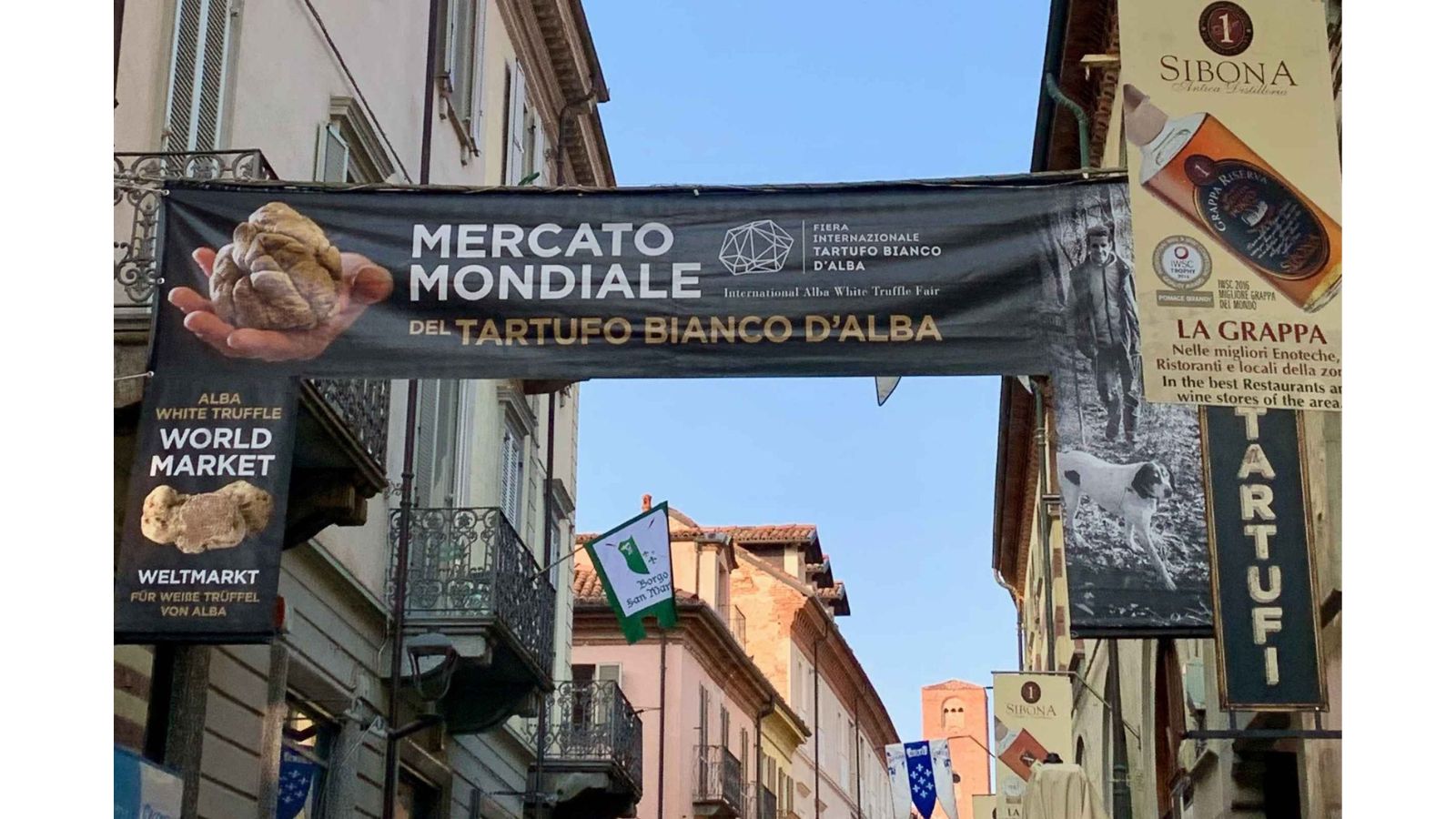
The Alba International White Truffle Fair, held annually from October through January, is the world's most important white truffle market and a primary global pricing reference point. The official season runs October 1 through January 31, with a regional biological stop in September. Peak aromatic quality and maximum market activity concentrate in late October through mid-November. Prices vary sharply by grade, size, and week of season — ranging from several hundred to several thousand euros per kilogram depending on supply conditions in any given year. Additional white truffle production occurs in the Monferrato hills, the Roero plateau, and the Asti province, each producing slightly different aromatic profiles due to variation in soil mineral content.
Early October lots frequently exhibit pale interiors and less stable aromatics. Late October through mid-November delivers the most consistent maturity and aromatic intensity. December and January show declining quality and increased price sensitivity as the season closes.
Umbria — Black Winter Truffle Heartland
Umbria is Italy's most important region for black winter truffle (Tuber melanosporum). The Valnerina — the valley of the Nera river — and the hill towns of Norcia and Spoleto sit at its center. Tartufo Nero di Norcia is one of the most recognized Italian truffle designations in professional kitchens worldwide.
Umbrian black truffles grow in forested limestone terrain at elevations between 400 and 1,000 meters, creating the cool, humid conditions the species requires. Harvest runs December through March, with January and February representing peak quality and maximum aromatic intensity. The region also produces significant quantities of white truffle in the Gubbio and Città di Castello areas, and summer truffle across lower elevations.
Tuscany — Versatile Multi-Species Production
Tuscany produces all three major commercial species across a geographically diverse landscape. The San Miniato area hosts a significant white truffle market in November. Black winter and summer truffle production is widespread across the Crete Senesi, the Mugello valley, and the Maremma coastal strip. The Casentino forests in eastern Tuscany are among the most productive summer truffle territories in Italy.
Marche — Acqualagna and the Apennine Corridor
Marche is one of Italy's most productive truffle regions by volume. Acqualagna — a small town in the upper Metauro valley — is arguably Italy's most important truffle trading hub after Alba. The National Truffle Fair of Acqualagna runs three separate events annually, covering white truffle in autumn, black winter truffle in winter, and summer truffle in spring.
The region produces white truffle, black winter truffle, summer truffle, and bianchetto across the Apennine foothills from Pesaro-Urbino province through Macerata and Ascoli Piceno. Its geological diversity — limestone, clay, and sandstone formations — supports multi-species production across a long combined harvest calendar.
Molise — Italy's Underrecognized Volume Producer
Molise ranks among Italy's highest-volume truffle producers despite receiving minimal international attention. The region's forests — predominantly oak, hornbeam, and beech at mid-elevation Apennine altitudes — support large populations of summer truffle, Burgundy truffle (Tuber uncinatum), and black winter truffle. The area around Frosolone and the Matese plateau is particularly productive.
For professional buyers, Molise contributes substantially to the volume of mid-grade truffle entering the Italian supply chain, often sold regionally before reaching international markets. Direct sourcing relationships in Molise can provide reliable summer and autumn truffle supply at prices below the better-known northern regions.
Abruzzo — High-Volume Apennine Production
Abruzzo is among Italy's largest truffle-producing regions by volume. The Gran Sasso massif, the Majella plateau, and the Sirente-Velino natural park support extensive white truffle, black winter truffle, and summer truffle populations.
An important trade reality: for decades, truffle merchants from northern Italy sourced product from Abruzzo hunters and sold it under northern designations — as Norcia black or Alba white — at significant markup. Buyers working directly with Abruzzo producers can access equivalent quality at lower cost, provided they have established sourcing relationships and reliable cold-chain logistics.
Emilia-Romagna — Bianchetto and the Lagotto Origin
Emilia-Romagna produces white truffle in the Apennine foothills bordering Tuscany and Marche, and bianchetto (Tuber borchii) across the Romagna plain and the Po delta zone. The bianchetto harvests February through April and offers a more accessible price point than white truffle with a sharper, less complex aromatic profile.
The region is also the origin of the Lagotto Romagnolo, the only dog breed officially recognized for truffle hunting. Its historical connection to truffle culture runs through the marshland drainage of the Po delta in the 19th century, when the breed was redirected from waterfowl retrieval to underground truffle detection. See our guide to truffle dogs for the full breed history and working breed overview.
Basilicata and Calabria — Southern Supply
Southern Italy's truffle production is dominated by summer truffle and black truffle varieties adapted to warmer, drier conditions. Basilicata's Pollino massif supports black truffle and summer truffle populations at higher elevations. Southern production is less consistent than central and northern zones and more vulnerable to irregular rainfall patterns. It contributes to Italy's summer truffle supply but is not a primary source for premium fresh product.
The Italian Truffle Harvest Calendar
Truffle availability is dictated by biology, not commerce. Each species matures according to soil temperature, rainfall patterns, and the growth cycle of its host trees. Buyers who understand these cycles can plan procurement 6–8 weeks ahead, avoiding the volatility of spot-market buying. Seasonal timing varies by 2–3 weeks depending on annual weather conditions: warm autumns delay white truffle maturation, dry summers reduce summer truffle yield, and late spring frosts can compress the bianchetto season significantly.
Note: Season dates below reflect typical Italian harvest windows based on established regional calendars. Actual timing varies by year, microclimate, and regional rainfall. Buyers should confirm current availability directly with their supplier before planning menus or allocations.
| Month | Primary species | Key regions | Buyer notes |
|---|---|---|---|
| January | Black winter, Bianchetto (early) | Umbria, Marche, Abruzzo | White quality tapers; black winter stabilizes; reliable supply |
| February | Black winter, Bianchetto | Umbria, Emilia-Romagna, Tuscany | Consistent pricing; highest melanosporum aromatic maturity |
| March | Black winter (late), Bianchetto | Emilia-Romagna, Tuscany, Marche | Transition month; monitor maturity closely; pricing softens |
| April | Bianchetto (late) | Emilia-Romagna, Sardinia | Short window; quality variability; season compresses in frost years |
| May | Summer truffle (early) | Marche, Tuscany, Umbria | Entry-level aromatic intensity; yield tied to spring rainfall |
| June–July | Summer truffle peak | Marche, Tuscany, Molise, Abruzzo | Volume improves; pricing accessible; most stable for planning |
| August | Summer truffle (late) | Marche, Molise | Heat affects shelf life; handle tightly; transit risk increases |
| September | Autumn truffle (early) | Molise, Marche, central Italy | Noticeable aromatic lift from summer profile; bridge season opens |
| October | White truffle (early), Autumn truffle | Piedmont, Tuscany, Marche | White begins; high market volatility; early lots variable |
| November | White truffle (peak), Autumn truffle (late) | Piedmont (Alba), Tuscany, Marche | Peak white quality and global demand; secure standing allocations |
| December | White truffle (late), Black winter (early) | Piedmont, Umbria, Marche | Overlap supports mixed menu formats; white intensity declining |
The most critical procurement window for U.S. buyers is October–November for white truffle. Post-harvest shelf life of Tuber magnatum is 7–10 days under correct storage. The interval from harvest to a U.S. kitchen should be under 72 hours for white truffle and under 96 hours for black winter truffle. Air freight from Italy to the U.S. East Coast takes 24–48 hours — the handling margin is narrow and requires unbroken cold-chain integrity. For storage protocol once product arrives, see our guide to storing and handling fresh truffles.
Quality and Grading Standards
Within each species, lots are graded by size, shape, surface integrity, and aromatic strength. Size matters less than maturity and scent — medium specimens often deliver superior flavor concentration compared to oversized examples, which can become watery. Professional evaluation begins with visual inspection for firmness, intact surface, and minimal soil residue. Aroma intensity is the primary quality marker: white truffles should project immediately upon unwrapping; black varieties reveal layered earthiness on close inspection.
The standard Italian grading system used by producers and the American Culinary Federation distinguishes three commercial grades:
| Grade | Size | Surface condition | Aromatic intensity | Culinary use |
|---|---|---|---|---|
| Extra | ≥20g per piece | Intact peridium, clean surface | Maximum; full volatile profile | Tableside shaving; raw finishing service |
| Prima (First) | 10–20g per piece | Minor cosmetic irregularities | Full; minor aromatic variation | Shaving, grating, fine finishing |
| Commercial (Pieces) | <10g or fragmented | Surface damage permissible | Reduced; suitable for infusion | Oils, butters, sauces, pastes |
For white truffles, reject any lot with fermented, ammoniacal, or alcoholic notes — these indicate degradation, not a grading issue. For black winter truffles, soft spots or deep surface cracking signal cellular breakdown. Minor surface mold on black truffles can sometimes be brushed away if the interior gleba is intact and aromatic; do not apply the same tolerance to white truffles.
Larger specimens shave more efficiently. Smaller pieces and fragments are better suited for sauces and infusions. Milan Truffle's fresh truffle collection includes sizing and grading information for buyers who need predictable portioning.
Procurement Strategy for U.S. Buyers
Purchasing truffles is a timing exercise as much as a sourcing decision. The same species can present differently week to week depending on maturity, weather, and supply from specific regions.
Align menus to species peaks
The most consequential procurement discipline is matching menu commitments to actual species windows rather than forcing out-of-season substitutions. A kitchen that commits to white truffle service in early October before consistent maturity has arrived, or that extends white truffle dishes into late December when quality has declined, is absorbing unnecessary cost and serving a diminished product. Build menus around the calendar, not the reverse.
Secure standing allocations for white truffle season
Professional kitchens planning holiday menus — Thanksgiving through New Year — should secure standing weekly allocations before the season opens. White truffle pricing is most volatile in the first and last three weeks of the season. Buyers without pre-agreed allocations face spot-market exposure during peak demand. Establish weekly pricing protocols rather than expecting fixed seasonal rates. For corporate and wholesale programs, contact Milan Truffle through our corporate and trade page.
Use shoulder months strategically
The shoulder months — late September through early October, and late December — are where procurement skill matters most. In the early shoulder, autumn truffle (Tuber uncinatum) bridges the gap between summer and white truffle seasons with a noticeably deeper aromatic profile. In the late shoulder, overlapping black winter truffle supply supports mixed menu formats without depending on declining white truffle quality.
Maintain a parallel pantry
Structured products stabilize programs that cannot depend on weekly fresh supply. Milan Truffle's white truffle oil and black truffle oil use Italian extra virgin olive oil bases and are used by professional kitchens to maintain menu continuity across shoulder months and off-season periods. The same extra virgin grade is bottled on its own as our 100% Italian extra virgin olive oil, a 500 mL cooking oil for the kitchen work that precedes the finishing drizzle. The full range is available through our truffle oil collection and truffle sauces collection.
Delivery frequency during peak seasons
During white truffle season, two to three deliveries per week are standard for maintaining quality in high-volume programs. High-turnover kitchens may require daily intake with same-day inspection and rotation. Plan deliveries to align with peak weekend service — schedule intake Tuesday and Friday for maximum freshness Thursday through Sunday.
Cold-Chain and Logistics for U.S. Import
The procurement chain for fresh Italian truffles into the United States involves three distinct risk points, each of which can compromise product quality before it reaches the kitchen.
Source verification
Italian truffle supply chains are opaque. Regional mislabeling is common — product harvested in Abruzzo is frequently sold as Umbrian or Piedmontese. Species substitution — selling Tuber brumale as Tuber melanosporum — is a documented and persistent issue in the trade. Reliable sourcing requires direct relationships with licensed hunters or verified regional cooperatives, with harvest date documentation on every shipment.
Export and customs clearance
Fresh truffles imported into the United States are typically subject to USDA APHIS inspection and FDA entry requirements. An experienced licensed customs broker is essential for navigating clearance within the perishable window. An established importer with pre-cleared labeling typically clears perishable shipments within 24–48 hours of arrival. First-time importers routinely face 5–10 day clearance windows — incompatible with white truffle viability.
Last-mile temperature control
The handoff from air cargo to ground transport is the highest-risk moment in the import process. Temperature must remain below 4°C. Above 4°C, aromatic degradation accelerates. Above 6°C, microbial bloom begins. Below 0°C, cell-wall rupture occurs. Fresh truffles should ship in insulated containers with gel packs — never loose ice, which introduces water and temperature shock on contact. White truffles require next-day ground delivery from the port of entry.
Milan Truffle operates as a U.S.-based procurement and distribution node with direct sourcing relationships in Piedmont, Umbria, and Marche, a licensed customs broker, and FDA-compliant labeling on all product. The Miami base provides proximity to Caribbean charter routes and the highest concentration of estate-level outdoor kitchen infrastructure in the continental United States. Explore our seasonal fresh truffle supply available to professional buyers across the United States and Canada.
Culinary Applications by Season
Application should follow species strength and volatility. White truffles require minimal heat and direct raw shaving. Black species tolerate gentle cooking and integrate into warm preparations. For a full technique guide, see our guide to using truffle oil and our best dishes for truffle oil.
White truffle season (October–December)
White truffles perform exclusively as a finishing ingredient. Shave raw, directly over warm risotto, buttered pasta, scrambled eggs, or fonduta. Portion control is critical given cost and aromatic intensity — typically 3–8 grams per plate is sufficient for full impact. Avoid aggressive heat. The dish matrix should be simple and fat-rich to carry the aroma. White truffle oil serves as a year-round bridge for menus that cannot depend on seasonal fresh supply.
Black winter truffle season (December–March)
Black winter truffles support light cooking and integrate well into sauces, compound butters, stuffed pastas, and poultry preparations. Their aromatic compounds are more thermally stable than white truffle and develop depth when introduced with residual heat. January and February represent peak quality and the most consistent procurement window of the year.
Shoulder and summer seasons (April–September)
Summer and autumn truffles are milder and often require higher quantities or supportive formats — infused oils, sauces, compound butters — to achieve presence comparable to winter species. These months are the correct time to build structured pantry programs. A kitchen that relies on truffle oil and preserved sauces during summer can maintain truffle identity on the menu without the cost volatility of fresh premium product.
Frequently Asked Questions
Where do the best Italian truffles come from?
For white truffle, the Langhe hills around Alba in Piedmont are the global benchmark. For black winter truffle, Norcia and the Valnerina in Umbria are the most recognized production zones. Both carry premium pricing. Equivalent quality is also produced in Marche, Abruzzo, and Tuscany at lower cost to buyers with direct sourcing relationships.
Which Italian region produces the most truffles by volume?
Molise and Abruzzo are among Italy's highest-volume producers, particularly for summer truffle and black winter truffle. Both receive far less international attention than Piedmont and Umbria, which creates pricing opportunities for buyers willing to establish direct sourcing relationships outside the benchmark regions.
Can truffles be farmed?
Black winter truffle (Tuber melanosporum) and summer truffle (Tuber aestivum) can be cultivated by inoculating host trees with truffle spores in prepared soil. White truffle (Tuber magnatum) cannot be reliably cultivated. Every white truffle on the market is wild-harvested, which is the primary reason its prices are significantly higher than black truffle.
When is the best time to buy white truffles?
The official Italian white truffle season runs October through January, with a regional biological stop in September. Late October through mid-November delivers the most consistent aromatic maturity and market activity. Early October lots are often variable; December and January show declining intensity and increasing price sensitivity. Professional kitchens planning holiday menus should secure standing weekly allocations before the season opens.
What drives price volatility during white truffle season?
Weather conditions in the weeks preceding harvest, daily supply fluctuations from specific hunting territories, and concentrated global demand all influence weekly pricing. Buyers should plan for dynamic pricing protocols rather than fixed seasonal rates. The first and last three weeks of white truffle season carry the highest price volatility.
How are truffles located if they grow underground?
Trained dogs detect truffle aroma through the soil and signal the location to the handler by pawing or nosing the ground. In Italy, the use of trained dogs is required by law — pigs were banned in 1985. The Lagotto Romagnolo is the only dog breed officially recognized specifically for truffle hunting. See our guide to truffle dogs for the full working breed overview.
How frequently should fresh truffles be delivered during peak season?
During white truffle season, two to three deliveries per week are standard for maintaining quality in high-volume programs. High-turnover kitchens may require daily intake. Plan deliveries to align with peak service days — Tuesday and Friday intake supports maximum freshness from Thursday through Sunday service.
How do I source fresh Italian truffles in the United States?
Milan Truffle imports fresh Italian truffles direct from licensed Italian producers, handling customs clearance, cold-chain logistics, and FDA-compliant labeling for delivery across the United States and Canada. Weekly allocations during active harvest seasons include white truffle, black winter truffle, and summer truffle. For wholesale and foodservice inquiries, visit the corporate and trade page.

