
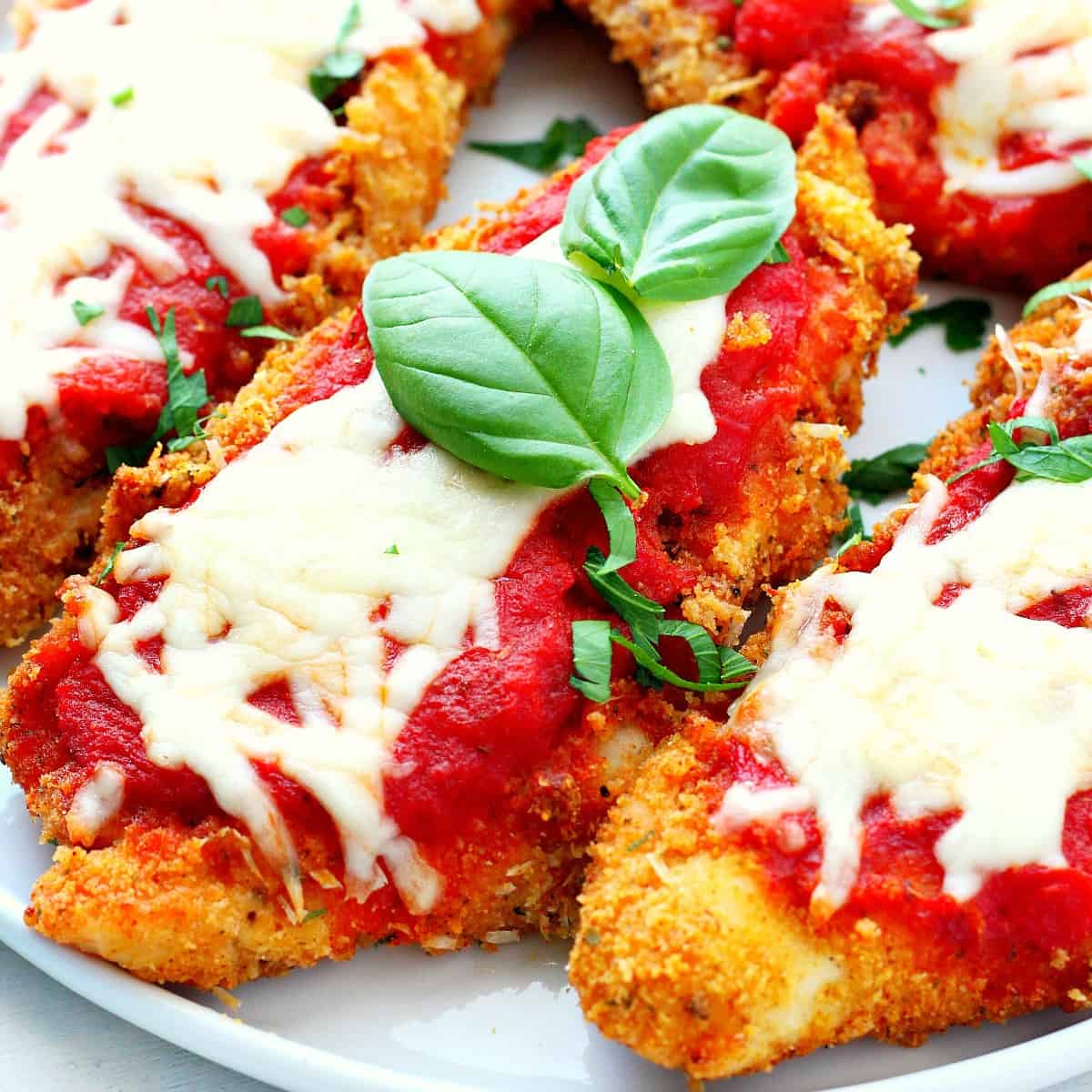
Most Chicken Parmesan recipes treat the dish as a formula: bread it, fry it, sauce it, bake it. But the difference between a forgettable version and a genuinely great one comes down to a handful of decisions most recipes skip past — how thin the cutlet is pounded, how much sauce is too much, and what kind of olive oil actually holds up to the pan. Get those right, and the dish does what it’s always meant to do: crisp edges, tender chicken, sauce that adds brightness instead of soaking through, and cheese that melts into the whole rather than sitting on top of it.
This guide breaks down the technique behind each of those decisions — not just the steps, but why they matter.
Why This Recipe Works
- Even pounding means even cooking. A consistent cutlet thickness (about ¼ inch / 6 mm) prevents the thin edges from drying out before the center finishes.
- The flour-egg-breadcrumb sequence isn't optional. Each layer has a job: the flour gives the egg something to grip, the egg binds the crumbs, and the crumbs deliver the crust.
- Pan-frying before baking builds the crust first. The oven’s job is only to melt the cheese and finish the chicken — not to brown it.
- Sauce restraint protects the crust. A measured amount of sauce, applied so part of the crust stays exposed, is what keeps the dish from turning soggy.
- Oil quality changes the result. Italian extra virgin olive oil contributes flavor while supporting steady, even browning during controlled shallow pan-frying.
Key Takeaways
- Total time: 45 minutes (20 min prep, 25 min cook). Yields 4 servings, one cutlet each.
- Pound cutlets to an even ¼ inch (6 mm) thickness for consistent cooking.
- Use the flour, egg, breadcrumb sequence in that order — skipping the flour weakens the coating.
- Fry at 350°F (175°C), about 3–4 minutes per side, then finish in a 425°F (220°C) oven for 8–10 minutes.
- Use tomato sauce sparingly (about ¼ cup per cutlet) and leave part of the crust exposed.
- Use low-moisture mozzarella, or drain fresh mozzarella thoroughly, to protect the crust.
- Cook to a final internal temperature of 165°F (74°C).
Recipe at a Glance
- Prep Time: 20 minutes
- Cook Time: 25 minutes
- Total Time: 45 minutes
- Yield: 4 servings (1 cutlet per serving)
- Internal Temperature: 165°F (74°C)
Is Chicken Parmesan Really Italian?
Chicken Parmesan is best understood as an Italian-American dish rather than a classic regional Italian recipe in the form commonly served across the United States.
Its culinary background connects two familiar Italian traditions. The first is parmigiana, especially eggplant parmigiana, in which fried slices are layered with tomato sauce and cheese. The second is cotoletta, the Italian tradition of breaded cutlets.
Italian immigrants and their descendants adapted those ideas in the United States, where chicken became widely available. Breaded chicken replaced eggplant as the central ingredient, while tomato sauce, mozzarella, and grated cheese created the dish now known as Chicken Parmesan or Chicken Parmigiana.
Today, it is a culinary tradition in its own right and one of the most recognizable dishes of Italian-American cooking.
Why Is It Called Chicken Parmesan?
The name refers to the parmigiana style of preparing a dish with tomato sauce and cheese. It does not mean that Parmigiano Reggiano is necessarily the only cheese used.
Most American versions combine mozzarella for melting with Parmesan or Parmigiano Reggiano for a sharper, more concentrated flavor.
Chicken Parmesan vs. Chicken Parmigiana
Chicken Parmesan and Chicken Parmigiana generally refer to the same dish. The difference is largely linguistic rather than culinary. “Chicken Parm” is the common shortened American name.
“Parmigiana” reflects the dish’s Italian culinary inspiration, while “Parmesan” became the more familiar English-language term in the United States.
What Is Chicken Parmesan?
Chicken Parmesan begins with thin chicken cutlets coated in flour, beaten egg, and breadcrumbs. The breaded cutlets are cooked until golden, topped with tomato sauce and cheese, and finished in the oven.
A good Chicken Parmesan should have contrasting textures. The exterior should remain crisp around the edges, the chicken should stay tender, the tomato sauce should taste bright and balanced, and the cheese should melt into a smooth topping.
What Does Chicken Parmesan Taste Like?
Chicken Parmesan combines savory, tangy, creamy, and crisp elements in a single dish.
The breading contributes crunch, the marinara adds acidity and sweetness, and the cheeses provide richness and umami. When prepared properly, no single component overwhelms the others.
Chicken Parmesan vs. Eggplant Parmigiana
Eggplant parmigiana is made with fried or baked eggplant layered with tomato sauce and cheese. Chicken Parmesan applies a similar combination of sauce and cheese to a breaded chicken cutlet.
The two dishes share flavor elements, but their textures are different. Eggplant becomes soft and layered, while Chicken Parmesan depends on preserving the contrast between crisp breading and tender meat.
Ingredients for Chicken Parmesan
- Boneless, skinless chicken breasts
- All-purpose flour
- Eggs
- Italian breadcrumbs
- Parmigiano Reggiano
- Mozzarella
- Marinara sauce or passata-based tomato sauce
- Italian extra virgin olive oil
- Fine salt
- Black pepper
- Fresh basil, optional
Ingredient Notes
Chicken breasts
Boneless, skinless chicken breasts are divided into cutlets and pounded to an even thickness. Thin, evenly shaped pieces cook more consistently and provide a better balance between the chicken and its breaded crust.
Flour, egg, and breadcrumbs
Chicken Parmesan typically uses a three-stage breading process: flour, beaten egg, and breadcrumbs.
The flour creates a dry surface for the egg to cling to. The egg forms the binding layer, and the breadcrumbs create the crisp exterior.
Traditional Italian breadcrumbs produce a fine, even coating. Panko creates a lighter and more irregular crust and can be used as a variation.
Parmigiano Reggiano
Parmigiano Reggiano adds a savory, nutty note to both the breadcrumb mixture and the finished dish. It is a protected-origin Italian cheese produced under defined regional and production standards.
Finely grated Parmigiano Reggiano distributes more evenly through the breading and melts smoothly when added to the topping.
Mozzarella
Mozzarella provides the soft, melted layer associated with Chicken Parmesan.
Low-moisture mozzarella melts predictably and releases less water, which helps protect the crisp breading. Fresh mozzarella can also be used, but it should be drained carefully before baking.
Marinara sauce
The tomato sauce should complement the chicken rather than cover it completely. A moderate amount adds acidity and moisture while leaving part of the golden crust exposed.
A balanced sauce with tomatoes, garlic, olive oil, and herbs works well. Excessively thick, sweet, or heavily applied sauce can make the breading soft.
Italian extra virgin olive oil: the differentiator
Most recipes treat the frying oil as an afterthought. It shouldn’t be — the oil is one of the few ingredients that touches every part of the dish, and its quality shows in both the crust and the flavor underneath it.
Extra virgin is the highest grade in the way Italian olive oil is classified, but the classification alone doesn’t guarantee what ends up in the bottle. Authenticity, freshness, and origin all affect how an oil performs under heat and what it tastes like once it’s absorbed into the crust.
For frying cutlets, the goal is shallow pan-frying at a controlled, moderate temperature (about 350°F / 175°C) — steady, even browning rather than high-heat deep frying. Italian extra virgin olive oil contributes flavor while supporting steady, even browning during controlled shallow pan-frying. It’s the difference between a crust that simply browns and one that tastes like something.
Our Italian Extra Virgin Olive Oil (500 mL) is produced and bottled in Italy and works well for this method.
For additional guidance, see how to choose real olive oil and why olive oil tastes peppery.
Chicken Parmesan Recipe
This recipe produces crispy breaded chicken cutlets topped with marinara, mozzarella, and Parmigiano Reggiano. Pan-frying before baking creates a golden crust while allowing the cheese to melt without overcooking the chicken.
Ingredients with Quantities
- 2 large boneless, skinless chicken breasts (about 1½ lb / 680 g total)
- 1 tsp fine salt (5 g)
- ½ tsp black pepper (1 g)
- ½ cup all-purpose flour (65 g)
- 2 large eggs, beaten
- 1 cup Italian breadcrumbs (110 g)
- ½ cup finely grated Parmigiano Reggiano (50 g)
- 6 tbsp Italian extra virgin olive oil (90 mL)
- 1 cup marinara sauce (240 mL)
- 8 oz low-moisture mozzarella, shredded (225 g)
- ¼ cup grated Parmigiano Reggiano (25 g)
- Fresh basil leaves, optional
How to Make Chicken Parmesan
Step 1: Prepare the Chicken
Slice each chicken breast horizontally into two even cutlets. Place the cutlets between sheets of plastic wrap and pound to approximately ¼ inch (6 mm) thickness — an even thickness is what keeps the thin edges from drying out before the center finishes cooking. Season both sides with salt and pepper.
Step 2: Set Up the Breading Station
Place flour in one shallow dish, beaten eggs in a second dish, and breadcrumbs mixed with ½ cup Parmigiano Reggiano in a third dish.
Step 3: Bread the Cutlets
Dredge each cutlet in flour, shaking off excess, then dip into the egg mixture, then coat evenly with the breadcrumb mixture. The flour-egg-breadcrumb order matters: flour gives the egg something to grip, and the egg binds the crumbs.
Step 4: Pan-Fry the Chicken
Heat the olive oil in a large skillet over medium heat until it reaches 350°F (175°C). Fry the cutlets in batches — crowding the pan drops the oil temperature and causes steaming instead of browning — for 3 to 4 minutes per side until golden brown. Transfer to a wire rack rather than paper towels, so trapped steam doesn’t soften the underside.
Step 5: Add Sauce and Cheese
Preheat the oven to 425°F (220°C). Arrange the cutlets on a baking sheet or baking dish. Top each cutlet with about ¼ cup marinara sauce, leaving part of the crisp edge exposed. Add mozzarella and the remaining Parmigiano Reggiano.
Step 6: Bake and Serve
Bake for 8 to 10 minutes until the cheese is melted and bubbling. Verify that the thickest part of the chicken reaches 165°F (74°C). Rest briefly, garnish with basil if desired, and serve immediately — the longer the dish sits, the more moisture works into the crust.
How to Keep Chicken Parmesan Crispy
Crispness is lost in small, avoidable ways — a wet cutlet, a crowded pan, too much sauce, a lid left on too long. None of these mistakes are dramatic on their own, but they compound. The details below address each point where crispness is typically lost:
- Before breading: Pat the chicken dry. Moisture on the surface interferes with how the flour and egg adhere.
- During breading: Follow the flour, egg, breadcrumb sequence in order, and let the coating set briefly before frying.
- During frying: Cook the cutlets in batches without crowding the pan.
- After frying: Drain the cutlets on a wire rack, not paper towels.
- When saucing: Use a measured amount of sauce and leave part of the crust exposed rather than fully covering the cutlet.
- When topping: Use well-drained or low-moisture mozzarella so excess water doesn’t run into the crust as it melts.
- At serving: Serve shortly after the oven finish.
Common Mistakes When Making Chicken Parmesan
- Skipping the flour layer before breading.
- Using thick or uneven cutlets.
- Applying excessive sauce.
- Using fresh mozzarella without draining it.
- Crowding the skillet.
- Overcooking the chicken.
- Not verifying the internal temperature.
Variations
Baked Chicken Parmesan
Baked Chicken Parmesan skips the pan-frying step and cooks the breaded cutlets in the oven. It uses less oil, but the crust will generally be softer than the pan-fried version.
Panko Chicken Parmesan
Panko breadcrumbs can be used for a lighter, more irregular crust. They produce a different texture from fine Italian breadcrumbs and work best as a deliberate variation.
Fresh Mozzarella Chicken Parmesan
Fresh mozzarella can replace low-moisture mozzarella if it is drained thoroughly. Because it contains more water, it may soften the breading more quickly.
Chicken Thigh Parmesan
Boneless chicken thighs can be used for a richer flavor. Their thickness and shape differ from chicken breasts, so the cooking time must be adjusted while still reaching the same safe internal temperature.
What to Serve with Chicken Parmesan
Pasta
- Spaghetti with tomato sauce
- Linguine
- Fettuccine
Vegetables
- Roasted broccoli
- Roasted zucchini
- Sautéed spinach
Salads
- Mixed green salad
- Arugula salad
- Caesar salad
Bread
- Garlic bread
- Italian bread
- Toasted focaccia
Straightforward sides allow the crisp chicken, tomato sauce, and cheese to remain the focus. For another Italian-American comfort-food recipe, see our Zuppa Toscana recipe.
Can Chicken Parmesan Be Made Ahead?
Yes. The chicken can be breaded several hours in advance and refrigerated until ready to cook. Marinara sauce can also be prepared ahead of time.
For the best texture, add the sauce and cheese just before baking so the breading remains as crisp as possible.
Storage and Reheating
Refrigeration
Refrigerate leftover Chicken Parmesan within two hours of cooking. Store it in shallow, covered containers at 40°F (4°C) or below and use it within 3 to 4 days.
Freezing
Chicken Parmesan can be frozen after cooking. Wrap portions tightly or store them in airtight freezer containers.
Food kept continuously frozen at 0°F (-18°C) remains safe indefinitely, although quality declines over time. For the best texture, use frozen portions within the recommended quality period.
Reheating
Reheat Chicken Parmesan until the center reaches 165°F (74°C). An oven or air fryer generally preserves the breading better than a microwave.
Frequently Asked Questions
Can I bake Chicken Parmesan instead of frying?
Yes. Breaded chicken cutlets can be baked instead of pan-fried. Baking uses less oil and can simplify preparation for larger batches. The crust is usually less crisp than a fried version, but the dish still develops the characteristic combination of chicken, marinara sauce, and melted cheese.
What cheese is best for Chicken Parmesan?
A combination of low-moisture mozzarella and Parmigiano Reggiano is the most common choice. Mozzarella provides the melted topping associated with the dish, while Parmigiano Reggiano contributes a deeper savory flavor.
Can I make Chicken Parmesan ahead of time?
Yes. The breaded chicken can be prepared several hours in advance and refrigerated until cooking time. Marinara sauce can also be prepared ahead. Delaying final assembly until shortly before baking helps maintain a crisp texture.
Can I freeze Chicken Parmesan?
Yes. Cooked Chicken Parmesan freezes well when cooled completely and stored in airtight containers. Reheat thoroughly before serving. Although the breading may soften slightly, freezing remains a practical option for meal preparation.
Why does my breading fall off?
Breading commonly separates when the chicken surface is too wet, the flour layer is skipped, or the coating is disturbed before it has time to set during frying. Allowing breaded cutlets to rest briefly before cooking can improve adhesion.
Can I use chicken thighs?
Yes. Boneless, skinless chicken thighs can replace chicken breasts and provide a richer flavor. Because thighs vary in thickness, cooking times may differ. Always verify that the internal temperature reaches 165°F (74°C).
What should I serve with Chicken Parmesan?
Pasta remains the classic accompaniment, but garlic bread, roasted vegetables, sautéed greens, and simple salads also pair well. The best side dishes provide balance while allowing the chicken, sauce, and cheese to remain the focus of the meal.
Sources
Historical and culinary background
For how Chicken Parmesan evolved from Southern Italian eggplant parmigiana and the Italian breaded-cutlet (cotoletta) tradition into an Italian-American classic, see La Cucina Italiana’s Chicken Parmigiana: Italian American At Home.
Food safety
For safe poultry cooking temperatures (165°F / 74°C), refrigeration, freezing, and reheating guidance, refer to FoodSafety.gov, the joint USDA/FDA consumer resource.
Olive oil in cooking
For guidance on olive oil and how it behaves during frying, refer to the International Olive Council, the intergovernmental body that sets international olive oil standards.

