
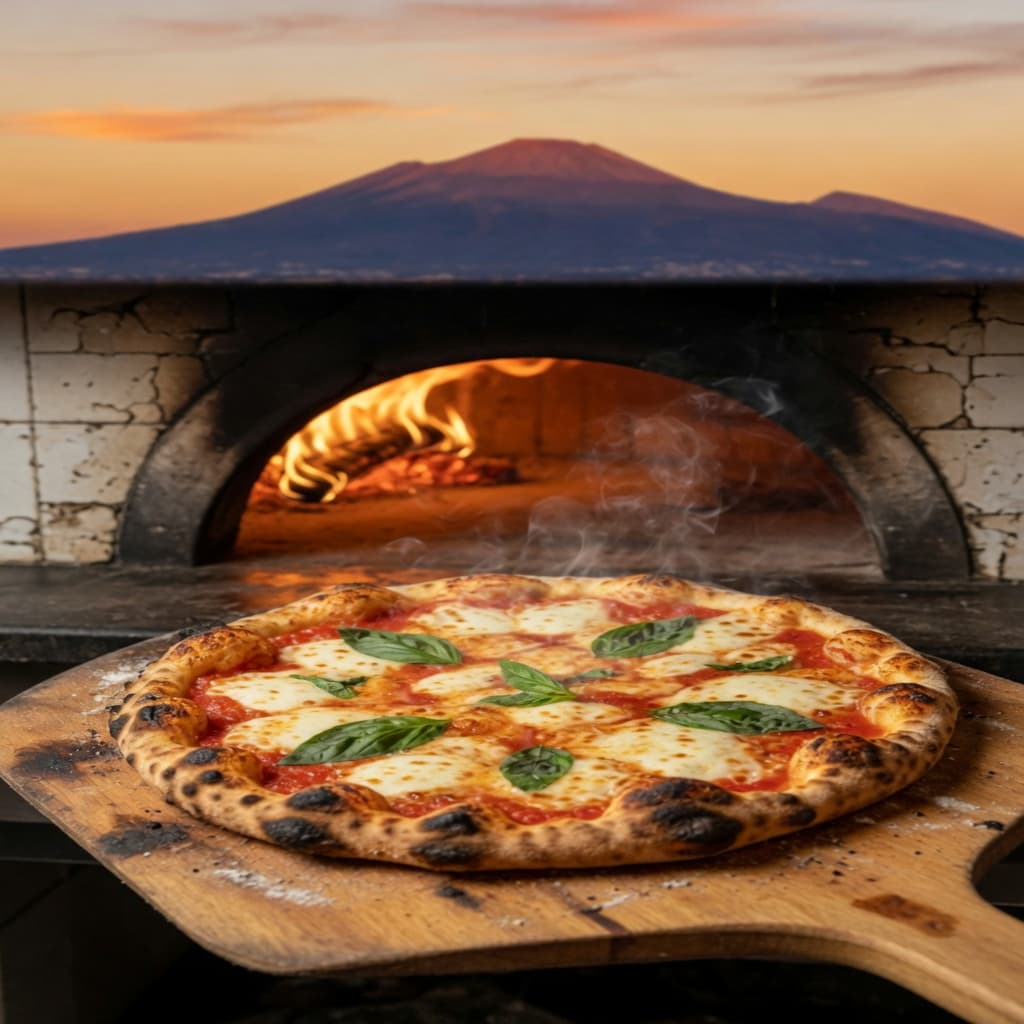
Pizza Napoletana STG: Italy's Protected Recipe and the US Gap
Pizza Napoletana STG is the European Union’s registered traditional specification for Neapolitan pizza. It defines dough characteristics, hand shaping, ingredient categories, baking conditions, and the Marinara and Margherita variants. STG means Specialità Tradizionale Garantita, or Traditional Speciality Guaranteed (TSG).
Quick Answer
- What is Pizza Napoletana STG? Pizza Napoletana STG is the European Union’s registered traditional specification for Neapolitan pizza. It defines dough characteristics, hand shaping, ingredient categories, baking conditions, and the Marinara and Margherita variants. STG means Specialità Tradizionale Garantita, or Traditional Speciality Guaranteed (TSG).
- Must Pizza Napoletana STG be made in Naples? No. Pizza Napoletana STG protects a traditional method and product specification rather than geographic origin. A qualifying pizza may be produced outside Naples and outside Italy. Ingredient designations such as Mozzarella di Bufala Campana DOP have separate geographic requirements.
- Are STG, AVPN, and UNESCO the same recognition? No. EU STG protection concerns a registered product specification; AVPN administers a separate private certification system; UNESCO recognizes the cultural art of the Neapolitan pizzaiuolo. Their functions differ, and one does not establish compliance with another.
Key Facts
The following table summarizes the registered specification. It is a reader-facing reference and does not replace the binding legislative text.
| Requirement | Registered standard |
|---|---|
| Protection type | Traditional Speciality Guaranteed (STG / TSG) |
| Recognized variants | Marinara and Margherita |
| Flour | Type 00 or Type 0 soft wheat flour; W-index 220–380; P/L ratio 0.50–0.70 |
| Water-to-flour proportion | Approximately 1 litre of drinkable water to 1.8 kg of flour (approximately 55% hydration) |
| Yeast | 3 g of fresh brewer’s yeast per litre of water |
| Salt | 50–55 g of sea or table salt per litre of water |
| Fermentation | Approximately 2 hours bulk rise, followed by 4–6 hours in individual dough balls |
| Dough ball weight | 180–250 g |
| Shaping | By hand only; rolling pins and mechanical disc presses are prohibited |
| Maximum diameter | 35 cm |
| Centre thickness | 0.4 cm ±10% |
| Cornicione height | 1–2 cm |
| Oven | Wood-fired oven (forno a legna) |
| Baking conditions | 485 °C for 60–90 seconds |
| Oil | Extra virgin olive oil is required |
Source: Commission Regulation (EU) No 97/2010, Annex II. Consult the binding legislation in the Primary regulatory sources section below.
How does STG differ from DOP and IGP?
The European Union operates distinct quality schemes for agricultural products and foodstuffs. These protections are often conflated in commercial language, but they perform different legal functions.
| Scheme | What it protects | Geographic link | Example in this guide |
|---|---|---|---|
| STG / TSG Specialità Tradizionale Garantita / Traditional Speciality Guaranteed |
Traditional production methods and registered product specifications | No geographic origin is required; the protected subject is the traditional practice and specification | Pizza Napoletana STG |
| DOP / PDO Denominazione di Origine Protetta / Protected Designation of Origin |
Products whose quality and characteristics are tied to a defined place of origin | Mandatory and exclusive; all production stages occur in the defined geographic area | Mozzarella di Bufala Campana DOP; Pomodoro San Marzano dell’Agro Sarnese-Nocerino DOP |
| IGP / PGI Indicazione Geografica Protetta / Protected Geographical Indication |
Products associated with a region where at least one qualifying production stage occurs | Mandatory, but less geographically restrictive than PDO | A protected geographical indication for qualifying food products |
Pizza Napoletana is registered under the STG scheme. It may therefore be produced outside Naples and outside Italy when the registered specification is followed. By contrast, Mozzarella di Bufala Campana and Pomodoro San Marzano dell’Agro Sarnese-Nocerino are DOP products whose production is tied to legally defined Italian territories.
These systems are complementary rather than interchangeable. Pizza Napoletana STG protects the traditional pizza specification; San Marzano DOP protects a defined tomato designation; and Mozzarella di Bufala Campana DOP protects a defined cheese designation.
How did Pizza Napoletana gain protection of its name?
Pizza Napoletana entered the European register of traditional specialities guaranteed through Commission Regulation (EU) No 97/2010 of 4 February 2010. The 2010 TSG registration application named both the Associazione Verace Pizza Napoletana (AVPN) and the Associazione Pizzaiuoli Napoletani (APN) as applicant groups. The registration was initially granted without reservation of name under the then-applicable EU framework.
From 2010 until 2022, producers within the European Union could use the name “Pizza Napoletana,” but only producers following the registered specification could use the STG mark and the wording “Prodotta secondo la Tradizione napoletana” (“Produced in the Neapolitan tradition”).
The position changed through Commission Implementing Regulation (EU) 2022/2313. Following an application submitted by Italy under the Article 26 procedure, the regulation granted reservation of the name “Pizza Napoletana.” It entered into force on 18 December 2022. From that date, use of the designation within the European Union is reserved for products that comply with the registered specification.
Enforcement within Italy is administered by the Ispettorato Centrale della tutela della Qualità e della Repressione Frodi (ICQRF), the inspectorate of Italy’s Ministry of Agriculture, Food Sovereignty and Forests (MASAF). The protection is territorial: it applies within the European Union and may receive recognition outside the EU only through applicable international agreements or domestic legal mechanisms.
Legal distinction: Pizza Napoletana STG is not a claim that every qualifying pizza was produced in Naples. It is a claim that the product follows the registered traditional specification.
Which ingredients does Pizza Napoletana STG require?
Pizza Napoletana STG is a product specification, but its ingredients operate across different provenance systems. The pizza itself is STG; certain ingredient designations may be DOP/PDO or IGP/PGI; and other required categories, including extra virgin olive oil, are governed by their own product standards and provenance frameworks.
Wheat flour
The specification requires Type 00 or Type 0 soft wheat flour meeting defined rheological parameters. It does not name a mill, producer, or commercial flour brand. Compliance depends on technical characteristics, including the flour’s W-index and P/L ratio.
Tomatoes
The registered specification permits peeled and/or fresh tomatoes that meet the relevant ingredient requirements. It references tomato categories that include Pomodoro San Marzano dell’Agro Sarnese-Nocerino DOP alongside other named cultivars.
Pizza Napoletana STG does not itself convert every tomato into a DOP product. The San Marzano designation is governed by a separate protected-origin framework. For the production zone, designation rules, and labeling distinction, see San Marzano DOP: Italy’s Protected Tomato.
Mozzarella
For Pizza Napoletana Margherita under the EU STG specification, the permitted protected cheese options are Mozzarella di Bufala Campana DOP or Mozzarella STG. These are legally distinct designations: Mozzarella di Bufala Campana is a buffalo-milk protected designation of origin, while Mozzarella STG identifies a traditional speciality guaranteed made through the relevant pasta-filata method.
For the protected-origin framework, production area, and terminology associated with buffalo mozzarella, see Mozzarella di Bufala Campana DOP.
Extra virgin olive oil
The Pizza Napoletana STG specification requires extra virgin olive oil. It does not prescribe a DOP, IGP, cultivar, or producing region. Italian olive-oil DOP and IGP designations are a separate framework, covering an oil’s origin and production rules.
For the separate rules governing an oil’s geographic provenance, see Italian Olive Oil DOP and IGP. Pizza Napoletana STG does not itself require an oil with either designation.
For practical bottle-selection guidance, read how to choose real olive oil. To explore Milan Truffle’s available oils, browse the Italian olive oil collection or view our 100% Italian extra virgin olive oil. These shopping links are separate from the STG specification, which does not prescribe a brand.
For Margherita and Marinara, explore our olive oil for pizza: Lumìa, a 100% Italian early-harvest extra virgin olive oil for the toppings before baking and a raw drizzle after the oven. The same page covers our white and black truffle-infused oils, which are added only after baking.
Salt, yeast, and water
Sea or table salt, fresh brewer’s yeast, and drinkable natural water complete the required dough ingredients. The specification prescribes proportions and technical handling but does not impose proprietary suppliers or geographic-origin requirements for these inputs.
How must Pizza Napoletana STG be prepared and baked?
The defining element of STG protection is the registered preparation method. The specification governs dough handling, shaping, dimensions, and baking conditions rather than simply describing a visual pizza style.
Dough and fermentation
The dough follows a two-stage rising process: approximately two hours in bulk, followed by four to six hours after division into individual panetti weighing 180–250 g. The stated flour range, water proportion, yeast quantity, salt quantity, and fermentation sequence are part of the registered method.
Hand shaping
The dough ball is shaped exclusively by hand. The pizzaiuolo works from the centre toward the perimeter to displace gas and form the raised cornicione. Rolling pins and mechanical disc presses are expressly prohibited by the specification.
The registered rationale is functional rather than decorative. Use of a rolling pin or mechanical press can leave a layer of air trapped in the centre of the dough disc, preventing the cornicione from forming correctly during baking. A pizza shaped with a rolling pin or mechanical press does not satisfy the STG specification even if its finished appearance resembles a Neapolitan pizza.
The finished pizza must not exceed 35 cm in diameter. The central section measures 0.4 cm thick with a tolerance of ±10%, while the cornicione measures 1–2 cm in height.
Wood-fired baking
Under the EU STG specification, Pizza Napoletana is baked in a wood-fired oven at 485 °C for 60–90 seconds. The short bake and high-temperature environment are part of the registered production method. A pizza baked at a lower temperature for a longer duration may resemble a Neapolitan pizza visually without satisfying the STG specification.
Visual appearance is not compliance
Leopardatura, the irregular dark spotting visible on the cornicione, is often treated as a shorthand for Neapolitan pizza authenticity. It is not sufficient evidence of STG compliance. Compliance depends on the cumulative registered requirements: flour characteristics, dough proportions, fermentation, hand shaping, dimensions, required ingredients, wood-fired baking, temperature, and time.
Technical note: dough rheology and oven conditions
The specification refers to the dough’s technical behavior through flour W-index and P/L ratio rather than commercial flour brands. The W-index, measured by the Chopin alveograph, expresses flour strength. The P/L ratio expresses tenacity relative to extensibility. Together, the registered range supports a dough that can be fermented, hand-shaped, and baked rapidly at the specified temperature.
The wood-fired oven environment combines radiative heat from the dome, conductive heat from the cooking floor, and convective heat from the oven chamber. These conditions help explain why the specification pairs a high baking temperature with a 60–90-second bake rather than treating time and temperature as independently interchangeable.
Which Pizza Napoletana STG variants are recognized?
The EU STG specification recognizes two named Pizza Napoletana variants: Marinara and Margherita. Both share the same dough, shaping, and baking requirements. They differ in topping architecture.
Pizza Napoletana Marinara
Marinara is topped with peeled and/or fresh tomatoes, garlic, oregano, and extra virgin olive oil. It contains no cheese and no basil. Under the STG specification, its ingredient architecture is specific and does not include broad topping substitutions.
Pizza Napoletana Margherita
Margherita is topped with peeled and/or fresh tomatoes, mozzarella, fresh basil, and extra virgin olive oil. Under the EU STG specification, the cheese category permits Mozzarella di Bufala Campana DOP or Mozzarella STG.
What does AVPN certification establish?
The Associazione Verace Pizza Napoletana (AVPN) is a Naples-based non-profit association that administers the “Vera Pizza Napoletana” collective brand and its own International Regulations. AVPN certification predates the EU STG registration and provides a voluntary international compliance and training framework for participating pizzerias.
AVPN certification is not the same thing as EU STG protection. The EU system protects the registered Pizza Napoletana product specification within its legal territory. AVPN administers a separate private certification system that applies to participating establishments under its own disciplinary rules.
The systems are aligned at a high level and share a common Neapolitan tradition, but they are not interchangeable. A pizzeria can be AVPN-certified while using practices or equipment that differ from the EU STG specification.
How do AVPN and EU STG requirements differ?
The EU STG specification and the AVPN International Disciplinary are often treated as if they were a single rulebook. They are not. Both protect a recognizable Neapolitan tradition, but they differ in specific technical and ingredient requirements.
| Element | EU STG specification | AVPN disciplinary |
|---|---|---|
| Central thickness | 0.4 cm ±10% | 0.25–0.30 cm ±10% |
| Total fermentation | Approximately 6–8 hours: 2 hours bulk plus 4–6 hours in panetti | Typically 12–24 hours under controlled conditions |
| Flour W-index | 220–380 | 250–320 for Type 00 flour |
| Salt per litre of water | 50–55 g | 40–60 g |
| Yeast | 3 g fresh brewer’s yeast per litre of water | 0.1–3 g per litre, with natural sourdough permitted under stated conditions |
| Oven type | Wood-fired oven only | Wood-fired; specified certified gas or electric ovens may be permitted by AVPN derogation |
| Margherita cheese | Mozzarella di Bufala Campana DOP or Mozzarella STG | Broader qualifying options can include bufala, cow’s-milk mozzarella, or fior di latte under AVPN rules |
| Named variants | Marinara and Margherita | Includes Marinara, Margherita, and additional traditional forms under AVPN rules |
These differences have practical consequences. For example, a pizzeria using an AVPN-approved gas or electric oven and qualifying fior di latte may comply with AVPN rules while not meeting the EU STG requirement for a wood-fired oven and the STG cheese provisions. The systems should not be treated as competing definitions of “real” pizza; they are separate frameworks with different authorities and scopes.
What did UNESCO recognize about the Neapolitan pizzaiuolo?
UNESCO inscribed the Art of Neapolitan “Pizzaiuolo” on the Representative List of the Intangible Cultural Heritage of Humanity in 2017. The inscription concerns the craft and social practice of the Neapolitan pizzaiuolo, including knowledge transmission, dough preparation, shaping, and baking practice.
UNESCO did not create a food-labeling certification for pizza. Its recognition concerns intangible cultural heritage. EU STG protection concerns a registered product specification. AVPN certification concerns a private collective mark and disciplinary. Each framework has a different function.
What does “Neapolitan pizza” mean in the United States?
EU STG protection applies within the European Union. Outside the EU, recognition depends on applicable international agreements and domestic legal frameworks. In the United States, “Neapolitan pizza” is not itself a protected food-labeling designation equivalent to the EU STG.
As a result, a US establishment may describe a product as “Neapolitan pizza” or “Neapolitan-style pizza” without demonstrating compliance with either the EU STG specification or AVPN rules. That fact does not establish whether a particular pizza is good or bad. It establishes that the label alone does not communicate a regulated US standard.
The American pizza landscape includes styles and topping traditions that differ from the Pizza Napoletana STG specification. For one example of that Italian-American evolution, see Pepperoni: Origins, Definition, and Italian-American History.
For US diners and readers, AVPN certification can serve as a useful voluntary indicator that a participating pizzeria follows the association’s separate disciplinary. Current member status should be verified through the official AVPN member directory because certifications and participating locations may change.
Practical takeaway: In the United States, “Neapolitan pizza” is not by itself proof of EU STG compliance. Look for clear disclosure of the producer’s standards, distinguish AVPN certification from EU STG protection, and evaluate ingredient provenance claims on their own terms.
Which primary sources document Pizza Napoletana STG?
The sources below are grouped by authority. European Union legislation is the primary source for the Pizza Napoletana STG registration and reservation of name.
Primary EU legislation
- Commission Regulation (EU) No 97/2010 of 4 February 2010 entering a name in the register of traditional specialities guaranteed (Pizza Napoletana (TSG)) (opens in a new tab)
- Commission Implementing Regulation (EU) 2022/2313 of 25 November 2022 entering a name in the register of traditional specialities guaranteed (Pizza Napoletana (TSG)) (opens in a new tab)
- Regulation (EU) No 1151/2012 on quality schemes for agricultural products and foodstuffs (opens in a new tab)
Official institutional sources
- Associazione Verace Pizza Napoletana: official site and International Regulations (opens in a new tab)
- Associazione Verace Pizza Napoletana: official member directory (opens in a new tab)
- UNESCO: Art of Neapolitan “Pizzaiuolo” (opens in a new tab)
Related Milan Truffle guides
- San Marzano DOP: Italy’s Protected Tomato
- Mozzarella di Bufala Campana DOP: Origins, History, and Protected Designation
- Italian Olive Oil DOP and IGP
- Italian Pesto and the Genovese DOP
Frequently asked questions
What is Pizza Napoletana STG?
Pizza Napoletana STG is a traditional Italian pizza protected under the European Union Traditional Speciality Guaranteed scheme. The registration protects a defined production specification, including dough characteristics, shaping, baking conditions, ingredient categories, and named variants. It does not restrict production to Naples.
What does STG mean?
STG means Specialità Tradizionale Garantita, or Traditional Speciality Guaranteed in English. Unlike DOP/PDO and IGP/PGI, STG protection is based on a traditional product specification or preparation method rather than a mandatory geographic origin.
How does Pizza Napoletana STG differ from DOP and IGP?
Pizza Napoletana STG protects a traditional pizza specification. DOP/PDO protects products whose production is tied to a defined geographic origin, while IGP/PGI protects products with a qualifying regional link. Mozzarella di Bufala Campana and Pomodoro San Marzano dell’Agro Sarnese-Nocerino are examples of DOP products associated with the broader Neapolitan pizza ingredient context.
Does Pizza Napoletana STG require extra virgin olive oil?
Yes. The Pizza Napoletana STG specification requires extra virgin olive oil. It does not prescribe a specific DOP, IGP, cultivar, region, producer, or olive-oil brand.
Which cheese is permitted for Pizza Napoletana Margherita under EU STG?
Under the EU STG specification, Margherita permits Mozzarella di Bufala Campana DOP or Mozzarella STG. AVPN rules may allow broader qualifying cheese options under the association’s separate disciplinary.
What are the two Pizza Napoletana STG variants?
The EU STG specification recognizes Marinara and Margherita. Marinara includes tomatoes, garlic, oregano, and extra virgin olive oil. Margherita includes tomatoes, mozzarella, basil, and extra virgin olive oil.
Does Pizza Napoletana STG require a wood-fired oven?
Yes. Under the EU STG specification, Pizza Napoletana is baked in a wood-fired oven at 485 °C for 60–90 seconds. AVPN may permit specified certified gas or electric ovens under its separate rules.
Is AVPN certification the same as Pizza Napoletana STG?
No. AVPN certification is a voluntary private certification system administered by the Associazione Verace Pizza Napoletana. Pizza Napoletana STG is an EU legal product-specification framework. The systems overlap but differ on specific matters including oven type, fermentation, thickness, cheese options, and named variants.
What did UNESCO recognize in 2017?
UNESCO recognized the Art of Neapolitan “Pizzaiuolo” as intangible cultural heritage. The inscription concerns the living craft and cultural practice of the pizzaiuolo, not a food-labeling or product-certification system.
Is “Neapolitan pizza” a regulated label in the United States?
No equivalent US food-labeling rule automatically requires compliance with the EU Pizza Napoletana STG specification. US establishments may use “Neapolitan pizza” or “Neapolitan-style pizza” without demonstrating EU STG or AVPN compliance.

