
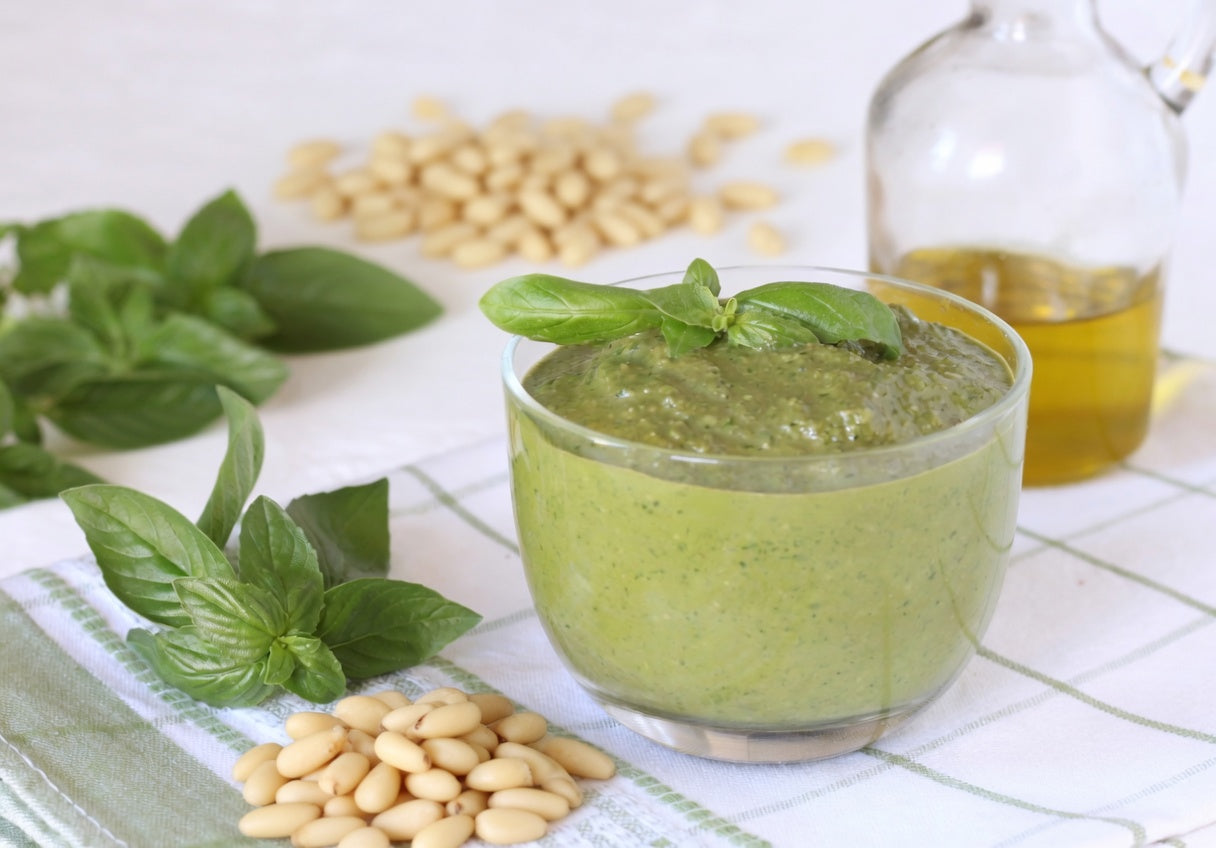
Most Americans know pesto as a single thing: the bright green basil sauce from a jar, tossed with pasta, named after a city in northern Italy.
That's about a third of the actual story.
"Pesto" in Italian is not the name of a sauce — it's the name of a technique. The word comes from pestare, the verb for pounding or crushing in a mortar. Anything pounded into a paste with a pestle can be called a pesto. Italy has at least a dozen regional pestos, but the two that matter most for global cuisine sit at almost opposite ends of the country and carry almost opposite ingredient lists: Pesto alla Genovese, the Ligurian original, and Pesto alla Trapanese, its Sicilian sister, born in the same century from the same Genoese tradition but rebuilt around what the western Sicilian coast actually grew.
This is the story of where both pestos come from, what their official ingredients actually are, why most jarred pesto in American supermarkets is neither, and what the maritime history of sixteenth-century Genoa has to do with it.
Origin: A Verb, Not a Noun
The word pesto is the past participle of pestare — to pound, to crush, to grind. It shares a Latin root with pistillum (pestle) and the modern Italian pestone (a heavy pounding tool). What unifies every pesto is not the basil, not the pine nuts, not the cheese, but the technique: raw ingredients reduced to a paste through pounding rather than cooking.
According to Encyclopaedia Britannica, pesto in its modern form is documented to nineteenth-century Genoa, but the broader tradition of pounded raw sauces in southern Europe is much older. The Romans had moretum, a pounded cheese-and-herb paste described by Virgil. Medieval Italian cookbooks describe agliata — a garlic-and-walnut pound used as both condiment and medicine. The Genoese basil sauce that the world now calls "pesto" is one branch of a much older Mediterranean tradition.
Pesto is the technique. The Genovese and Trapanese versions are two regional answers to the same question: what do you pound, when you pound it raw, with what's around you.
Pesto alla Genovese: The Ligurian Original
Pesto alla Genovese as written today comes out of nineteenth-century Genoa. The first recorded recipe dates to the mid-1800s, but the tradition behind it is older. The Consorzio del Pesto Genovese cites a legend that the original basil-and-pine-nut paste was developed by a monk at the convent of San Basilio on the heights above Genoa, who mixed basil with the pine nuts and garlic offered by pilgrims. Whether or not that's literally true, it captures the geography: Genoese pesto is a coastal product, born within sight of the Mediterranean, on terraced hillsides where basil grows year-round in the maritime climate.
The seven canonical ingredients, codified by the Consorzio del Basilico Genovese DOP and the Consorzio del Pesto Genovese, are:
- Basilico Genovese DOP — at least 25% by weight of the final pesto
- Italian extra virgin olive oil — preferably from the Riviera Ligure, with a delicate flavor profile that doesn't dominate
- Parmigiano Reggiano DOP — aged at least 24 months (Grana Padano DOP is permitted as a variant)
- Pecorino Sardo DOP — specifically the Fiore Sardo aged sheep's-milk variety
- Pine nuts — from Pinus pinea, Mediterranean origin
- Garlic — Italian, dolce (sweet), used sparingly so it backs the basil rather than overpowering it
- Coarse sea salt — Italian
The recipe itself is not DOP-protected. EU law protects ingredients (Basilico Genovese DOP, Parmigiano Reggiano DOP, Grana Padano DOP, Pecorino Sardo DOP, Olio Extravergine Riviera Ligure DOP), not the assembled sauce. An authentic Pesto alla Genovese is essentially a stack of DOP-protected ingredients combined according to a specification published by the Consorzio del Pesto Genovese, headquartered in Genoa.
Basilico Genovese DOP: What Makes the Basil Different
The defining ingredient of Pesto alla Genovese is the basil. Basilico Genovese DOP earned EU Protected Designation of Origin in October 2005, with the Consorzio di Tutela officially recognized by Italy's Ministry of Agriculture in 2008. The DOP applies only to basil grown on the maritime slopes of Liguria — the narrow coastal strip facing the Ligurian Sea — using authorized native cultivars (primarily "Gigante Genovese" and "Nano Compatto"), in natural soil, following the published disciplinare registered with the EU.
What makes Ligurian basil distinctive is measurable. Peer-reviewed Italian food-science research published in Foods and led by the University of Naples Federico II identifies the chemical signature of Basilico Genovese DOP as a high content of linalool and eugenol combined with the absence of estragole — the last point being the critical differentiator. Many basil chemotypes from outside Italy, including tropical and Indian varieties, are dominated by estragole (also called methyl chavicol) as their primary aromatic compound; Genovese DOP basil specifically lacks it, which is what produces its sweet, floral, anise-free aroma. The same paper documents trans-α-bergamotene as a sesquiterpene marker that increases substantially in second-harvest Genovese cultivars, alongside rosmarinic acid — the most abundant phenolic in basil leaves and a primary radical-scavenging antioxidant. The broader compound profile of Ocimum basilicum has been documented in additional peer-reviewed reviews published in Frontiers in Pharmacology and the Iranian Journal of Basic Medical Sciences.
Sweet basil (Ocimum basilicum) — the species used in pesto — should not be confused with holy basil or tulsi (Ocimum sanctum), a related but distinct species used in South Asian Ayurvedic traditions and not in Italian cooking. The two plants have different chemistries, different aromas, and different research literatures. Most popular health-related coverage of "basil" actually concerns tulsi, not sweet basil.
For pesto, what matters is that the maritime climate of coastal Liguria and cultivation in natural soil produce a phytochemical profile that other growing regions don't replicate at the same concentration. The Basilico di Pra' park, inaugurated in 2006 at Villa Lomellini-Doria-Podestà in Genoa, exists specifically to preserve and document the cultivation. The volatile oils in Ligurian basil leaves break cleanly under the pestle, releasing aromatic compounds that bond with olive oil into a stable emulsion. Pesto made with industrial supermarket basil tastes different from pesto made with Basilico Genovese DOP because the molecular composition isn't the same.
The King: Why Extra Virgin Olive Oil Anchors Real Pesto
If basil is the prince of pesto, extra virgin olive oil is the king. The Consorzio del Pesto Genovese is the only one of the seven canonical ingredients to specify a named regional DOP — Olio Extravergine Riviera Ligure DOP — rather than simply "Italian." That specificity is structural, not stylistic.
EVOO does the structural work that turns pounded basil, pine nuts, garlic, and cheese from a paste into a sauce. It's the binder, the emulsifier, the carrier for every aromatic compound the basil releases under the pestle, and the volume ingredient that sits second only to the basil itself in the final composition. Without extra virgin olive oil, pesto isn't pesto — it's a green-tinted ground paste. Mediterranean tradition has called extra virgin olive oil "liquid gold" for centuries, and in pesto specifically, that role is structural.
The Consorzio specifies Riviera Ligure DOP for a reason: the Ligurian coastal climate produces an olive oil with a delicate flavor profile — light, slightly sweet, low in pungency — that supports the basil without competing with it. The dominant olive variety in Liguria is Taggiasca, a small black-purple olive grown in terraced groves on the same maritime slopes where Basilico Genovese DOP is cultivated. A Taggiasca-based EVOO doesn't dominate; it carries. By contrast, an aggressive Tuscan or Pugliese EVOO — peppery, bitter, robust — would overwhelm the basil and unbalance the pesto entirely. The choice of regional EVOO is not arbitrary; it is structural to the recipe.
This is also where industrial jarred pesto collapses most decisively. The single biggest substitution in supermarket pesto is not the basil and not the cheese — it's the oil. Mass-produced pesto routinely substitutes sunflower oil, canola oil, soybean oil, or "vegetable oil blends" for extra virgin olive oil, often listing EVOO as a minority ingredient or omitting it entirely. The reason is purely economic: EVOO costs many multiples of seed oils per liter. The result is a pesto where the structural king has been quietly swapped out, leaving basil, garlic, and cheese suspended in a flavorless, lower-quality fat that fails to carry the aromatic compounds the way authentic EVOO does.
The simplest test of any pesto's authenticity is to read its ingredient list and check what oil it uses. If extra virgin olive oil isn't the first or second ingredient — and isn't from Italy — the rest of the recipe doesn't matter.
Pesto alla Trapanese: The Sicilian Sister
Pesto alla Trapanese — known in Sicilian dialect as agghiata trapanisa or pasta cull'agghia — comes from the port city of Trapani on the western coast of Sicily, roughly 1,200 kilometers south of Genoa. It is recognized by the Italian Ministry of Agriculture as a Prodotto Agroalimentare Tradizionale (PAT), the designation Italy uses for traditional regional products that don't carry full DOP/IGP status but are nonetheless legally documented as part of the country's culinary heritage.
The historical link to Genoa is direct, not coincidental. In the sixteenth and seventeenth centuries, Genoese merchant ships made regular stops at the port of Trapani — strategically located on the western tip of Sicily, on trade routes between Genoa and the eastern Mediterranean. The sailors brought with them their agliata, the pounded garlic-and-walnut sauce that was the Ligurian everyday condiment of the period. Trapanese fishermen and farmers, working with what their land actually produced, rebuilt the recipe around local ingredients:
- Almonds from the Avola and Belice valleys, replacing the pine nuts of Liguria
- Fresh ripe tomato, added as a primary ingredient — Sicily's defining vegetable
- Sicilian basil, native to the island
- Pecorino Siciliano, the local sheep's-milk cheese, replacing the Sardinian and Reggio Emilian cheeses of the Genoese version
- Nubia red garlic, a Slow Food Presidium product cultivated only in small areas around Trapani
- Sicilian extra virgin olive oil, often from the Belice or Trapani-area frantoi
- Sea salt — historically from the famous Trapani salt pans, in production since at least Phoenician times
The result is a pesto that is structurally Genoese (raw, pounded, basil-and-garlic-anchored, finished with hard cheese and olive oil) but visually and gustatorily Sicilian (red rather than green from the tomato, drier and more granular from the almonds, more aromatic from the Nubia garlic). It is sometimes called pesto rosso for the color. Its traditional pasta pairing is busiati — a hand-rolled twisted Sicilian pasta shape made by wrapping fresh dough around a thin reed (the busa) — a combination that the Italian Ministry of Agriculture lists as a PAT under the name busiati con pesto trapanese.
Pesto alla Trapanese is not a Sicilian invention copied from Genoa. It is a Sicilian reconstruction of a Genoese sauce, built from sixteenth-century maritime trade and four centuries of Sicilian adaptation.
The Mortar Question
The technique that gives pesto its name is also the technique that produces the best result. A marble mortar and a wooden pestle work the basil leaves by tearing them gradually, releasing the aromatic oils contained in the leaf veins without bruising or oxidizing them. A blender or food processor cuts through the leaves with rotating metal blades, generating heat through friction, oxidizing the chlorophyll, and producing a darker, less aromatic, often slightly bitter sauce.
The technique difference is significant enough that Serious Eats and other US food publications have run side-by-side tests demonstrating measurable color, aroma, and flavor differences between mortar-pounded and blender-processed pesto. The Consorzio del Pesto Genovese sponsors the World Pesto Championship in Genoa every two years — a competition restricted to mortar-and-pestle preparation, judged by experts on aroma, color, texture, and balance.
For home cooks, the practical compromise is a low-speed food processor used in short pulses, with the basil added late and the cheese added last. The result is closer to mortar pesto than full-speed blending produces. Real pesto, by either tradition, is made cold, fast, and raw — never cooked, never warmed, added to hot pasta only at the moment of serving.
The Authenticity Problem
Most "pesto" sold in American supermarkets is neither Genovese nor Trapanese in any meaningful sense. Industrial jarred pesto typically substitutes:
- Generic large-leaf basil for Basilico Genovese DOP
- Sunflower or canola oil for Italian extra virgin olive oil
- Cashews or domestic walnuts for Mediterranean pine nuts or Sicilian almonds
- Domestic Parmesan-style cheese for Parmigiano Reggiano DOP and Pecorino Sardo DOP
- Stabilizers, preservatives, and ascorbic acid to prevent the oxidation that mortar technique avoids by design
The result is a green oil dressing with basil notes — closer to a salad vinaigrette than to either traditional pesto. The line between "pesto-flavored sauce" and pesto in the Italian DOP sense is enforced by the Consorzio del Pesto Genovese for the Genovese tradition and by the Italian Ministry of Agriculture's PAT registry for the Trapanese. The seven Genovese ingredients are not optional. The Sicilian almond-and-tomato profile is not optional. Substitutions produce a different sauce — sometimes a perfectly acceptable sauce in its own right, but not the one the regional traditions named.
This matters less for whether you enjoy what's in the jar and more for whether the jar's label matches what's inside. Brands that label their product "Pesto alla Genovese" without using Basilico Genovese DOP are making a regional claim they cannot substantiate. Brands that label their product "Pesto alla Trapanese" without using Sicilian almonds are doing the same. The Italian Ministry of Agriculture's enforcement reach is limited inside the EU and almost nonexistent in the US — which is why the burden falls on the consumer to read the ingredient list, not the front label.
How Italians Eat Pesto
Both pestos are finishing sauces, never cooked. They are added to hot pasta off the heat, often with a spoonful of the pasta cooking water to loosen the consistency, and tossed at the table.
Pesto alla Genovese in Liguria is most traditionally served with three pasta shapes: trofie (short twisted hand-rolled fresh pasta), trenette (a flat, narrow ribbon similar to linguine), and mandilli de saea ("silk handkerchiefs," large thin sheets of egg pasta). The Genoese tradition often adds boiled potato chunks and green beans cooked in the same pot as the pasta — the potato adds starch to the cooking water, contributing to the creamy emulsion when the pesto is tossed in. Genoese pesto is also added to minestrone alla genovese, the Ligurian vegetable soup, as a finishing touch off the heat.
Pesto alla Trapanese in Sicily is most traditionally served with busiati (or busiate) — the hand-rolled twisted Sicilian pasta whose name comes from the busa reed used to shape it. The combination "busiati con pesto trapanese" is the version specifically registered as a Prodotto Agroalimentare Tradizionale by the Italian Ministry of Agriculture. The Trapanese sauce is also paired with other short shapes (casarecce, gemelli) and used as a topping for grilled fish, vegetables, and bruschetta — applications where its tomato content and lighter consistency make it more versatile than the Genovese version.
Both are room-temperature sauces, made fast, used immediately or within a few days. Refrigerated pesto loses aroma quickly. Frozen pesto holds better than refrigerated but loses the bright color of the original. Industrial jarred pesto, with its preservatives and stabilizers, is essentially a different product engineered for shelf life rather than aroma.
The Valorization Gap
Pesto is one of the most widely recognized Italian sauces in the world and one of the most consistently misrepresented. The same forces that have hit other regional Italian foods — Parmigiano Reggiano, balsamic vinegar from Modena, Prosciutto di Parma — apply to pesto: a global market for the recognition without a corresponding market for the regional specification.
Slow Food has documented this gap for decades, advocating for ingredient-level protection (Basilico Genovese DOP, Pecorino Sardo DOP, Olio Extravergine Riviera Ligure DOP) rather than recipe-level protection. The reasoning is structural: a recipe can be cooked anywhere by anyone, but an ingredient grown in a specific place cannot be substituted without losing the characteristics that defined the dish in the first place. The protection that matters is at the ingredient level, not the dish level.
Pesto also belongs to the broader Mediterranean dietary pattern — fresh herbs, extra virgin olive oil, garlic, nuts, aged cheeses, raw and lightly processed ingredients — that originated in the countries surrounding the Mediterranean Sea, Italy among them, with several recognized Blue Zone longevity regions. The Mediterranean diet was inscribed by UNESCO on the Representative List of the Intangible Cultural Heritage of Humanity in 2010, with Italy named as one of the originating countries alongside Greece, Spain, and Morocco. Mainstream US authorities have covered this pattern continuously for years: U.S. News & World Report has named the Mediterranean diet its #1 Best Overall Diet for eight consecutive years, evaluated by a panel of 69 medical doctors, registered dietitians, and nutritional epidemiologists, and Good Housekeeping's long-running Mediterranean diet meal plans, reviewed by registered dietitians, list every primary pesto ingredient — basil, extra virgin olive oil, pine nuts, almonds, garlic, and Parmigiano Reggiano — among the foods to eat most. The pattern itself has been studied for decades in association with cardiovascular outcomes, longevity, and cognitive aging in Mediterranean populations. Pesto is not a health food. It is a regional sauce built entirely from ingredients that, taken together as part of a long-established dietary pattern, are very well studied. The two framings are not the same, and the difference matters for both honest cooking and for honest commerce.
Frequently Asked Questions
What is the difference between Pesto alla Genovese and Pesto alla Trapanese?
Pesto alla Genovese is the Ligurian original from Genoa: basil, pine nuts, garlic, Parmigiano Reggiano DOP and Pecorino Sardo DOP, extra virgin olive oil, salt — green, served with trofie or trenette. Pesto alla Trapanese is the Sicilian version from Trapani: basil, almonds (instead of pine nuts), fresh tomato, garlic, Pecorino Siciliano, extra virgin olive oil, salt — red ("pesto rosso"), served with busiati. The Trapanese is a sixteenth- to seventeenth-century Sicilian reinterpretation of the Genoese tradition brought by Genoese sailors stopping at the port of Trapani.
Is Pesto Genovese DOP-protected?
The pesto recipe itself is not DOP-protected, but its ingredients are. Basilico Genovese DOP, Parmigiano Reggiano DOP, Grana Padano DOP, Pecorino Sardo DOP, and Olio Extravergine Riviera Ligure DOP are all individually EU-protected. The Consorzio del Pesto Genovese, headquartered in Genoa, publishes the official seven-ingredient recipe specification but it is not an EU-protected designation in the way the basil itself is.
What is Basilico Genovese DOP?
Basilico Genovese DOP is sweet basil (Ocimum basilicum) grown on the maritime slopes of Liguria, in natural soil, using authorized native cultivars (primarily Gigante Genovese and Nano Compatto), following a published EU production specification. EU Protected Designation of Origin was granted in October 2005, with the Consorzio di Tutela officially recognized by Italy's Ministry of Agriculture in 2008. Its leaves are smaller and more convex than common large-leaf basil, and its essential oil chemistry is distinguished by a high content of linalool and eugenol combined with the absence of estragole — the chemical signature documented in peer-reviewed Italian food-science research as the marker of authentic Genovese DOP basil.
Why does pesto turn brown?
The chlorophyll in basil oxidizes when exposed to heat, friction, or extended air contact. Mortar-and-pestle preparation is slower and cooler than blender preparation, releasing the basil oils gradually without generating the friction heat that triggers oxidation. Industrial jarred pesto adds ascorbic acid and other stabilizers specifically to suppress this browning, which is also why the flavor profile differs from fresh-made pesto.
What pasta shape pairs with pesto?
Pesto alla Genovese is most traditionally served with trofie, trofiette, trenette, and mandilli de saea. The Genoese tradition also adds boiled potato chunks and green beans cooked in the same pot as the pasta. Pesto alla Trapanese is most traditionally served with busiati — the hand-rolled twisted Sicilian pasta — under the registered combination "busiati con pesto trapanese."
Can pesto be made with a blender or food processor?
Yes, but the result is not the same. The mortar and pestle work the basil leaves gradually, releasing essential oils contained in the leaf veins. A blender's metal blades cut through the leaves with rotational friction, generating heat that oxidizes the chlorophyll and produces a darker, less aromatic, sometimes slightly bitter sauce. A low-speed food processor used in short pulses, with the basil added late, is the closest practical compromise.
Is "pesto" Italian for a kind of sauce?
No. "Pesto" is the past participle of the Italian verb pestare — to pound or crush — and refers to the technique of pounding raw ingredients into a paste with a mortar and pestle. The word describes the technique, not any specific recipe. Italy has multiple regional pestos beyond Genovese and Trapanese, including marjoram-based varieties from Liguria and pistachio-based varieties from Sicily.
What is the difference between sweet basil and holy basil (tulsi)?
Sweet basil (Ocimum basilicum) is the Mediterranean culinary herb used in pesto and Italian cooking. Holy basil or tulsi (Ocimum sanctum) is a separate species used in South Asian Ayurvedic traditions and is not used in Italian cooking. The two plants have different chemistries, different aromas, and different research literatures. Most popular "basil health benefits" coverage actually concerns tulsi, not sweet basil.
Is pesto part of the Mediterranean diet?
Pesto is built from ingredients that are central to the Mediterranean dietary pattern. Basil, extra virgin olive oil, pine nuts (or almonds, in the Trapanese version), garlic, and Parmigiano Reggiano DOP all appear among the foods most recommended in mainstream Mediterranean diet guides, including Good Housekeeping's. The Mediterranean dietary pattern itself originated in the countries surrounding the Mediterranean Sea — Italy, Greece, and Spain among them — and has been ranked the #1 Best Overall Diet for eight consecutive years by U.S. News & World Report. Pesto is a regional sauce, not a health food, but it is built from ingredients that the Mediterranean tradition has used for centuries and that mainstream US dietary authorities consistently rank at the top.
What kind of olive oil should I use for pesto?
The Consorzio del Pesto Genovese specifies Italian extra virgin olive oil, preferably Olio Extravergine Riviera Ligure DOP — typically made from the Taggiasca olive variety, the signature Ligurian olive grown on the same maritime slopes as Basilico Genovese DOP. The Ligurian coastal climate produces an EVOO with a delicate, slightly sweet flavor profile that supports the basil without overwhelming it. Aggressive Tuscan or Pugliese EVOOs are too pungent and bitter for pesto and will dominate the basil. Industrial jarred pesto often substitutes sunflower, canola, or generic "vegetable oil" for extra virgin olive oil entirely; reading the ingredient list is the simplest test of pesto authenticity.

