
Olive Oil 101
Italian Olive Oil Regions Explained
Where Italian olive oil is actually produced, which regions lead by volume, and what regional origin can—and cannot—tell you about the oil.
Italy produces olive oil from the southern Mediterranean islands to small growing areas near the northern lakes. But production is not distributed equally.
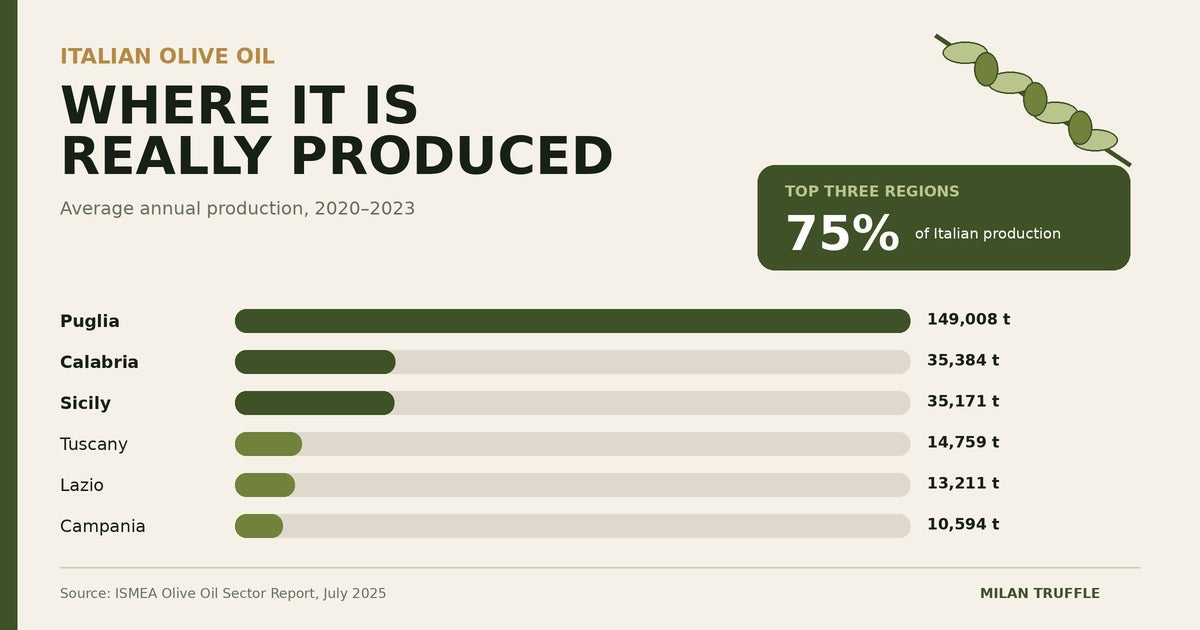
Southern Italy is the country’s olive-oil center. Puglia produces approximately half of Italian olive oil, while Calabria and Sicily complete the three largest producing regions.
Key Facts About Italian Olive-Oil Production
- Italy has approximately 1.14 million hectares of olive groves.
- There are 619,378 olive-growing businesses.
- About 58% of those businesses cultivate three hectares or less.
- Italy has approximately 4,240 active olive mills.
- Puglia, Sicily and Calabria contain 54% of Italian olive-growing businesses.
- Southern Italy and the islands produce approximately 86% of Italian olive oil.
- Italy recognizes 42 DOP and 8 IGP olive-oil designations.
These figures come from ISMEA’s official Italian olive-oil sector report. The regional production figures below use the 2020–2023 average because one harvest can differ sharply from another.
How Much Olive Oil Does Each Italian Region Produce?
ISMEA reports an average national production of 292,895 tonnes for 2020–2023. The table shows how that production was distributed.
| Rank | Region | Average production | National share |
|---|---|---|---|
| 1 | Puglia | 149,008 tonnes | 50.9% |
| 2 | Calabria | 35,384 tonnes | 12.1% |
| 3 | Sicily | 35,171 tonnes | 12.0% |
| 4 | Tuscany | 14,759 tonnes | 5.0% |
| 5 | Lazio | 13,211 tonnes | 4.5% |
| 6 | Campania | 10,594 tonnes | 3.6% |
| 7 | Abruzzo | 8,295 tonnes | 2.8% |
| 8 | Sardinia | 4,918 tonnes | 1.7% |
| 9 | Umbria | 4,657 tonnes | 1.6% |
| 10 | Basilicata | 4,374 tonnes | 1.5% |
| 11 | Marche | 3,005 tonnes | 1.0% |
| 12 | Molise | 2,884 tonnes | 1.0% |
| 13 | Liguria | 2,665 tonnes | 0.9% |
| 14 | Veneto | 1,626 tonnes | 0.6% |
| 15 | Emilia-Romagna | 1,233 tonnes | 0.4% |
| 16 | Lombardy | 637 tonnes | 0.2% |
| 17 | Trentino-Alto Adige | 352 tonnes | 0.1% |
| 18 | Friuli-Venezia Giulia | 105 tonnes | Less than 0.1% |
| 19 | Piedmont | 17 tonnes | Less than 0.1% |
| Italy | 292,895 tonnes | 100% | |
Valle d’Aosta has a very small olive-growing area but does not appear as a producing region in ISMEA’s 2020–2023 olive-oil production table.
Production volume does not rank quality. It shows where Italian olive oil is actually produced and corrects the common impression that Tuscany dominates the national industry.
Southern Italy and the Islands: The Center of Production
Puglia, Calabria, Sicily, Campania, Abruzzo, Sardinia, Basilicata and Molise account for approximately 86% of average Italian olive-oil production.
Puglia
Puglia is the undisputed production leader, contributing about half of Italy’s olive oil. Important cultivars include Coratina, Peranzana, Ogliarola Barese and Ogliarola Salentina. Protected origins include Terra di Bari DOP and Dauno DOP.
Calabria
Calabria ranks second, with about 12% of national production. Its olive-growing heritage includes cultivars such as Carolea, Ottobratica and Dolce di Rossano. Its production scale is frequently underestimated outside Italy.
Sicily
Sicily closely follows Calabria and also produces about 12% of the national total. Its cultivars include Nocellara del Belice, Biancolilla, Cerasuola and Tonda Iblea.
Sicily contains several protected origins, including Sicilia IGP, Monti Iblei DOP, Val di Mazara DOP and Valli Trapanesi DOP. Because the island contains different climates, elevations and cultivars, “Sicilian olive oil” does not describe one uniform flavor.
Campania, Abruzzo, Sardinia, Basilicata and Molise
Campania is Italy’s sixth-largest producer and is associated with cultivars such as Ravece, Ortice and Pisciottana. Abruzzo also maintains substantial production, followed by Sardinia, Basilicata and Molise.
These regions may produce less oil than Puglia, Calabria or Sicily, but each contributes its own cultivars, protected origins and local production traditions.
Central Italy: Reputation, Protected Origins and Regional Identity
Tuscany, Lazio, Umbria and Marche produce approximately 12% of Italian olive oil.
Tuscany
Tuscany is Italy’s fourth-largest producing region, representing about 5% of average national output. Its international reputation is much larger than its share of production.
Important Tuscan cultivars include Frantoio, Leccino and Moraiolo. Toscano IGP and Chianti Classico DOP are among its recognized geographical designations.
Lazio, Umbria and Marche
Lazio follows Tuscany by volume and includes cultivars such as Itrana and Caninese. Umbria and Marche produce smaller quantities but maintain established regional traditions and protected-origin oils.
Central Italy demonstrates why reputation and production volume must be treated separately. A region can have a strong identity without producing the largest quantity.
Northern Italy: Small Production, Defined Growing Areas
Northern Italy contributes approximately 2% of national olive-oil production. Liguria is the largest northern producer, followed by Veneto and Emilia-Romagna.
Smaller amounts are produced in Lombardy, Trentino-Alto Adige, Friuli-Venezia Giulia and Piedmont. Olive cultivation in the North is often concentrated around specific lakes, coastal areas or protected microclimates.
Northern production is limited in volume, but regional oils can still have clear geographic identities. Examples include Garda DOP, Riviera Ligure DOP and Brisighella DOP.
Does an Italian Region Determine Quality or Flavor?
No. Regional origin provides context, not a guaranteed sensory result or quality grade.
The finished character of olive oil depends on the interaction of:
- Cultivar
- Geography and climate
- Harvest timing
- Fruit condition
- Time between harvesting and milling
- Extraction decisions
- Filtration
- Storage and age
Geography and cultivar influence an oil’s sensory potential; neither independently determines the flavor of the finished oil.
Two oils from the same region can therefore taste different. The same cultivar grown and processed under different conditions can also produce different results.
Read more about why olive oils taste different.
How Should Buyers Use Regional Information?
Regional information helps buyers understand provenance, but it must be read correctly.
- Italian origin identifies Italy as the declared country of origin.
- Regional origin identifies a defined area such as Puglia, Sicily or Tuscany.
- DOP or IGP means the oil follows the specification of a registered geographical designation.
- Cultivar identifies the olive variety, not necessarily the geographic origin.
A regional name is not a substitute for freshness or sound production. Buyers should also consider the harvest date, producer information, packaging, storage and condition of the oil.
For related guidance, read what single-origin olive oil means, how Italian DOP and IGP olive oil works, and our extra virgin olive oil guide.
The Bottom Line
Italian olive oil does not come from one famous landscape. It comes from a large, diverse agricultural system led overwhelmingly by Southern Italy.
Puglia produces approximately half of the national total. Calabria and Sicily complete the three largest producing regions. Tuscany is important for regional identity and protected-origin value, but it accounts for a much smaller share of production.
Regional origin tells you where an oil comes from. It can connect the oil to local cultivars, climate and production traditions. It does not, by itself, prove quality or determine flavor.
Official Sources
Frequently Asked Questions
Which Italian region produces the most olive oil?
Puglia produces the most olive oil in Italy. ISMEA’s 2020–2023 average attributes approximately 51% of national production to Puglia.
Which three Italian regions produce the most olive oil?
Puglia, Calabria and Sicily are Italy’s three largest olive-oil-producing regions. Together, they account for approximately three-quarters of average national production.
Is Tuscany Italy’s largest olive-oil-producing region?
No. Tuscany represents approximately 5% of average Italian production. Its international reputation is much larger than its share of national output.
Does the region determine how an olive oil tastes?
No. Region influences growing conditions, but flavor also depends on cultivar, harvest timing, fruit condition, extraction, filtration, storage and freshness.
Does a famous Italian region guarantee better olive oil?
No. A regional name provides provenance, not an automatic quality guarantee. Fresh olives, prompt milling, careful extraction and proper storage remain essential.
What should I look for besides the Italian region?
Look for clear origin information, a harvest date when available, responsible packaging, proper storage and enough producer information to understand what is in the bottle.

