
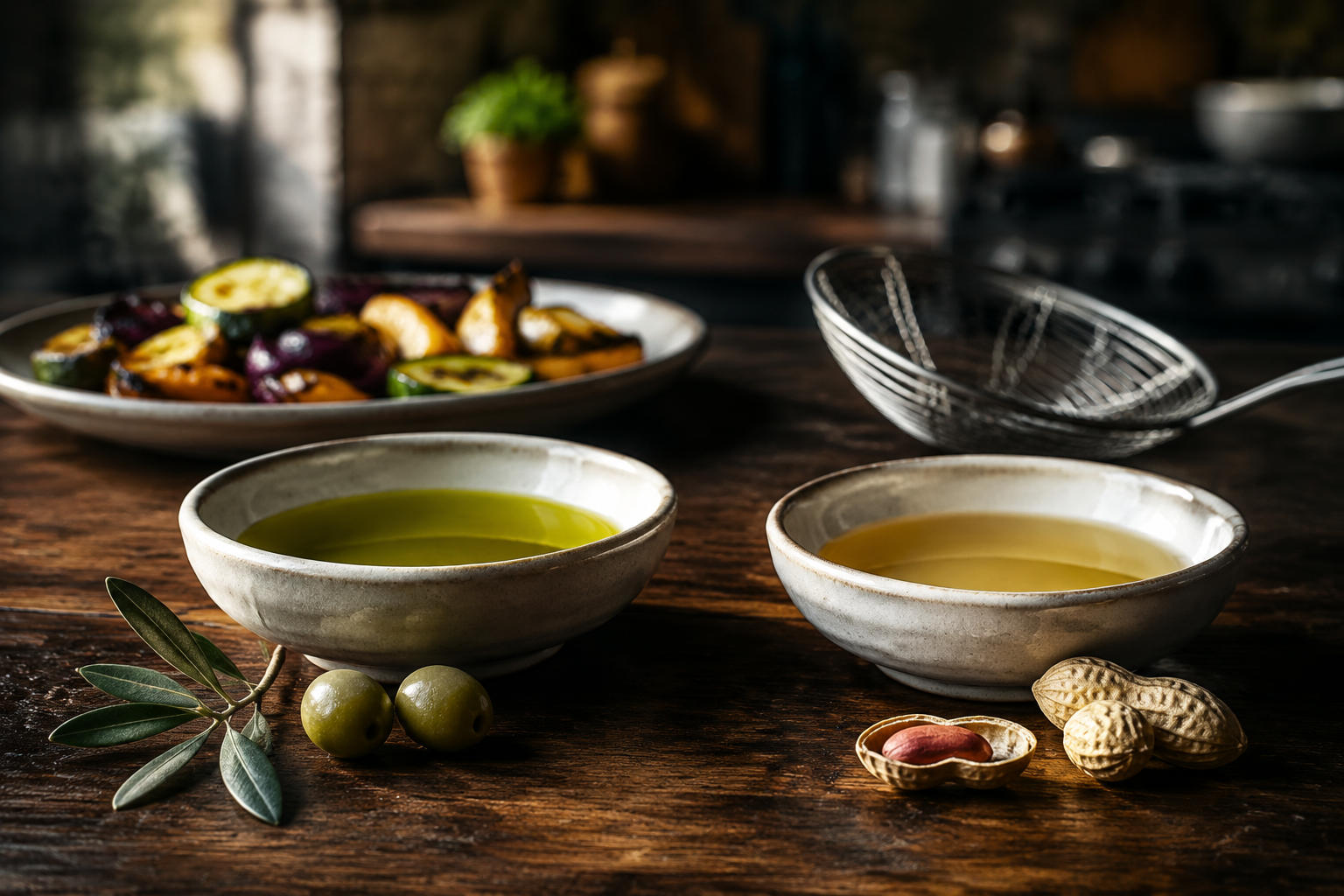
Which is better for everyday cooking? Extra virgin olive oil is generally more versatile because it works for cooking, dressings, dipping, and finishing.
Which is better for deep-frying? Refined peanut oil is commonly chosen for deep-frying because it has a neutral flavor and can tolerate sustained high temperatures.
Can olive oil replace peanut oil? Yes, in most recipes. Use the same quantity, but expect extra virgin olive oil to contribute more flavor.
01 — THE SHORT ANSWER
Olive Oil vs. Peanut Oil: Which Should You Use?
Choose extra virgin olive oil for most everyday cooking and when you want the oil to contribute flavor. Choose refined peanut oil for deep-frying, stir-frying, and recipes requiring a relatively neutral oil.
Both oils contain predominantly unsaturated fats. The practical differences are processing, flavor, cooking use, and the possibility of peanut allergy.
02 — THE DIFFERENCE
What Is the Difference Between Olive Oil and Peanut Oil?
Olive oil is obtained from the fruit of the olive tree. Peanut oil—also called groundnut oil—is obtained from peanuts, which are legumes rather than tree nuts.
Extra virgin olive oil is produced through mechanical or other physical processes without refining and must meet defined chemical and sensory requirements. Peanut oil is available in several forms, including refined, cold-pressed, roasted, and blended oils.
Most peanut oil used by restaurants and for deep-frying is refined. Refined peanut oil has a mild flavor, while cold-pressed or roasted peanut oils retain more pronounced nutty aromas.
For more about the production and classification of EVOO, read our complete guide to extra virgin olive oil.
Olive Oil vs. Peanut Oil: Quick Comparison
| Characteristic | Extra Virgin Olive Oil | Peanut Oil |
|---|---|---|
| Source | Olive fruit | Peanuts |
| Common processing | Unrefined and mechanically extracted | Frequently refined; cold-pressed and roasted versions also exist |
| Predominant fat | Monounsaturated fat | Monounsaturated fat |
| Flavor | Fruity, grassy, bitter, or peppery | Neutral when refined; nutty when unrefined or roasted |
| Typical uses | Cooking, roasting, dressings, dipping, and finishing | Deep-frying, stir-frying, and peanut-forward dishes |
03 — COMPOSITION
How Do Their Fat Profiles Compare?
Olive oil and peanut oil provide similar amounts of calories and total fat. Both contain substantial amounts of monounsaturated fat, although their complete fatty-acid profiles differ.
Extra virgin olive oil retains naturally occurring phenolic compounds because it is not refined. These compounds contribute to the oil’s bitterness, pungency, and oxidative stability. Their concentration varies according to olive variety, harvest timing, production, freshness, and storage.
Peanut oil contains vitamin E and unsaturated fats. The amount of its naturally occurring minor compounds depends partly on whether the oil is refined, cold-pressed, or roasted.
Neither oil should be judged from a single nutrient or fatty-acid percentage. The specific product, its processing, freshness, storage, and intended use all matter.
04 — FLAVOR
How Do Olive Oil and Peanut Oil Taste?
Extra virgin olive oil contributes recognizable flavor. Depending on the olives and harvest, it may taste fruity, grassy, bitter, peppery, delicate, or robust.
Refined peanut oil has a relatively neutral flavor, making it useful when the cooking oil should remain in the background. Cold-pressed and roasted peanut oils taste more distinctly nutty and are often selected specifically for that character.
Extra virgin olive oil is particularly useful for dressings, marinades, dipping, roasting, and finishing dishes. Our olive oil food-pairing guide explains how different flavor intensities work with food.
05 — COOKING
Which Oil Is Better for Frying?
Refined peanut oil is a practical choice for sustained deep-frying. It is widely used in restaurant fryers because of its mild flavor and relatively high smoke point.
Extra virgin olive oil is suitable for most everyday home cooking, including sautéing, roasting, pan-frying, sauces, and baking. Its flavor also allows it to serve as a finishing ingredient after cooking.
Smoke point should not be the only consideration. Oil composition, refinement, antioxidant content, cooking temperature, heating time, and repeated reuse also affect cooking performance. See our guide to the smoke point of olive oil.
06 — SUBSTITUTION
Can You Substitute Olive Oil for Peanut Oil?
Yes. Olive oil can replace peanut oil in a 1:1 ratio for most sautéing, roasting, pan-frying, marinades, sauces, and baked goods:
1 cup peanut oil = 1 cup olive oil
The main difference will be flavor. Extra virgin olive oil contributes its own aroma and taste, while refined peanut oil is comparatively neutral.
For large-volume or sustained deep-frying, refined peanut oil may be the more practical choice. For everyday cooking and recipes in which flavor matters, extra virgin olive oil is generally more versatile.
07 — ALLERGY
What About Peanut Allergies?
Peanuts are one of the major food allergens recognized in the United States. However, U.S. law excludes highly refined oils derived from major allergens from the statutory definition of a major food allergen because refining removes the proteins responsible for most allergic reactions.
This exemption does not automatically apply to cold-pressed, expelled, or unrefined peanut oils, which may retain peanut proteins. The FDA explains the labeling distinction for highly refined oils.
Anyone managing a peanut allergy should check the exact oil, ingredient information, and preparation environment and follow guidance from a qualified healthcare professional.
08 — WHICH SHOULD YOU CHOOSE?
When Should You Use Each Oil?
Choose extra virgin olive oil for:
- Everyday sautéing and roasting
- Salad dressings and marinades
- Pan-frying
- Dipping bread
- Finishing vegetables, pasta, meat, and fish
- Recipes in which the oil should contribute flavor
Choose refined peanut oil for:
- Deep-frying
- High-temperature stir-frying
- Recipes requiring a neutral cooking oil
- Cooking in which olive flavor is not desired
Choose roasted or unrefined peanut oil for:
- Sauces, noodles, and stir-fries requiring a distinct peanut flavor
09 — THE BOTTOM LINE
The Bottom Line
Extra virgin olive oil is generally the more versatile everyday oil. It works across common cooking methods and contributes flavor when used raw or as a finishing oil.
Refined peanut oil has a clearer specialized role: sustained deep-frying and high-temperature cooking where a relatively neutral flavor is preferred. Roasted peanut oil belongs in a different category because its pronounced flavor is usually the reason for using it.
The appropriate choice depends on the cooking method, desired flavor, processing of the specific oil, and any allergy considerations.
When purchasing olive oil, evaluate its grade, producer, origin, harvest information, and packaging. Our olive oil buyer’s guide explains what to check.
For the applicable production lot, Milan Truffle will provide the available certificate of analysis upon request to customers who purchase our 100% Italian extra virgin olive oil.
Frequently Asked Questions
Is olive oil healthier than peanut oil?
Both oils contain substantial amounts of unsaturated fat. Extra virgin olive oil is unrefined and retains naturally occurring phenolic compounds, while most peanut oil used for frying is refined. The overall dietary pattern and the specific product matter more than declaring every example of one category superior to every example of the other.
Can olive oil replace peanut oil?
Yes. Use the same quantity for most sautéing, roasting, pan-frying, marinades, sauces, and baking. Extra virgin olive oil will contribute more flavor than refined peanut oil.
Is peanut oil good for deep-frying?
Refined peanut oil is commonly used for deep-frying because it has a mild flavor and tolerates sustained high temperatures. Extra virgin olive oil remains suitable for most everyday home-cooking methods.
Disclosure: Milan Truffle imports and sells Italian extra virgin olive oil. This comparison is intended to explain objectively where olive oil and peanut oil fit in the kitchen.

