
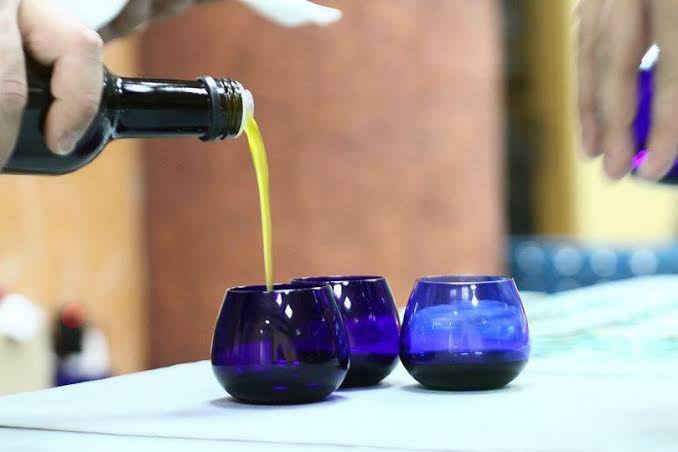
Oleocanthal is a phenolic compound created inside the mill, not carried over from the olive. It is the compound behind the sting at the back of the throat in a fresh extra virgin olive oil, and it is one of the most heavily marketed molecules in the category. It is also one of the most misreported. Published oleocanthal figures span three orders of magnitude, and much of that spread has nothing to do with the oil.
This guide covers the compound itself: what it is, how it forms, how it is measured, and how to read a number when a producer gives you one. For the sensation and how to interpret it while tasting, see why olive oil tastes peppery.
Oleocanthal: Key Facts
- Not in the fruit: Formed from ligstroside during crushing and malaxation.
- Its pair: Oleacein is the equivalent compound formed from oleuropein.
- Not the health-claim compound: The EU claim covers hydroxytyrosol and its derivatives; oleocanthal comes from the other branch of the family.
- Measured, not tasted: Quantified by qNMR or HPLC on a specific sample.
- Method changes the number: One study measured the same oil between 69 and 1,324 mg/kg using five extraction protocols.
- What a figure needs: Sample, method, date, laboratory. Without all four it cannot be compared to anything.
What Is Oleocanthal?
Oleocanthal is a dialdehydic secoiridoid, one of the minor phenolic compounds that make up part of the roughly two percent of extra virgin olive oil that is not fat. Secoiridoids occur in the plant family Oleaceae, which is why this group of compounds is found in olive oil and not in seed oils.
Oleocanthal and its counterpart oleacein were first identified among the secoiridoid derivatives of virgin olive oil by Montedoro and colleagues in 1993. The compound became widely known in 2005, when research published in Nature reported that it inhibited the cyclooxygenase enzymes COX-1 and COX-2 under laboratory conditions.
It is a defined chemical entity, and it is not a synonym for total polyphenols, for the oleuropein in olive leaves, or for olive oil quality in general.
Oleocanthal, Oleacein, Oleuropein, Hydroxytyrosol: What Is the Difference?
Four different compounds, one family, and olive oil marketing treats them as interchangeable. They are not.
Two phenolic alcohols sit at the base of the family: tyrosol and hydroxytyrosol. Each has a secoiridoid form present in the olive fruit — ligstroside from tyrosol, oleuropein from hydroxytyrosol. Each of those, in turn, produces a dialdehydic form during extraction.
| Compound | Type | Relationship |
|---|---|---|
| Tyrosol | Phenolic alcohol | Parent of ligstroside |
| Hydroxytyrosol | Phenolic alcohol | Parent of oleuropein |
| Ligstroside | Secoiridoid, present in the fruit | Precursor of oleocanthal |
| Oleuropein | Secoiridoid, present in the fruit | Precursor of oleacein |
| Oleocanthal | Dialdehyde, formed during extraction | From ligstroside |
| Oleacein | Dialdehyde, formed during extraction | From oleuropein |
Oleocanthal and oleacein differ by a single hydroxyl group. Neither is the same as the oleuropein found in olive leaves, and no single polyphenol figure describes how much of each an oil contains. For what phenolic content does and does not tell you, see what polyphenols in olive oil actually are.
How Does Oleocanthal Form in Olive Oil?
Oleocanthal is made in the mill. The olive contains ligstroside and oleuropein. When the fruit is crushed, β-glucosidase enzymes present in the skin and kernel break these down into their aglycone forms. Those convert to monoaldehydic forms, and a further step — hydrolysis of the methyl ester followed by decarboxylation — produces the dialdehydes oleocanthal and oleacein.
That final step can occur enzymatically or through the acidic aqueous conditions inside the malaxer. Researchers at the University of Trieste noted in 2021 that no specific enzyme responsible for the conversion has yet been isolated.
The practical consequence is the part worth remembering. Because oleocanthal is a product of extraction rather than a property of the fruit, milling decisions change how much of it exists in the finished oil. Crushing method, malaxation temperature, malaxation time, and oxygen exposure all move the result. A 2020 study of harvest timing and malaxation conditions found that individual phenols followed different trends depending on the variety, rather than one universal rule.
The grove sets the raw material. The mill decides much of what is made from it. That is why production detail tells you more than a variety name on a label, a point covered in how olive oil is made.
Is Oleocanthal the Compound in the EU Olive Oil Health Claim?
No. The authorised EU claim covers hydroxytyrosol and its derivatives — and oleocanthal comes from the ligstroside branch of the family, not the hydroxytyrosol branch. This distinction disappears in most marketing copy, and it is one of the clearest ways to tell a careful producer from a careless one.
In 2011 the European Food Safety Authority assessed the relationship between olive-oil polyphenols and the protection of blood lipids from oxidative damage. The resulting condition, set out in Commission Regulation (EU) No 432/2012, requires at least 5 mg of hydroxytyrosol and its derivatives per 20 g of olive oil.
Three consequences follow:
- A total polyphenol figure cannot satisfy the claim. Total phenols include phenolic acids, cinnamic acids, flavonoids, and lignans, none of which the claim covers.
- A high oleocanthal figure is not evidence the claim is met, and a bottle carrying the claim is not telling you its oleocanthal content. They are two separate statements about two different compounds.
- The list of qualifying derivatives is not fully settled. The 2021 Trieste study noted that it is not clear which derivatives must be counted, and that the only official method for the purpose is the International Olive Council's COI/T.20/Doc. No 29.
If a bottle shows a polyphenol number, a health claim, and an oleocanthal figure all at once, those are three separate assertions requiring three separate kinds of evidence.
How Is Oleocanthal Measured?
By analysing a specific sample of oil, using quantitative proton NMR or high-performance liquid chromatography. In qNMR the two aldehydic protons of oleocanthal appear in a region of the spectrum where they can be told apart, and the concentration is read against an internal standard. HPLC separates the compounds and quantifies them against a calibration curve.
The 2021 Trieste study ran both methods on the same samples and found close agreement, concluding that qNMR gives a reliable oleocanthal figure while using far less solvent. It also documented a real difficulty with chromatographic analysis: oleocanthal reacts with water and methanol, both common mobile phases, forming acetals and hemiacetals that complicate the chromatogram, and it can shift between its E and Z isomers during separation.
This matters commercially. An oleocanthal number is not a routine measurement like free acidity. It is a specialised analysis, which is part of why so few producers can name the method behind theirs. Free acidity is a different measurement with a different meaning, explained in our guide to olive oil acidity.
Why Do Published Oleocanthal Numbers Disagree?
Because the extraction step performed before analysis changes the result on the same oil by more than a factor of ten. This single fact explains most of the confusion in the category.
The Trieste team took one extra virgin olive oil and prepared it five different ways before quantification by qNMR, varying the solvent, the ratio of methanol to water, and whether a defatting solvent was used.
| Preparation before analysis | Oleocanthal (mg/kg) |
|---|---|
| Protocol A — hexane and acetonitrile | 237 |
| Protocol B — as above, halved solvent volume | 237 |
| Protocol C — hexane with methanol–water 80:20 | 1,324 |
| Protocol D — hexane with methanol–water 50:50 | 69 |
| Protocol E — fifth extraction protocol | 884 |
Nothing about the oil changed across those five figures. Only the laboratory preparation did.
Held against that, here is what a valid comparison looks like. Using one method throughout, the same study measured two monocultivar Bianchera oils at 768 and 724 mg/kg, and a commercial European blend of unknown varietal composition at 283 mg/kg. Those three numbers can be compared with each other precisely because the method was constant. None of them can be compared with a figure produced by a different protocol.
So when two brands publish oleocanthal numbers and one is triple the other, the honest answer is that you cannot tell which oil contains more until you know how each was measured.
How Do You Read an Oleocanthal Number on a Bottle?
An oleocanthal concentration means something only when four things are stated alongside it. Without them the number is not merely approximate — it is unanchored, because the same oil can legitimately produce values an order of magnitude apart.
- The sample. Which lot or batch was analysed. A figure attached to a brand rather than a lot describes nothing you can actually buy.
- The method. The analytical technique, and the extraction protocol used before it.
- The date. Phenolic compounds change with time and storage. A figure describes a moment, not a permanent property of the oil.
- The laboratory. Who performed the analysis.
A producer who can answer all four is telling you something real. A producer who publishes a number and cannot answer any of them is telling you less than the number appears to say. This is the same evidence standard that applies to every analytical claim on an olive oil, and it belongs to the wider question of how to choose real olive oil.
Can You Estimate Oleocanthal by Counting Coughs?
No. The idea that one cough indicates a moderate level and two a high one circulates widely, but it is not a validated measurement. It treats one person's sensory response as a scale, when perception differs between individuals and is shaped by the whole composition of the oil.
Pungency tells you that pungent compounds are present. It does not tell you how many milligrams per kilogram there are, and it cannot be converted into a figure. What tasting can and cannot establish is covered in how to taste olive oil.
Does Early Harvest Mean More Oleocanthal?
Earlier harvest is associated with greater phenolic intensity, but it does not guarantee a higher oleocanthal figure. The 2020 harvest-timing study found that the effects of harvest time and malaxation conditions varied by cultivar rather than following one rule.
"Early harvest" on a label describes a decision taken in the grove. An oleocanthal figure describes a measured outcome in the finished oil. Every processing choice in the mill sits between the two.
Does Cooking Destroy Oleocanthal?
Heat reduces phenolic content, but there is no single temperature at which oleocanthal disappears. The extent depends on temperature, duration, cooking method, oxygen exposure, and the particular oil. Raw or gently warmed extra virgin olive oil retains more of its original character than oil held at high heat for a long time. The separate question of cooking performance is covered in our guide to the smoke point of olive oil.
Is Oleocanthal the Same as Ibuprofen?
No. They are structurally different compounds observed to act on the same enzymes under laboratory conditions. The 2005 Nature work reported COX-1 and COX-2 inhibition by oleocanthal, and ibuprofen also acts on those enzymes.
That shared laboratory observation does not establish equivalent dose, absorption, pharmacokinetics, safety profile, effectiveness, or clinical effect in people, and it does not support converting a quantity of olive oil into a quantity of medicine. Extra virgin olive oil is a food. The research explains why a compound in it produces a distinctive sensation and why chemists find that compound interesting — not what it will do in a body.
Frequently Asked Questions
What is oleocanthal?
Oleocanthal is a dialdehydic secoiridoid phenolic compound formed in extra virgin olive oil during extraction, derived from ligstroside present in the olive fruit.
What is the difference between oleocanthal and oleacein?
They differ by a single hydroxyl group and by their precursor. Oleocanthal derives from ligstroside; oleacein derives from oleuropein.
Is oleocanthal the compound covered by the EU olive oil health claim?
No. Commission Regulation (EU) No 432/2012 requires at least 5 mg of hydroxytyrosol and its derivatives per 20 g of olive oil. Oleocanthal derives from ligstroside rather than from hydroxytyrosol, and is assessed separately.
How is oleocanthal measured?
By quantitative proton NMR or by HPLC, performed on a specific oil sample. The two methods have been shown to agree closely when applied to the same samples.
Why do oleocanthal figures vary so much between sources?
Because the extraction protocol used before analysis strongly affects the result. One study measured the same oil at between 69 and 1,324 mg/kg using five different extraction methods.
Can you tell how much oleocanthal an oil contains by tasting it?
No. Pungency indicates that pungent compounds are present, but perception varies between individuals and cannot be converted into a concentration.
Scientific Sources
- Starec, M., Calabretti, A., Berti, F., and Forzato, C. "Oleocanthal Quantification Using 1H NMR Spectroscopy and Polyphenols HPLC Analysis of Olive Oil from the Bianchera/Belica Cultivar." Molecules, 26(1), 242, 2021. View the study.
- Diamantakos, P., Giannara, T., Skarkou, M., Melliou, E., and Magiatis, P. "Influence of Harvest Time and Malaxation Conditions on the Concentration of Individual Phenols in Extra Virgin Olive Oil Related to Its Healthy Properties." Molecules, 25(10), 2449, 2020. View the study.
- Beauchamp, G. K., Keast, R. S. J., Morel, D., Lin, J., Pika, J., Han, Q., Lee, C. H., Smith, A. B., and Breslin, P. A. S. "Ibuprofen-like activity in extra-virgin olive oil." Nature, 437, 45–46, 2005. View the study.
- European Commission. Commission Regulation (EU) No 432/2012 establishing a list of permitted health claims made on foods other than those referring to the reduction of disease risk and to children's development and health. View the consolidated regulation.
Related Resources

