
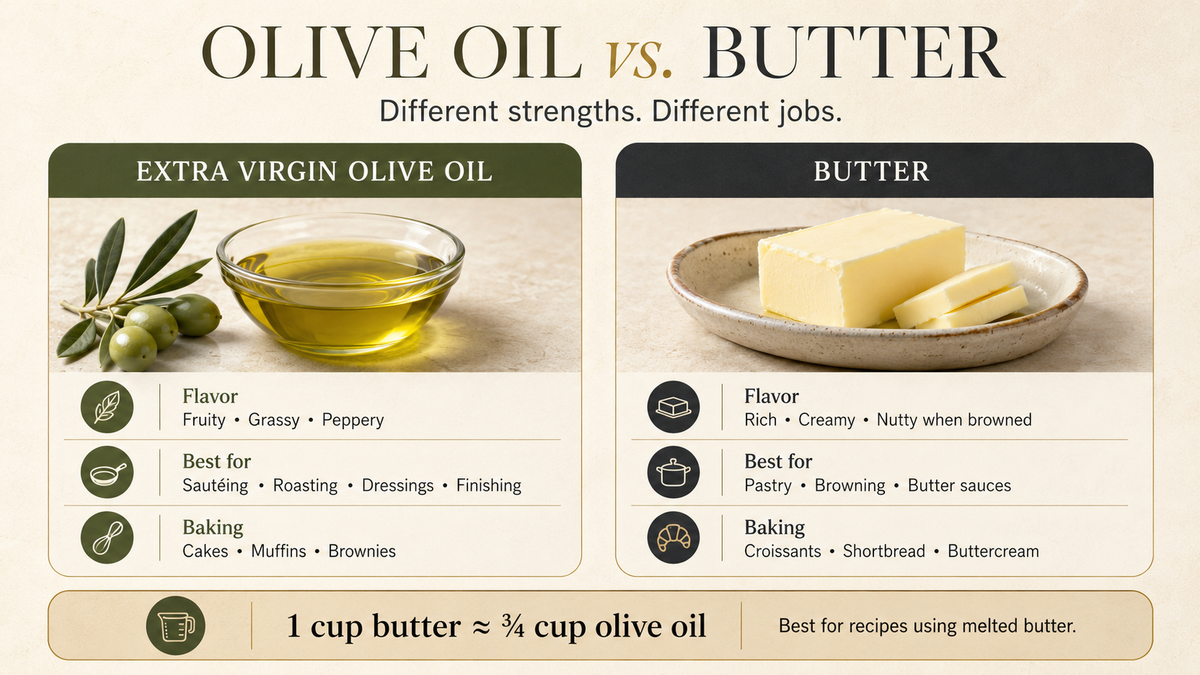
Which is better for everyday cooking: olive oil or butter? Extra virgin olive oil is generally more versatile for sautéing, roasting, dressings, and finishing. Butter is better when dairy richness, browning, or solid-fat structure is essential.
Can you use them together? Yes. Cook with olive oil and add a small amount of butter near the end when you want both fresh olive-oil character and dairy richness.
Can olive oil replace butter in baking? Sometimes. A practical starting conversion is ¾ cup olive oil for every 1 cup of butter, but it does not work for every recipe.
Our Perspective as an Olive-Oil Family
Our family’s relationship with olive cultivation comes from Sicily. Beginning with the 2026 harvest, we will also harvest olives from our properties in Palma di Montechiaro and Pozzallo, Sicily.
We do not treat olive oil and butter as identical fats or universal competitors. They create different flavors and perform different technical functions in the kitchen.
Disclosure: Milan Truffle imports and sells Italian extra virgin olive oil. This comparison explains when each fat is useful rather than treating one as the correct choice for every recipe.
What Is the Difference Between Butter and Olive Oil?
Butter is a dairy product made by churning cream until the butterfat separates from the liquid. It contains fat, water, and milk solids and remains solid or semisolid at room temperature.
Olive oil is obtained from olive fruit and remains liquid at room temperature. Extra virgin olive oil is mechanically extracted without refining and must meet defined chemical and sensory requirements. See our complete guide to extra virgin olive oil.
Olive Oil vs. Butter: Quick Comparison
| Characteristic | Extra Virgin Olive Oil | Butter |
|---|---|---|
| Source | Olive fruit | Milk or cream |
| Physical form | Liquid | Solid or semisolid |
| Composition | Essentially all fat | Approximately 80% fat, plus water and milk solids |
| Flavor | Fruity, grassy, bitter, or peppery | Rich, creamy, and dairy-forward |
| Best uses | Sautéing, roasting, dressings, sauces, dipping, and finishing | Browning, pastry, creaming, butter sauces, and dairy-rich dishes |
| Dairy-free | Yes | No |
Flavor: Two Different Directions
The difference is not simply that one tastes better. Olive oil and butter move a dish in different directions.
Extra virgin olive oil can contribute fresh, fruity, grassy, bitter, or peppery characteristics. The peppery sensation of some EVOOs is associated with phenolic compounds, including oleocanthal in olive oil.
Butter adds dairy richness. When browned, its milk solids develop nutty, toasted, and caramel-like flavors that olive oil cannot reproduce.
Our olive oil pairing guide explains how delicate, medium, and robust EVOOs work with different foods.
When Should You Use Butter?
Choose butter when its water content, milk solids, or solid structure is part of the recipe:
- Croissants, puff pastry, and laminated doughs
- Shortbread and classic cookies
- Recipes requiring butter to be creamed with sugar
- Buttercream frosting
- Browned-butter sauces
- Dishes in which dairy richness is the intended flavor
Butter’s water can produce steam, while its solid fat helps create layers and structure. Liquid olive oil cannot reproduce those effects directly.
When Should You Use Olive Oil?
Choose extra virgin olive oil for:
- Sautéing vegetables, fish, meat, and eggs
- Roasting
- Salad dressings and marinades
- Pasta sauces
- Dipping bread
- Finishing cooked food
- Cakes, muffins, brownies, and quick breads designed for liquid fat
Extra virgin olive oil is suitable for most everyday cooking temperatures. Its performance depends on the particular oil, temperature, and heating time—not one universal smoke-point number. Read our guide to the smoke point of olive oil.
Can You Use Olive Oil and Butter Together?
Yes. They can complement each other rather than compete.
Use olive oil as the primary cooking fat, then add a small amount of butter near the end for dairy richness. This approach works particularly well with vegetables, eggs, fish, pasta sauces, and pan-cooked proteins.
You can also reverse the emphasis: prepare a dish with butter and finish it with a small drizzle of extra virgin olive oil for freshness and aroma.
Can You Substitute Olive Oil for Butter?
For sautéing, roasting, and recipes that call for melted butter, olive oil can often be substituted successfully.
Because butter contains water and milk solids while olive oil is essentially all fat, do not automatically use equal volumes in baking. Use this as a practical starting guide:
| Butter Required | Olive Oil Substitute |
|---|---|
| ¼ cup butter | 3 tablespoons olive oil |
| ½ cup butter | 6 tablespoons olive oil |
| 1 cup butter | ¾ cup olive oil |
This conversion works best in moist cakes, muffins, brownies, and quick breads. It is not suitable when the recipe depends on creamed butter, laminated layers, or solid-fat structure.
The Bottom Line
Extra virgin olive oil is the more versatile everyday cooking fat, while butter remains essential for specific flavors and baking techniques.
Use EVOO for sautéing, roasting, dressings, dipping, and finishing. Use butter for browning, pastry, creaming, and dishes in which dairy richness is the point. Use them together when the food benefits from both.
When buying EVOO, evaluate the grade, origin, producer, harvest information, and packaging. Our olive oil buyer’s guide and guide to olive-oil packaging explain what to check.
For the applicable production lot, Milan Truffle will provide the available certificate of analysis upon request to customers who purchase our 100% Italian extra virgin olive oil.
Frequently Asked Questions
Is olive oil healthier than butter?
Olive oil and butter have different fat profiles. Extra virgin olive oil is primarily monounsaturated fat and contains naturally occurring phenolic compounds, while butter contains more saturated fat and provides dairy flavor and structure. The appropriate choice also depends on the recipe and overall diet.
How much olive oil replaces one cup of butter?
Use approximately ¾ cup of olive oil for 1 cup of butter as a practical starting point. This works best when the recipe calls for melted butter or another liquid fat.
Can you replace butter with olive oil in baking?
Yes, in many cakes, muffins, brownies, and quick breads. Do not use a direct olive-oil substitution for croissants, puff pastry, shortbread, buttercream, or recipes that require creaming butter with sugar.

